
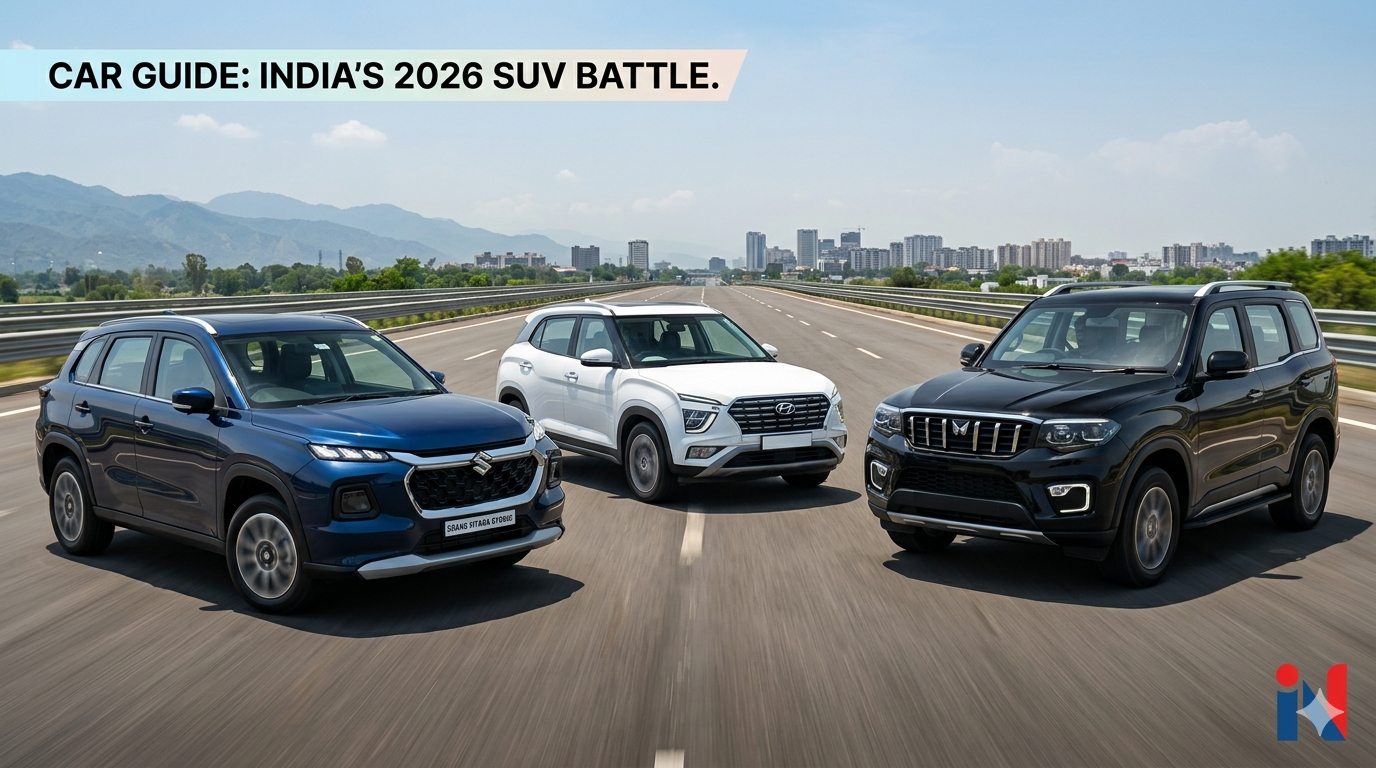
The landscape of Indian roads has fundamentally changed. If you look out at a traffic signal today, the sea of low-slung sedans and compact hatchbacks that once defined daily commutes has vanished, replaced by an imposing wall of high-ground-clearance silhouettes.
The numbers from early 2026 paint an undeniable picture. The Indian automotive market has hit a major structural shift where sub-compact and mid-size SUVs are completely sidelining traditional body types. Buyers are actively walking past sleek sedans to sign bookings for elevated cabins.
But what is truly driving this obsession, and if you are in the market today, how do the absolute heavyweights stack up against each other when the heat rises?
Why Buyers Are Skipping Sedans: The Top 5 Features Driving the Shift
For decades, buying a sedan was a symbol of “making it.” Today, that logic feels outdated to the modern Indian family. The preference shift isn’t just about aesthetics; it comes down to five practical design features that sedans simply cannot replicate:
- The Command Seating Position: Sitting higher changes how you interpret chaotic traffic. The elevated viewpoint allows drivers to look over the roofs of hatchbacks, anticipate sudden stops three cars ahead, and reduce the psychological stress of tight bumper-to-bumper navigation.
- Imunity to Broken Roads: With ground clearance consistently hitting 190mm to 210mm across the mid-size segment, the fear of scraping expensive underbodies on unscientific speedbreakers or waterlogged monsoon craters is gone.
- The Ingress and Egress Factor: Standard sedans require you to “squat down” into them, while SUVs let you “step in.” For elderly parents or anyone with knee discomfort, this ergonomic difference alone often seals the purchase decision.
- Modular Boot Practicality: While sedans offer deep trunks, their fixed metallic shelves limit vertical storage. SUVs provide tall loading bays and 60:40 split rear seats that can swallow bicycles, oversized airport luggage, or large business inventory seamlessly.
- Perceived and Real Structural Safety: The mental peace provided by a high bonnet line, wider stance, and robust build ratings has become a top-tier priority for families investing their hard-earned money.
The Ultimate Mid-Size SUV Showdown
To help your readers cut through the marketing noise, we have built a straight-talking comparison matrix of the three most dominant names on the sales charts this year: the reigning Hyundai Creta, the ultra-efficient Maruti Suzuki Grand Vitara, and the robust Mahindra Scorpio-N.
We are bypassing the standard brochure talk to evaluate them on what actually matters right now: price-to-feature value, real-world highway fuel economy, and how their air conditioning systems hold up against brutal Indian summer waves.
Performance & Value Comparison Matrix
| Feature/Metric | Hyundai Creta | Maruti Suzuki Grand Vitara | Mahindra Scorpio-N |
| Price Range (Approx.) | ₹11.00 Lakh – ₹20.10 Lakh | ₹10.80 Lakh – ₹19.80 Lakh | ₹14.00 Lakh – ₹24.50 Lakh |
| Real-World Mileage | Petrol: 13-16 km/l Diesel: 18-21 km/l | Mild Hybrid: 16-19 km/l Strong Hybrid: 22-25 km/l | Petrol: 10-12 km/l Diesel: 13-15 km/l |
| Cabin Cooling Efficiency | Excellent. Fast pull-down; features dual-zone climate control & front ventilated seats. | Good. Effective in front, but panoramic sunroof curtain lets in slight heat soak. | Brute Force. Massive blower capacity easily cools huge 3-row volume. |
| ADAS Reliability | Level 2 (Camera + Radar). Exceptional lane keep and smooth stop-and-go assist. | Level 2 (Camera-based). Decent day visibility; can struggle in torrential rain. | Level 2 (Radar-focused). Tuned well for large vehicle distances; aggressive braking. |
| Core Audience | The Tech-Savvy Urban Family | The High-Mileage Daily Commuter | The Highway Tourer & Rough Road Enthusiast |
Deep Dive: How the Contenders Behave in Real Life
1. Hyundai Creta: The Gold Standard of Urban Convenience
The Creta continues to be a masterclass in packaging. What makes it a relentless bestseller is how effortless it makes the daily grind.
When the outdoor temperature climbs to an unbearable degree, the Creta’s cabin remains a sanctuary. Its ventilated front seats are not a gimmick—they prevent the dreaded damp-back syndrome within two minutes of starting the engine. Furthermore, Hyundai’s Level 2 ADAS setup feels incredibly intuitive. The lane-keep assist doesn’t jerk the steering wheel violently; it gently nudges, mimicking an experienced driver.
2. Maruti Suzuki Grand Vitara: The Anti-Inflation Machine
If your primary concern is the monthly fuel bill, the Grand Vitara Strong Hybrid is unmatched in this weight class. By pairing a 1.5-litre petrol engine with an electric motor, it spends a vast portion of its city life running purely on battery power.
Achieving a real-world city mileage of over 22 km/l in a vehicle of this size feels like a magic trick. However, there is a summer trade-off: the translucent mesh curtain under its massive panoramic sunroof allows more ambient cabin heating compared to the Creta’s thicker lining, meaning the AC compressor works a bit harder at noon.
3. Mahindra Scorpio-N: The Unapologetic Heavyweight
The Scorpio-N belongs to a completely different mechanical school—it is a body-on-frame, rear-wheel-drive brute. If your driving involves broken highways, rural sectors, or heavy loads, its mHawk diesel engine offers effortless, muscular pulling power.
Because it is a massive three-row vehicle, Mahindra equipped it with high-capacity air conditioning blowers that can turn a hot cabin chilly remarkably fast. The trade-up is its size: navigating tight urban parking spots requires patience, and fuel economy reflects its heavy structure.
The Verdict for Buyers:
Go with the Grand Vitara if your daily office commute is long and running costs are your bottom line. Pick the Creta if you want an effortless, feature-loaded urban family car that manages extreme weather beautifully. Choose the Scorpio-N if you love long highway road trips and need an indomitable build that ignores potholes completely.
For a complete visual walkthrough of how these vehicles handle real-world road conditions and cabin ergonomics, you can watch this comprehensive Mid-size SUV Comparison Review, which analyzes how the market benchmarks have evolved this season.
Frequently Asked Questions (FAQs)
Q1: Why are Indian buyers completely shifting from sedans to SUVs in 2026?
The structural shift in the Indian market comes down to practical everyday driving realities. SUVs offer a commanding seating position that improves visibility over traffic, high ground clearance (typically 190mm–210mm) to safely navigate broken roads and unscientific speed breakers, and easier entry and exit for elderly family members. Additionally, the modular boot space and perceived structural safety make them far more versatile for single-car households than traditional sedans.
Q2: Which mid-size SUV offers the absolute best mileage for daily city commuting?
The Maruti Suzuki Grand Vitara Strong Hybrid is the undisputed efficiency champion in this segment. By utilizing a 1.5-litre petrol engine paired with a self-charging electric motor, it runs predominantly on battery power during low-speed bumper-to-bumper city traffic. This allows it to deliver an exceptional real-world city mileage of 22 to 25 km/l, heavily outperforming both standard petrol and diesel rivals.
Q3: How does the Hyundai Creta’s Level 2 ADAS perform on chaotic Indian roads?
Hyundai’s Level 2 ADAS setup (which uses a combination of cameras and radar) is highly tuned and predictable for Indian driving conditions. Features like Lane Keep Assist and Adaptive Cruise Control operate smoothly without aggressive, sudden steering jerks. The system is particularly efficient in structured highway traffic and well-marked urban ring roads, though drivers should remain fully alert during heavy, unlaned city congestion.
Q4: Is diesel still a viable option for mid-size SUVs like the Mahindra Scorpio-N?
Yes, absolutely. For heavy, body-on-frame SUVs like the Mahindra Scorpio-N, a diesel engine remains highly practical. It delivers the massive low-end torque (pulling power) required to move a heavy vehicle efficiently, especially when fully loaded or climbing inclines. If your monthly usage exceeds 1,500 to 2,000 kilometers or involves frequent long-distance highway touring, a modern BS6 Phase 2 compliant diesel engine is still highly economical compared to a turbo-petrol counterpart.
Q5: How do panoramic sunroofs impact cabin cooling during extreme Indian summers?
While panoramic sunroofs are a highly requested premium feature, they act as a major source of greenhouse heat soak when cars are parked under direct sunlight. Vehicles like the Maruti Grand Vitara use a lighter, translucent mesh curtain which can let in more ambient heat, requiring the air conditioning system to work harder at noon. In contrast, the Hyundai Creta features a thicker, more opaque roof lining that blocks heat more effectively, contributing to a faster cabin temperature pull-down.
Q6: What is the ideal ground clearance needed to tackle waterlogged roads and rough terrains in India?
For hassle-free driving across most Indian topographies, a minimum ground clearance of 190mm is highly recommended. Sub-compact and mid-size SUVs in this segment generally offer between 190mm and 210mm of clearance. This height ensures that the vehicle’s expensive underbody components, oil pan, and exhaust system remain safe from scraping against deep potholes, high speed bumps, and minor monsoon water-logging.
Q7: Which SUV should I buy if my budget is strictly under ₹15 Lakhs?
If your on-road budget is capped under ₹15 Lakhs, the mid-spec variants of the Hyundai Creta (such as the EX or S trims) or the Maruti Suzuki Grand Vitara (Delta or Zeta Mild Hybrid trims) offer the best balance of features, safety, and reliability. They cover all essential modern needs, including touch-screen infotainment, automatic climate control, steering-mounted controls, and a robust safety kit including 6 airbags.
Q8: What are the safety ratings for these top-selling SUVs?
Safety has become a non-negotiable metric for modern buyers. While older models relied purely on sheet-metal thickness, current iterations are heavily judged by Global NCAP and Bharat NCAP (B-NCAP) scores. The Mahindra Scorpio-N boasts a 5-star safety rating from Global NCAP, making it a fortress on wheels. The updated Hyundai Creta and Maruti Grand Vitara come equipped with robust structural reinforcements and 6 standard airbags, aiming for top-tier honors under the stringent new crash testing protocols.
Q9: Between Petrol, Diesel, and Strong Hybrid, which engine type holds the best resale value?
Historically, diesel SUVs held the crown for resale value due to their long-term fuel efficiency. However, with tightening emission norms, the trend is shifting. In 2026, Strong Hybrids and Petrol variants maintain incredible resale velocity in major tier-1 cities where older diesel vehicles face stricter registration lifespans. If you plan to sell your car within 5 years, a strong hybrid or a turbo-petrol will fetch a massive premium in the used car market.
Q10: How much do ADAS features increase the maintenance cost of a mid-size SUV?
The Advanced Driver Assistance Systems (ADAS) themselves do not require regular maintenance or servicing. However, they can significantly impact your insurance premiums and accidental repair bills. Because ADAS relies on highly sensitive radar sensors in the front grille and cameras mounted behind the windshield, even a minor front-end collision or a cracked windshield can require expensive sensor replacement and recalibration, which must be calibrated precisely at authorized service centers.
Q11: Which mid-size SUV offers the best legroom and comfort for three passengers in the rear seat?
If your primary requirement is seating three adults abreast comfortably in the back row, the Mahindra Scorpio-N takes the lead due to its superior cabin width and individual headroom. In the 5-seater category, the Maruti Grand Vitara offers excellent knee room, but the Hyundai Creta provides a slightly better rear-seat recline angle and superior under-thigh support, making it highly comfortable for long, continuous family journeys.
Q12: Are sub-compact SUVs a better choice than mid-size SUVs for crowded cities?
Sub-compact SUVs (like the Hyundai Venue or Maruti Brezza) are highly practical if your driving is 90% restricted to narrow city lanes and tight parking complexes. They offer the same high ground clearance benefits as mid-size SUVs but feature a smaller footprint. However, if your family loves weekend road trips, a mid-size SUV is worth the upgrade for its superior high-speed highway stability, larger boot volume, and wider cabin.
Q13: Why are waiting periods so high for certain variants, and how can I get a car faster?
Waiting periods are primarily driven by the high demand for specific top-tier variants that require advanced semiconductor chips—such as those with panoramic sunroofs, digital cockpit screens, and ADAS modules. To get your car delivered faster, consider looking at mid-spec variants (which use fewer chip-heavy features) or being flexible with your exterior color choices. Additionally, checking inventory with multiple dealerships across neighboring districts can sometimes reveal ready-stock vehicles.
Q14: How does a Strong Hybrid system perform on steep mountain roads compared to a Turbo-Petrol?
On steep mountain inclines, a Turbo-Petrol engine provides an instantaneous rush of power as the turbocharger kicks in, making it incredibly fun and effortless to drive uphill. A Strong Hybrid handles hills differently: it uses the massive, instant torque of its electric motor to pull away smoothly from a dead stop on an incline, and then seamlessly blends in the petrol engine. While it won’t feel as aggressively fast as a turbo-petrol, a hybrid climbs effortlessly while keeping fuel efficiency remarkably high.
Q15: Is it worth upgrading to an All-Wheel Drive (AWD) variant in this segment?
For 95% of buyers, a standard Front-Wheel Drive (FWD) or Rear-Wheel Drive (RWD) vehicle is more than enough to handle heavy rains, muddy roads, and broken village tracks. You should only pay the premium for an AWD variant (available in models like the Grand Vitara) if you frequently travel to regions with heavy snowfall, loose sand, or slippery slush where extra traction is mandatory to keep the vehicle from getting stuck.
Q16: What is the Battery-as-a-Service (BaaS) model introduced in the 2026 EV segment, and how does it lower purchase costs?
The Battery-as-a-Service (BaaS) model is an innovative ownership framework where buyers purchase the vehicle shell at a significantly lower upfront price while renting or subscribing to the battery pack separately. Because the battery pack accounts for roughly 30% to 40% of an electric vehicle’s manufacturing cost, BaaS effectively slashes the initial acquisition price of an EV to match or even beat equivalent petrol or diesel variants. Owners then pay a nominal fee per kilometer driven or a fixed monthly subscription for the battery usage.
Q17: Will Maruti Suzuki adopt the BaaS model for its upcoming electric vehicles like the e Vitara?
While manufacturers like Tata Motors have aggressively pushed BaaS to bring entry-level pricing down, Maruti Suzuki is initially focusing on traditional ownership structures for its flagship EV launches, such as the e Vitara. However, industry sources suggest that as Maruti expands into the budget EV space with smaller entry-level hatchbacks (like the production-spec eWX concept), a subscription or BaaS-style model could be introduced to directly challenge entry-level urban rivals.
Q18: What is the Maruti Suzuki e Vitara, and when is it launching in India?
The e Vitara is Maruti Suzuki’s highly anticipated first global all-electric SUV, built on a dedicated “e-HEARTECT” skateboard EV platform. Spawning from the heavily discussed eVX concept, the production-ready e Vitara features a rugged “Polyhedral Muscular Stance” and premium cabin layouts. It is slated to officially roll out into the Indian market with competitive ex-showroom pricing expected to range between ₹16 Lakh and ₹25 Lakh depending on the battery size.
Q19: What battery sizes and real-world driving ranges can buyers expect from the Maruti e Vitara?
Maruti Suzuki is expected to offer the e Vitara with two distinct battery configurations to appeal to different driving needs:
- Base Battery Pack: A 49 kWh unit designed for daily urban commutes with an estimated real-world range of around 350–380 km.
- Long-Range Battery Pack: A larger 61 kWh pack delivering a claimed driving range of up to 550 km on a single full charge, which translates to a highly reliable 420+ km under real-world highway conditions.
Q20: Will the Maruti Suzuki e Vitara feature an All-Wheel Drive (AWD) option?
Yes. Unlike many urban electric vehicles that are strictly front-wheel drive, the e Vitara’s dedicated skateboard platform is engineered to accommodate an advanced dual-motor setup. The higher-end variants will feature an e-AWD system, giving the vehicle excellent traction control and mild off-roading capabilities, which sets it apart from traditional front-wheel-drive competitors in the mid-size EV segment.
Q21: What safety and tech features are debuting inside Maruti’s new electric SUV?
The e Vitara marks a massive technology leap for Maruti Suzuki. The interior breaks away from older parts-sharing designs to feature a premium unified dual-screen setup that integrates a fully digital driver’s instrument cluster and a massive touchscreen infotainment system. For comfort, the SUV incorporates high-end features such as ventilated front seats, a panoramic sunroof, and wireless smartphone integration.
Q22: Is Maruti Suzuki introducing Level 2 ADAS features with its EV lineup?
Yes, the e Vitara will be the first vehicle in Maruti Suzuki’s Indian lineup to come equipped with a comprehensive Level 2 Advanced Driver Assistance System (ADAS). The system uses a suite of cameras and radar units to enable advanced driver safety aids, including Adaptive Cruise Control, Autonomous Emergency Braking, Lane Keep Assist, and Forward Collision Warning to handle highway safety aggressively.
Q23: What is the upcoming Maruti “YMC” 7-Seater EV, and who is it built for?
Internally codenamed YMC, this upcoming vehicle is Maruti Suzuki’s first all-electric multi-purpose vehicle (MPV). Recently spotted testing on Indian roads, the YMC shares the same e-HEARTECT platform and battery packs as the e Vitara but features an extended wheelbase and a flatter, elongated roofline to comfortably accommodate three rows of seating. It is specifically built for large, eco-conscious families looking for a premium, spacious people-mover.
Q24: How will Maruti Suzuki’s electric SUVs be charged, and do they support fast charging?
Both the e Vitara and the upcoming YMC MPV support high-capacity DC fast charging. When plugged into a standard public DC fast charger, the battery can juice up from 10% to 80% in under 45 minutes, making mid-day top-ups highly convenient during long highway road trips. For home charging, Maruti will provide an AC wall-box charger that can fully replenish the battery overnight.
Q25: Who are the primary market rivals for Maruti Suzuki’s new electric vehicles?
The mid-size electric SUV space is incredibly competitive. Maruti Suzuki’s e Vitara will go head-to-head against established segment leaders and hot new arrivals, including the Tata Curvv EV, the MG ZS EV, the Mahindra BE 6, and the highly anticipated Hyundai Creta EV. Meanwhile, the larger YMC 7-seater electric MPV will position itself against premium family electric vehicles like the upcoming Kia Carens EV and the Mahindra XEV 9S.
Q26: What is the current on-road price range for the Mahindra Thar Roxx in India?
The 5-door Mahindra Thar Roxx starts at an aggressive ex-showroom price of ₹12.39 Lakh for the base MX1 RWD petrol variant, stretching up to ₹22.82 Lakh for the top-of-the-line AX7L 4WD diesel automatic variant. Depending on the state of registration, road tax structures, and insurance packages, on-road prices generally scale between ₹14.50 Lakh and ₹27.00 Lakh.
Q27: Is the 4×4 (4WD) option available on the petrol variants of the Mahindra Thar Roxx?
No. In an interesting mechanical packaging decision, Mahindra has limited the 4×4 drivetrain exclusively to the 2.2-litre mHawk diesel engine line-up. Buyers choosing the 2.0-litre mStallion turbo-petrol engine are restricted to a Rear-Wheel Drive (RWD) configuration.
Q28: What is the real-world mileage of the Mahindra Thar Roxx, and why is it lower than the Scorpio-N?
While the official ARAI rating for the diesel stands at 15.2 km/l, real-world highway mileage stays around 12 to 13 km/l, and city driving drops to 9 to 10 km/l. The petrol variants yield even lower figures, averaging 7 to 9 km/l under heavy urban loads. This is lower than the Scorpio-N because the Thar Roxx features a boxy, vertical windshield and a less aerodynamic “brick-like” design that creates significant wind resistance at high speeds.
Q29: What premium comfort features distinguish the Thar Roxx from the standard 3-door Thar?
The Thar Roxx moves cleanly into the family lifestyle vehicle category by offering premium additions that were completely absent in the 3-door model. These include a massive panoramic sunroof, ventilated front seats, a 9-speaker Harman Kardon sound system, a 360-degree camera system with blind-view monitoring, soft-touch dashboard materials, and dedicated rear AC vents.
Q30: How much is the official price of the recently launched Hyundai Creta Electric (Creta EV)?
The long-awaited entry of Hyundai into the mainstream EV space has officially happened, with the Hyundai Creta Electric starting at an ex-showroom price of ₹18,02,800. This positions it as a direct premium alternative to its top-spec internal combustion engine (ICE) variants.
Q31: What current discount benefits can buyers get on the petrol/diesel Hyundai Creta right now?
In an effort to sustain its undisputed leadership in the mid-size SUV segment, Hyundai is extending attractive consumer benefits of up to ₹1 Lakh across the Creta lineup (excluding base E variants). This package bundles direct cash discounts of up to ₹35,000, exchange/scrappage bonuses of up to ₹50,000, and additional loyalty add-ons for customers upgrading from hatchbacks or sub-compact SUVs.
Q32: When is the next-generation Hyundai Creta scheduled to launch in India?
While the current facelift continues to heavily dominate sales charts, Hyundai is already engineering a completely new, next-generation Creta slated for a 2027 launch. The upcoming generation is expected to undergo massive architectural design overhauls, major software-defined upgrades, and will critically debut a strong-hybrid powertrain to combat rising fuel costs.
Q33: Which major alternative fuel car is Maruti Suzuki launching?
Marking a massive pivot toward sustainable fuels, Maruti Suzuki officially unveiled its first production-ready Flex-Fuel vehicle ahead of World Environment Day. Built to run seamlessly on higher ethanol-blended petrol (up to E85), this alternative fuel vehicle targets a dramatic reduction in carbon emissions without forcing buyers to bear the high upfront costs of battery-electric platforms.
Q34: What is a Plug-in Hybrid Electric Vehicle (PHEV), and how does it differ from Maruti’s Strong Hybrid?
Unlike a traditional Strong Hybrid (which relies entirely on the petrol engine to self-charge a tiny internal battery), a Plug-in Hybrid (PHEV) features a much larger battery pack and an external charging port. This allows a PHEV to be charged via a standard EV charger and driven for 60–100 km entirely on pure electricity for zero-emission city commuting, while retaining the petrol engine for uninterrupted long-distance highway trips.
Q35: Which major manufacturer is bringing the first mass-market Plug-in Hybrid SUV to India?
Global EV giant BYD is expanding its Indian portfolio with a highly advanced Plug-in Hybrid vehicle. Utilizing their specialized DM-i (Dual Mode intelligent) technology, this vehicle couples a highly efficient 1.5-litre petrol engine with a high-capacity electric motor, promising a combined driving range close to a staggering 1,000 km on a single tank and charge.
Q36: What luxury brand is introducing a flagship Plug-in Hybrid vehicle in India?
Mercedes-Benz is launching its facelifted flagship luxury sedan, the S-Class (S 450e), featuring an integrated plug-in hybrid powertrain. It couples a 3.0-litre inline-six turbo petrol engine with an electric motor to dish out a combined 435 hp, offering ultra-silent, electric-only operation inside highly congested luxury urban zones.
Q37: What is the highly anticipated Tata Sierra EV, and when is it arriving?
The iconic “Sierra” nameplate is making its official comeback as a pure electric flagship SUV, the Tata Sierra EV. Positioned above the Safari and Harrier lines, it is built on Tata’s advanced Acti.ev dedicated architecture, featuring a distinctive glass-house rear aesthetic, a massive 75 kWh battery option, and an estimated real-world highway range of nearly 500 km.
Q38: What premium hybrid SUV is Honda launching to sit above the Elevate?
Honda is aggressively expanding its hybrid presence in India by bringing in the Honda ZR-V Hybrid as a premium CBU (Completely Built Unit) import. Powered by an advanced 2.0-litre e:HEV strong-hybrid system generating 184 hp and a muscular 315 Nm of torque, it brings premium fitments like a Bose acoustic system and advanced Level 2 ADAS to take on high-end configurations of the Creta and Tucson.
Q39: Is Skoda launching a performance-oriented SUV in India?
Yes. Skoda is catering directly to driving enthusiasts by introducing the Skoda Kodiaq RS, marking the debut of the legendary “RS” performance badge on an SUV body type in the Indian market. It comes loaded with a potent 2.0-litre TSI turbo-petrol engine, an intelligent All-Wheel Drive (AWD) layout, aggressive blacked-out cosmetic packages, and track-tuned suspension.
Q40: What luxury performance Coupe-SUV is making a comeback to India?
BMW India is re-introducing its aggressively styled luxury coupe-SUV, the BMW X6, arriving via the premium CBU import route in the high-performance M60i xDrive trim. It features a massive 4.4-litre twin-turbo V8 engine pushed by a 48V mild-hybrid setup to churn out 523 bhp, rocketing the heavy SUV from 0 to 100 km/h in just 4.3 seconds.
Q41: How does Mini plan to make its premium SUVs more affordable for Indian buyers?
Mini is launching the Countryman C and transitioning it into a locally assembled model at the BMW Group facility in Chennai. Dropping the high import duties associated with CBU cars allows Mini to dramatically lower the entry price point, allowing it to compete aggressively with volume luxury crossovers like the BMW X1, Audi Q3, and Mercedes GLA.
Q42: Why are sub-compact SUVs like the Tata Punch and Maruti Brezza out-selling traditional hatchbacks?
Vehicles like the Tata Punch and Maruti Brezza have fundamentally taken over the entry-level automotive market. For nearly the same price as a premium hatchback, they provide a raised seating posture, significantly better capability over broken city roads, and much higher cabin safety ratings—all while maintaining the sub-4-meter length required for tight city parking.
Q43: What is the structural difference between a dedicated “Skateboard EV” platform and a modified ICE platform?
A modified ICE platform takes an existing petrol/diesel car chassis and replaces the engine with a battery pack, which often eats into cabin floor space and compromises weight balance. A dedicated Skateboard EV platform (like Maruti’s e-HEARTECT) places the battery pack completely flat beneath the cabin floor between the wheels. This eliminates the transmission tunnel hump, maximizes interior legroom, lowers the center of gravity, and expands front/rear structural crumple zones for superior crash safety.
Q44: Can I use standard home wall sockets to charge a mid-size electric SUV?
Yes, you can charge any electric vehicle using a standard 15A home wall socket via a portable trickle charger supplied by the manufacturer. However, because home sockets deliver low power (typically 2.5 kW to 3.3 kW), fully charging a large 60 kWh battery pack can take up to 20–24 hours. For practical use, installing a 7.2 kW AC home wall-box charger reduces that time to an overnight 7–8 hours.
Q45: How long do the battery packs of modern electric SUVs last before needing replacement?
Modern electric SUVs use highly advanced Lithium-Iron-Phosphate (LFP) or Nickel-Manganese-Cobalt (NMC) cells equipped with active liquid thermal management. These packs are engineered to last between 1,500 to 2,000 full charge-discharge cycles before their total capacity degrades below 80%. For an average driver, this translates to roughly 8 to 10 years or over 3,00,000 kilometers of operational life, far outlasting standard manufacturer warranties.
Q46: Why is India seeing a massive surge in 7-Seater MPVs like the Maruti Ertiga?
The Indian market is witnessing a major consolidation toward single-vehicle, multi-generational large households. The Maruti Ertiga has become a default choice because it offers the optimal utility of a 3-row family mover, dependable reliability, and dual-fuel flexibility (CNG) that keeps operating costs lower than even standard petrol hatchbacks.
Q47: Are modern panoramic sunroofs safe during a roll-over accident?
Yes. The panoramic sunroof assemblies used in modern SUVs utilize highly reinforced, multi-layered tempered or laminated safety glass. The structural frame surrounding the panoramic roof is heavily integrated with high-tensile steel cross-members designed to absorb and redistribute forces evenly during a vehicle rollover, ensuring cabin structural integrity matches standard steel-roof configurations.
Q48: What is “Hyper-miling,” and can it be done in automatic lifestyle SUVs?
Hyper-miling is a collection of specialized driving habits aimed at extracting maximum possible fuel efficiency out of a vehicle—such as coasting down hills, keeping engine RPMs below 1,500, and gentle throttle modulation. While highly effective in light aerodynamic vehicles, hyper-miling is exceptionally difficult in heavy, high-riding lifestyle automatic SUVs (like the Thar Roxx) because their gearboxes are tuned to hold higher RPMs to overcome high weight and aero-drag.
Q49: Does extreme heat affect the driving range of an Electric Vehicle (EV)?
Yes, extreme summer heatwaves can temporarily decrease an EV’s real-world driving range by 10% to 15%. This loss is not from the battery failing, but rather from the high energy demands placed on the vehicle’s electrical systems. The high-capacity air conditioning compressor must work constantly to cool down the hot cabin, while the electronic battery management system simultaneously runs liquid cooling pumps to keep the battery cells inside their optimal operating temperature zone.
Q50: Which vehicle body style is facing the highest risk of extinction in India?
The traditional 3-box executive sedan is facing the highest risk of phasing out in mass-market segments. Barring a few highly dedicated enthusiast models, the combination of low ground clearance, challenging cabin entry/exit ergonomics, and limited vertical boot storage has caused the mainstream consumer base to permanently migrate toward sub-compact and mid-size SUVs.
📊 Editor’s Checklist for WordPress:
- FAQ Schema: Copy these questions directly into your RankMath/Yoast FAQ block to gain rich search snippet visibility on Google.
- Internal Linking: Link this FAQ block to your main body text where specific models (like the Creta or Thar Roxx) are analyzed in depth.
