
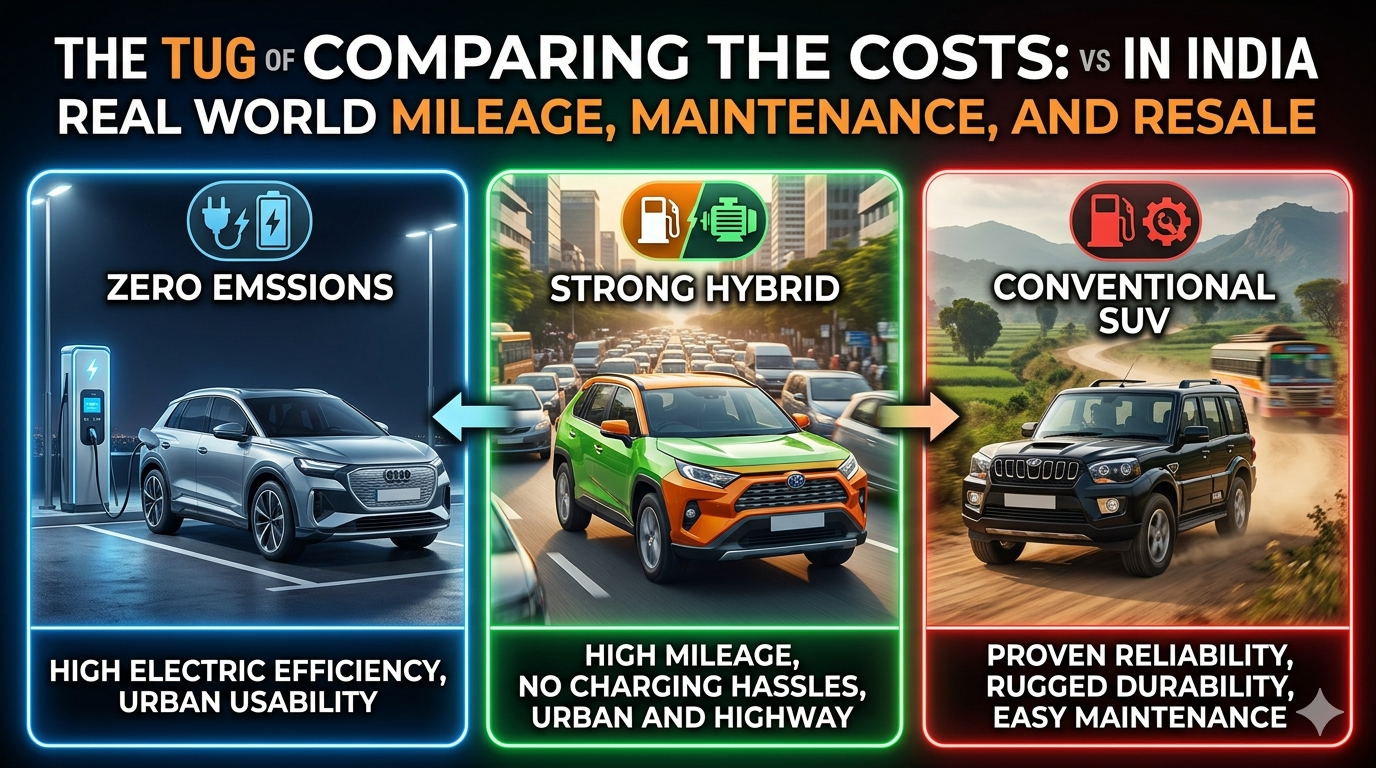
The Indian passenger vehicle market is experiencing an intense tug of war that leaves buyers completely perplexed when walking into a dealership showroom. For decades, the car buying decision was straightforward, revolving entirely around choosing between petrol and diesel variants based on monthly running requirements. Today, that simple dynamic is completely gone.
Buyers stand at an unprecedented crossroads. On one side are traditional internal combustion engine mid size SUVs, which remain the baseline for rugged dependability and pure road presence. On another side are pure Electric Vehicles, promising zero tailpipe emissions and incredibly low running costs. Right in the middle sit Strong Hybrids, presenting themselves as the ultimate bridge technology that offers the high fuel efficiency of an electric motor alongside the absolute convenience of a petrol engine.
Each technology claims to be the definitive choice for the modern Indian household. Making the wrong choice can cost hundreds of thousands of rupees in depreciation, unexpected maintenance, or simple operational frustration. Deciding correctly requires cutting through aggressive dealership marketing pitches to analyze the hard realities of real world mileage, long term maintenance costs, charging infrastructure limitations, and future resale valuation.
The True Cost of Operation: Real World Mileage Comparison
The biggest marketing trap in the Indian automotive industry is the certified fuel economy figure approved by testing bodies. These tests are conducted in controlled laboratory environments that completely fail to replicate the brutal realities of Indian bumper to bumper traffic, intense summer heatwaves, and erratic driving cycles.
Traditional Petrol and Diesel SUVs
For a standard mid size internal combustion engine SUV, city traffic is an absolute fuel efficiency nightmare. A vehicle certified for fifteen kilometers per liter will routinely drop to eight or nine kilometers per liter when crawling through congested urban corridors. The constant idling, heavy curb weight, and repetitive stop and go cycles force the engine to burn massive amounts of fuel just to move the vehicle from a dead stop. On the highway, these traditional engines find their rhythm, raising efficiency back up to acceptable double digit figures. However, for a buyer whose daily commute is primarily urban, a standard petrol SUV is an expensive proposition.
Strong Hybrids
Strong hybrids turn traditional fuel consumption logic completely on its head. Because these systems use an electric motor to pull the vehicle from a complete standstill and handle low speed crawling, they achieve their maximum fuel efficiency in dense city traffic. During urban commutes, the internal combustion engine remains turned off for extended periods, allowing the car to run purely on battery power.
Every time the driver presses the brake pedal, regenerative braking systems capture the kinetic energy that would normally be wasted as heat, converting it back into electricity to charge the onboard battery pack. This allows strong hybrids to consistently deliver between twenty and twenty five kilometers per liter in heavy city traffic. On open highways, the efficiency drops slightly because the petrol engine takes over primary propulsion duties at sustained high speeds, but the overall average remains incredibly high.
Electric Vehicles
Electric vehicles completely eliminate the concept of liters of fuel, shifting the metric entirely to watt hours per kilometer or total driving range per full charge. While an electric vehicle is undeniably the most cost effective option per kilometer, the real world range rarely matches the optimistic manufacturer claims.
Running the air conditioning at maximum capacity during peak summer months, navigating waterlogged streets, and keeping up with high speed highway traffic drain the battery far faster than expected. A vehicle advertised with a four hundred kilometer range will typically deliver closer to two hundred and eighty or three hundred kilometers of actual driving in real world Indian conditions. Even with this drop, the actual running cost remains under two rupees per kilometer when charged at domestic electricity rates, making it an incredibly cheap option for daily running.
Maintenance and Long Term Reliability
Initial fuel economy is only one part of the financial equation. True ownership costs reveal themselves over a five to ten year timeline through routine service bills and component longevity.
+--------------------------+------------------------+------------------------+------------------------+
| Cost Parameter           | ICE SUV (Petrol/Diesel)| Strong Hybrid SUV      | Pure Electric Vehicle  |
+--------------------------+------------------------+------------------------+------------------------+
| Routine Service Frequency| 10,000 km / Annual     | 10,000 km / Annual     | 10,000 km / Annual     |
| Mechanical Complexity    | High                   | Very High              | Low                    |
| Brake Wear and Tear      | High                   | Low (Regen Assisted)  | Low (Regen Assisted)  |
| Critical Component Cost  | Moderate (Turbo/Inject)| High (Dual Powertrain) | Very High (Battery)    |
+--------------------------+------------------------+------------------------+------------------------+
Mechanical Complexity vs Component Wear
A traditional internal combustion engine SUV features hundreds of moving parts, including turbochargers, complex multi speed transmissions, intricate fuel injection systems, and elaborate exhaust treatment setups like diesel particulate filters. Regular maintenance requires periodic changes of engine oil, oil filters, air filters, spark plugs, and coolant. Over time, components like clutches, brake pads, and drive belts naturally wear out and require costly replacements.
Electric vehicles present a massive contrast because they are mechanically simple. There are no spark plugs, no engine oil, no pistons, and no complex gearboxes to service. Routine maintenance is largely limited to checking coolant levels for the thermal management system, replacing cabin air filters, balancing tires, and inspecting suspension bushings. Furthermore, because electric vehicles use aggressive regenerative braking to slow down, mechanical brake pads experience minimal wear and tear, often lasting twice as many kilometers as those on a conventional car.
Strong hybrids combine both worlds, resulting in a highly complex mechanical ecosystem. A strong hybrid houses a full internal combustion engine alongside an electric motor, a power control unit, and a dedicated battery pack. This dual architecture naturally raises concerns about long term reliability. However, data from mature automotive markets indicates that strong hybrids are surprisingly durable.
Because the electric motor handles the high strain tasks of launching the vehicle and crawling through traffic, the petrol engine operates under far less stress. The engine spends less time idling and operates mostly within its ideal RPM range, which actually reduces wear on internal engine components. Like electric vehicles, hybrids also utilize regenerative braking, which vastly extends the lifespan of the mechanical braking system.
The Battery Replacement Question
The undeniable elephant in the room for both hybrids and electric vehicles is the long term degradation of the lithium ion or nickel metal hydride battery pack. Manufacturers in India typically provide an official warranty of eight years or one hundred and sixty thousand kilometers on these high voltage batteries.
For the initial period of ownership, buyers are well protected. However, if you plan to keep the vehicle beyond the warranty period, a degraded battery pack becomes a massive financial liability. Replacing a fully depleted electric vehicle battery pack can easily cost between three lakh and seven lakh rupees depending on the total capacity of the pack. A strong hybrid battery is significantly smaller and therefore much cheaper to replace, typically costing between one lakh and one point five lakh rupees, but it remains a substantial expense that traditional petrol car owners never have to consider.
The Infrastructure and Charging Reality
The joy of driving an advanced powertrain can quickly turn into severe anxiety if the surrounding ecosystem cannot support the vehicle. This is where the divide between these three technologies becomes a stark operational reality.
The Complete Freedom of Conventional SUVs
Traditional internal combustion engine SUVs offer total operational freedom. The refueling network across India is absolute, stretching from the centers of major metropolitan cities to the most remote mountain passes in Ladakh and the northeastern states. Refueling takes less than five minutes, and every roadside mechanic understands how to diagnose and repair basic mechanical issues. For buyers who love impromptu cross country road trips without meticulous pre planning, the traditional powertrain remains completely unmatched.
The Self Sustaining Hybrid Ecosystem
Strong hybrids mimic this exact infrastructure convenience. They do not require any external charging whatsoever. You never have to search for a working public charging station, download multiple smartphone applications, or wait around for hours at a highway food mall while the car replenishes its battery.
You simply fill the tank with standard petrol at any regular fuel station and drive away. The vehicle handles its own energy management automatically, charging the internal battery using the petrol engine and braking energy. This makes the strong hybrid an ideal option for buyers who want the high efficiency of an electric drive but live in high rise apartment complexes where installing a dedicated personal charger is a bureaucratic nightmare.
The Electric Vehicle Charging Dilemma
Choosing a pure electric vehicle requires a fundamental shift in mindset and lifestyle. For daily city commuting, an electric vehicle is incredibly convenient if you have a dedicated parking slot with a home charger installed. You simply plug the car in overnight and wake up to a full charge every single morning.
The real challenge emerges the moment you decide to head out on a long distance highway journey. Despite the rapid expansion of public fast charging networks along major national highways, the charging infrastructure in India remains uneven and prone to operational issues.
Highway charging requires careful planning. Drivers must map out their routes around functional fast chargers, build buffer time into their travel schedules for charging stops, and pray that the charger is not broken, occupied by another vehicle, or non functional due to local power outages when they arrive. Until fast charging stations become as ubiquitous and reliable as petrol pumps, long distance traveling in an electric vehicle will continue to demand a degree of patience and calculation that many buyers are simply not willing to accept.
Future Resale Value and Market Dynamics
A car is an depreciating asset, and understanding how much value a vehicle will retain after five years is a critical factor in calculating the overall cost of ownership. The Indian used car market is notoriously risk averse, heavily favoring predictability and long term durability over cutting edge technology.
The Safe Haven of Traditional Vehicles
Traditional mid size SUVs hold their value exceptionally well in the Indian pre owned market. Used car buyers appreciate the simplicity of a standard petrol or diesel engine because they know any local workshop can maintain it cheaply. There is no looming fear of an expensive battery failure. Popular models from established brands routinely retain seventy to seventy five percent of their original value after three years of ownership, making them a very safe financial bet.
The Hybrid Rise
Strong hybrids are starting to establish a very strong position in the resale market. As fuel prices continue to climb, used car buyers are actively seeking out highly efficient vehicles.
Because a strong hybrid operates exactly like a regular petrol car and carries no charging baggage, the second hand market accepts them with open arms. The only major factor holding back even higher residual values is the lingering uncertainty among used car buyers regarding the replacement cost of the hybrid battery as the vehicle approaches the end of its eight year warranty period.
The Electric Vehicle Depreciation Risk
Pure electric vehicles currently face the steepest depreciation curves in the automotive market. The technology is evolving at an incredibly rapid pace. An electric vehicle purchased today might look completely obsolete in four years due to massive advancements in battery chemistry, faster charging capabilities, and increased driving range offered by newer models at lower price points.
Furthermore, a second hand buyer is highly cautious about purchasing a used electric vehicle that has already exhausted four or five years of its original eight year battery warranty. The terrifying prospect of paying several lakh rupees for a battery replacement shortly after buying a used car drives resale prices down significantly. If you plan to trade in your vehicle every three to four years, an electric vehicle will likely result in a much larger hit to your wallet through depreciation compared to its hybrid or petrol counterparts.
Final Verdict: Which One Belongs in Your Garage?
There is no single correct answer to this automotive puzzle; the ideal choice depends entirely on your specific geographic location, monthly driving distance, and personal lifestyle.
Choose a Traditional SUV if:
Your monthly driving is relatively low, dropping below one thousand kilometers, or your travel involves frequent long distance road trips into rural areas with unpredictable infrastructure. If you prioritize maximum upfront savings over long term fuel costs, want a proven mechanical package, and intend to sell the vehicle within three to four years to maximize resale returns, stick with a conventional internal combustion engine.
Choose a Strong Hybrid SUV if:
Your monthly running is high, exceeding fifteen hundred kilometers, and consists primarily of commuting through heavily congested urban traffic. If you want the ultra quiet refinement and exceptional fuel efficiency of an electric drive but absolutely refuse to deal with the anxiety of highway charging stations or the hassle of installing dedicated charging hardware in your apartment building, the strong hybrid is the most balanced, stress free premium solution available today.
Choose a Pure Electric Vehicle if:
You possess a secure, dedicated parking space at home or work where a personal charger can be permanently installed, and your driving profile is dominated by predictable daily urban commutes. If you are willing to spend time planning occasional long distance highway trips around charging networks in exchange for enjoying the lowest possible running costs per kilometer, instant electric acceleration, and a completely tailpipe emission free driving experience, take the leap into full electrification.
