
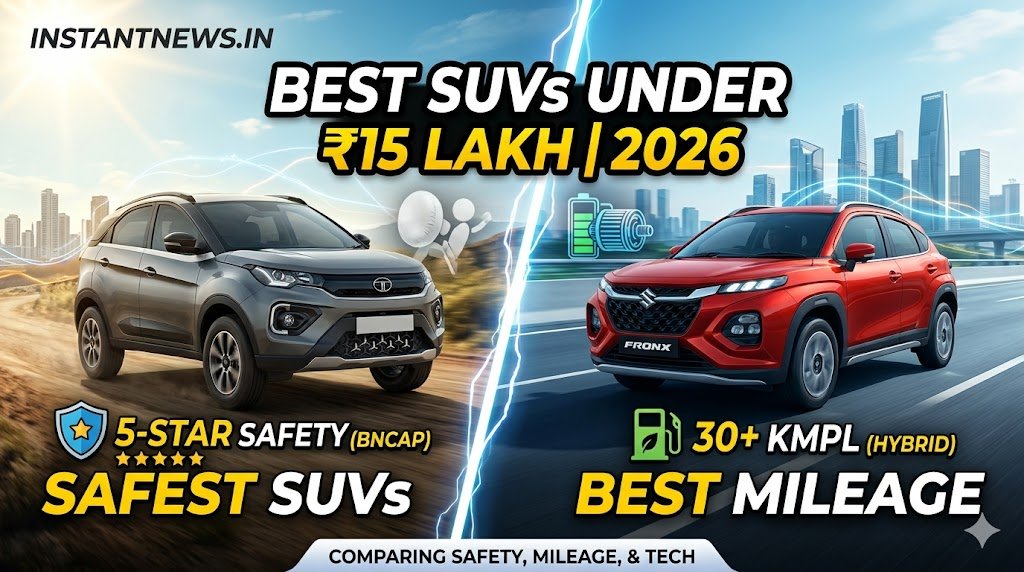
Choosing the right SUV in India used to be easy—you either bought a Maruti for mileage or a Tata for “loha” (build quality). But as we hit the middle of 2026, the game has changed entirely. With the ₹15 lakh mark being the “sweet spot” for most Indian families, the competition is no longer just about looks; it’s a high-stakes battle between strong hybrids, 5-star BNCAP safety ratings, and Level 2 ADAS.
If you are looking to swipe your card for a new set of wheels this month, here is a deep dive into the best SUVs under ₹15 lakh that actually deserve your money.
1. The Mileage Monsters: Maruti Fronx Hybrid & Toyota Taisor
Gone are the days when “Hybrid” meant spending ₹20 lakh+. In 2026, the Maruti-Toyota partnership has perfected the Strong Hybrid tech for the sub-4-meter segment.
- The Tech: We’re seeing real-world efficiency of 28–30 kmpl in city traffic. This is a game-changer for daily commuters in Bengaluru or Delhi who are tired of fluctuating petrol prices.
- The Drive: These cars feel like EVs at low speeds—silent and punchy. However, the boot space is slightly compromised due to the battery placement.
- Target Keyword: Best mileage SUV in India 2026, Hybrid cars under 15 lakh.
2. The Safety Fortresses: Tata Nexon & Mahindra XUV 3XO
If your priority is keeping your family safe on unpredictable Indian highways, Tata and Mahindra are still leading the pack. By 2026, Bharat NCAP (BNCAP) ratings have become the industry standard, and these two are the gold standard.
- Tata Nexon: It remains the “OG” of safety. The 2026 version features a reinforced chassis and 6 airbags as standard across all variants. The infotainment has finally caught up with the competition, offering a lag-free experience.
- Mahindra XUV 3XO: It’s the widest car in its class. If you have three adults sitting in the back, this is the only sub-compact SUV that won’t feel cramped. Plus, the Level 2 ADAS (Advanced Driver Assistance Systems) in the top-end manual and automatic trims is surprisingly well-calibrated for Indian road chaos.
- Target Keyword: Safest SUV under 15 lakh, 5 star BNCAP rated cars India.
3. The Tech Savvy Choices: Kia Sonet & Hyundai Venue
For the “digital-first” generation, Hyundai and Kia continue to offer features that feel like they belong in a luxury sedan.
- Features that matter: Ventilated seats (a blessing in the 48°C Indian summers), 360-degree cameras with blind-spot monitoring, and fully digital clusters that sync with your smartphone seamlessly.
- The Engine: Their 1.0 Turbo Petrol engines paired with a 7-speed DCT (Dual Clutch Transmission) are perfect for those who enjoy a spirited drive. It’s not as efficient as the hybrids, but the “fun-to-drive” factor is significantly higher.
- Target Keyword: Tech-loaded SUVs India, Best automatic SUV under 15 lakh.
Quick Comparison: 2026 Top Picks
| Model | Primary USP | Expected Mileage | BNCAP Rating |
| Maruti Fronx Hybrid | Extreme Efficiency | 28.5 kmpl | 4 Star (Projected) |
| Tata Nexon | Rugged Safety | 17.0 kmpl | 5 Star |
| Mahindra XUV 3XO | Performance & Space | 18.2 kmpl | 5 Star |
| Kia Sonet | Features & Interior | 16.5 kmpl | 4 Star |
The “Hidden” Factors You Must Consider
Before you head to the showroom, keep these 2026 market realities in mind:
The Hybrid vs. EV Debate
While EVs are great, the charging infrastructure in many Tier-2 cities is still catching up. A Strong Hybrid under ₹15 lakh offers the best of both worlds—EV-like fuel savings without the “range anxiety” of finding a charger on a road trip.
Insurance and Maintenance
With ADAS sensors and hybrid batteries, insurance premiums have climbed slightly. Always check if your policy covers “Battery Protection” and “Sensor Calibration”—these are the hidden costs of modern car ownership.
The Resale Value
In 2026, the second-hand market is starting to favor Hybrids and 5-star safety cars. A car that scores low on safety today will be much harder to sell four years down the line.
Which one should you buy?
- Buy the Maruti Fronx/Toyota Taisor if your monthly running is over 1,500 km and you want to slash your fuel bill in half.
- Buy the Tata Nexon or Mahindra XUV 3XO if you do frequent highway trips and safety is non-negotiable.
- Buy the Kia Sonet if you want the coolest gadgets and the best-looking cabin in the segment.
The “Best SUV” doesn’t exist—only the “Best SUV for your lifestyle.” Test drive at least three of these before making a choice, because, in 2026, the spec sheet only tells half the story.
Building on the comparison of the top models, Part 2 dives into the “Future-Proofing” aspect of buying an SUV in 2026. From upcoming launches to keeping your car alive in the brutal Indian summer, here is what you need to know before signing the dotted line.
4. The New Challengers: Upcoming SUV Launches (Q3 2026)
If you aren’t in a hurry to buy today, the second half of 2026 is bringing some heavy hitters that might disrupt the current rankings.
- The Renault Duster 2026: The legend is finally back. Expected to start around ₹10.5 lakh, the new-gen Duster is focusing on a “lifestyle off-roader” vibe without the heavy price tag of a 4×4. It’s rumored to feature a Mild-Hybrid engine that balances power and economy.
- Kia Syros: Positioned between the Sonet and Seltos, the Syros is aiming for the “family first” buyer. Expect a “tall-boy” design that offers more headroom than any other sub-compact SUV, along with Kia’s signature 20+ Standard Safety Package.
- Skoda Kylaq: For those who prioritize German (well, Czech) engineering, the Kylaq is the most affordable way into the Skoda family. It’s compact, punchy, and built on the MQB-A0-IN platform which has already proven its 5-star BNCAP capability.
- Target Keyword: Upcoming SUVs India June July 2026, New Renault Duster launch price, Kia Syros features.
5. Survival Mode: Maintaining Your SUV in 48°C Heat
With Indian summers hitting record highs in 2026, your car is under more stress than ever. A ₹15 lakh investment deserves a little extra care to avoid “thermal breakdown.”
- The Nitrogen Switch: If you’re planning a highway trip (like the Mumbai-Nagpur Samruddhi Expressway), switch to Nitrogen in your tyres. Regular air expands rapidly at 48°C, leading to highway blowouts. Nitrogen stays 10–15% cooler.
- The 20-Minute AC Rule: Never jump into a parked car and blast the AC on “Low” immediately. Roll down all windows, drive for 2 minutes to let the trapped 60°C air escape, and then switch on the climate control. It saves your compressor from premature death.
- Coolant Pressure Tests: Don’t just check the level; get a pressure test done. In extreme heat, even a microscopic leak in a hose can turn into a steam explosion under the hood.
- Target Keyword: Car maintenance tips for Indian summer 2026, beat the heat car care, AC service cost India.
6. The Resale Reality: Hybrid vs. Petrol
In 2026, the second-hand car market is undergoing a massive shift. Data shows that Strong Hybrids (like the Grand Vitara or Fronx) are retaining up to 15% more value than pure petrol variants after two years of ownership.
Why? Because as fuel prices remain unpredictable, the next buyer wants a car that won’t burn a hole in their pocket. If you plan to upgrade your car every 3–4 years, spending the extra ₹1.5 lakh on a Hybrid today is essentially an “investment” that you’ll recover at the time of resale.
The “Smart Buyer” Checklist for May 2026
Before you leave the dealership, ensure you’ve asked these three questions:
- Is the ADAS tuned for India? Some systems are too sensitive and slam the brakes for a passing cyclist. Test the Level 2 ADAS in local traffic.
- What is the BNCAP Child Safety Score? A 5-star rating for adults doesn’t always mean 5 stars for kids. Check the specific breakdown.
- Does it support OTA Updates? In 2026, cars are like smartphones. Over-the-air (OTA) updates can improve your gearbox tuning or map accuracy without a visit to the service center.
Final Thoughts
The “under ₹15 lakh” segment is no longer about compromise. Whether you choose the fuel-sipping Hybrids, the tank-like Tatas, or wait for the upcoming Duster, make sure your choice aligns with your 5-year plan. In the 2026 market, a “cheap” car that lacks safety or tech will cost you much more in the long run.
To round out your guide for instantnews.in, here is a comprehensive FAQ section designed to answer the most common questions readers are searching for in May 2026. This section is structured to keep readers on your page longer and provide quick, shareable answers.
Frequently Asked Questions: SUV Buying & Maintenance (May 2026)
1. Which is the safest SUV under ₹15 lakh in India right now?
As of May 2026, the Tata Nexon and Mahindra XUV 3XO are the top picks, both boasting 5-star ratings from Bharat NCAP (BNCAP). They come with standard safety kits including 6 airbags, Electronic Stability Control (ESC), and ISOFIX mounts.
2. Should I buy a Strong Hybrid or a Pure Petrol SUV?
If your daily city commute is over 40–50 km, a Strong Hybrid (like the Maruti Grand Vitara or Toyota Hyryder) is better as it offers up to 28 kmpl. However, if your running is low or you mostly drive on highways, a Turbo Petrol or Diesel might be more cost-effective due to the lower initial purchase price.
3. Is the 48°C heatwave dangerous for my car’s battery?
Yes. Extreme heat accelerates chemical reactions inside the battery, leading to fluid evaporation and internal corrosion. In a 2026 Indian summer, it is highly recommended to get a Battery Health Check if your battery is more than 2 years old and always park in the shade when possible.
4. What is the benefit of Nitrogen in tyres during summer?
Nitrogen is less susceptible to temperature fluctuations. While regular air expands significantly at 48°C (increasing the risk of a highway blowout), Nitrogen keeps the tyre temperature roughly 10–15% cooler, providing more stable pressure and better fuel efficiency.
5. Which upcoming SUVs are launching in the second half of 2026?
The most anticipated launches for Q3 and Q4 2026 include:
- Renault Duster (Gen-3): Expected to disrupt the mid-size segment.
- Tata Sierra EV: A nostalgic revival in a purely electric avatar.
- Skoda Kylaq: A compact SUV aimed at driving enthusiasts.
6. Why is my car AC not cooling effectively at traffic signals?
This is a common issue in 2026 heatwaves. It usually indicates a weak condenser fan or a low refrigerant (gas) level. If the AC cools well only when the car is moving fast, your condenser isn’t getting enough airflow while stationary.
7. Does Bharat NCAP (BNCAP) replace Global NCAP in India?
While Global NCAP still tests Indian cars, Bharat NCAP is now the primary localized authority. BNCAP tests “India-spec” models, making the results more relevant for local buyers compared to international versions of the same car.
Quick Summary Table
| Question | Short Answer |
| Best Mileage? | Maruti Grand Vitara / Toyota Hyryder (Hybrid) |
| Best Safety? | Tata Nexon / Mahindra XUV 3XO |
| Best for Off-road? | Mahindra Thar (Base Variant) |
| Heatwave Essential? | Nitrogen air & Coolant top-up |
