
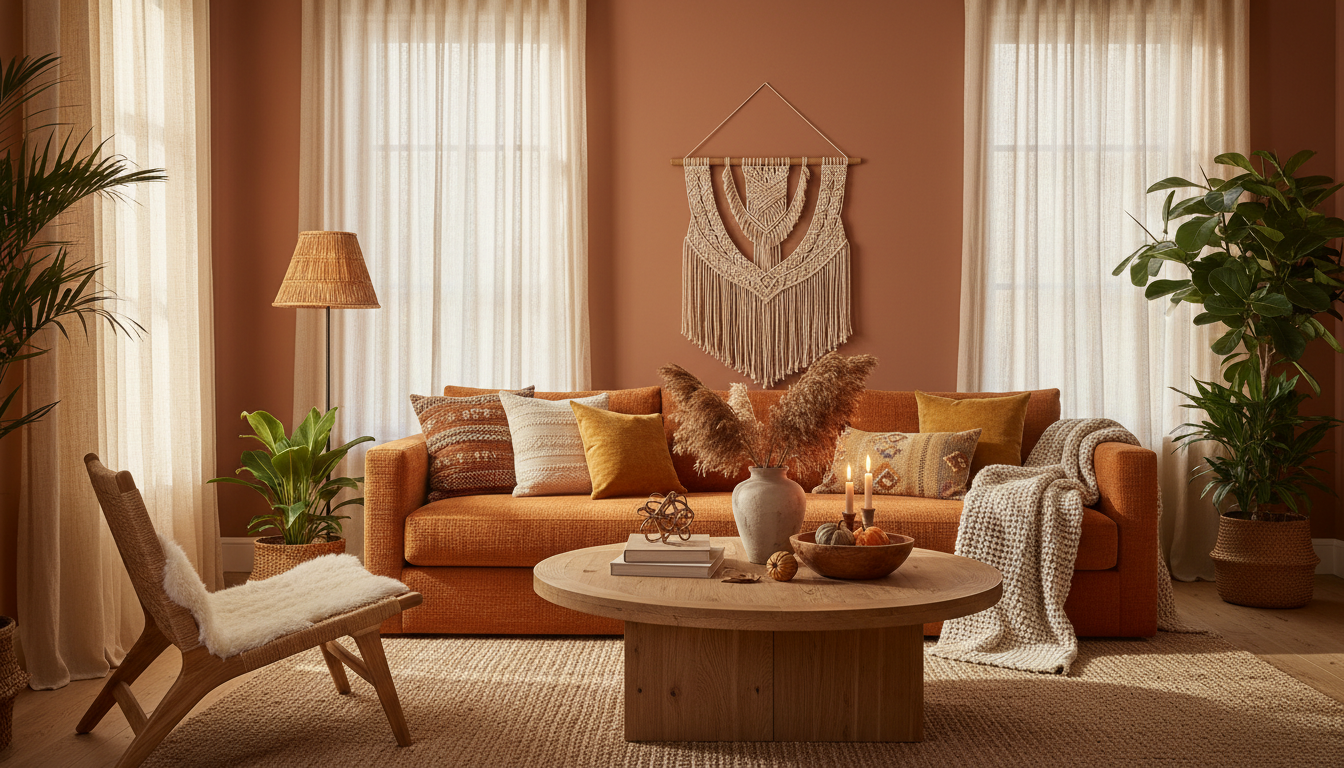
Autumn interior design trends are steering decisively away from minimalist austerity toward spaces that feel like an embrace. As the season settles in across 2026, homeowners are rethinking their walls, their materials, and their relationship with the objects around them.
The shift is unmissable. Warm tones dominate. Natural textures matter more. And clutter—or rather, its absence—is finally being recognised as essential to peace of mind at home.
What’s driving autumn interior design trends?
Three forces converge. First, the seasons themselves: autumn prompts a psychological hunger for warmth. Second, fatigue with Instagram-perfect minimalism. Third, a new willingness to ask what a home should actually do—not just look like.
According to Business Insider’s assessment of autumn 2026 design, colour drenching remains the dominant technique. This means painting walls, trim, and ceilings in the same or closely related shades. It sounds bold. In practice, it feels enveloping.
The effect is deeper than decoration. A colour-drenched room doesn’t fight itself. Your eye rests. The room becomes a mood rather than a collection of separate surfaces.
Softening the industrial look
Industrial design isn’t disappearing. It’s just warming up.
The hard-edged aesthetic—exposed brick, steel, concrete—is being layered with natural materials and softer textures. Jennifer Aniston’s dining room exemplifies this hybrid approach: industrial bones, warmed by wood, textiles, and careful lighting.
This matters for Indian homes too. Many urban flats built in the last decade embrace industrial minimalism by default. The trend now allows owners to keep those architectural bones while making rooms feel less austere.
Raw wood, woven textiles, warm-toned metals, and layered lighting are the tools. They’re affordable and widely available.
The rise of home beverage bars
A more specific trend: dedicated beverage bars within homes.
This isn’t about wealth signalling. It’s about intentionality. A beverage bar—whether a corner shelf or a full wall—signals that hospitality and ritual matter. The bar becomes a focal point. It also solves a practical problem: it centralises bottles, glasses, and mixing tools rather than scattering them across the kitchen.
For homes where entertaining is frequent or space is limited, a beverage bar offers a clean, designed solution to a functional need.
Ikigai and the joy-centred home
The Japanese concept of ikigai—roughly, the reason for being—is reshaping how people think about home décor.
Rather than following trends because they’re trending, the ikigai approach asks: what brings you joy? What adds value to your daily life? What do you actually use? An object earns its place by serving that question, not by matching a mood board.
This is quieter than maximalism but richer than minimalism. A room built on ikigai principles might have fewer things, but each thing is there because it matters.
For Indian households, where multi-generational living and shared spaces are common, ikigai thinking helps resolve competing aesthetic preferences. Each family member’s non-negotiable joys get represented. The room becomes genuinely lived-in rather than curated.
Counter clutter is stealing your calm
Here’s a hard fact: clutter on countertops is a measurable source of stress.
Research cited by House Beautiful links visual clutter directly to anxiety and reduced focus. Your brain never fully rests when surrounded by unfinished tasks and scattered objects.
The solution isn’t perfection. It’s systems.
Drawer organisers, shelf dividers, and closed storage reclaim peace. Coffee machines, spice jars, and cooking utensils belong in cupboards, not on display. The rule: if something doesn’t earn counter space by being beautiful or essential to daily ritual, it goes away.
This is especially relevant in compact Indian homes where kitchen counter space is precious. Every inch counts. Treating it as prime real estate—not a dumping ground—changes how a home feels.
Natural materials and warmth
Autumn trends emphasise natural materials: wool, linen, wood, stone, clay.
These materials age visibly. A linen cushion fades slightly over months. Wood grain shifts with light. Clay vessels develop patina. This visibility of ageing is the point.
Mass-produced, uniform goods evoke nothing. Natural materials tell stories. They connect you to seasons and time passing.
Indian design traditions already emphasise natural materials—jute, cotton, terracotta, teak. The global trend toward natural materials is partly a rediscovery of what works.
Multifunctional spaces matter more
Not everyone has a dedicated dining room. Many don’t have a proper home office. Autumn 2026 trends embrace this reality through multifunctional design.
A wall-mounted desk that folds away. A dining table that doubles as a workspace. Storage that’s also seating. These solutions aren’t compromises. They’re elegance under constraint.
For apartments in cities like Mumbai, Delhi, and Bangalore, where space is finite, multifunctional furniture isn’t a trend—it’s necessity. But necessity, when designed well, stops feeling like a limitation.
FAQ
What exactly is colour drenching?
Colour drenching means painting walls, trim, and ceilings in the same colour or closely related shades. Instead of white trim against coloured walls, everything harmonises. Rooms feel more cohesive and calming.
Is industrial design going out of style?
Not entirely. It’s being softened. Hard industrial edges are being tempered with warm woods, natural textiles, and layered lighting. The skeleton remains; the warmth increases.
How do I apply ikigai to my home décor?
Ask: Does this object bring me joy? Does it serve a purpose I value? Will I actually use it regularly? If yes to all three, it earns a place. If no, it doesn’t—regardless of trend.
What’s the easiest way to reduce counter clutter?
Start by moving items into closed storage. Buy drawer dividers and shelf organisers. Keep only what you use daily or what’s genuinely beautiful. Everything else goes away.
Can I use these trends in a small space?
Yes. Colour drenching actually makes small rooms feel larger by eliminating visual fragmentation. Multifunctional furniture is essential. Natural materials work at any scale.
