
1. The Congratulatory Crossfire: Modi vs. Gandhi
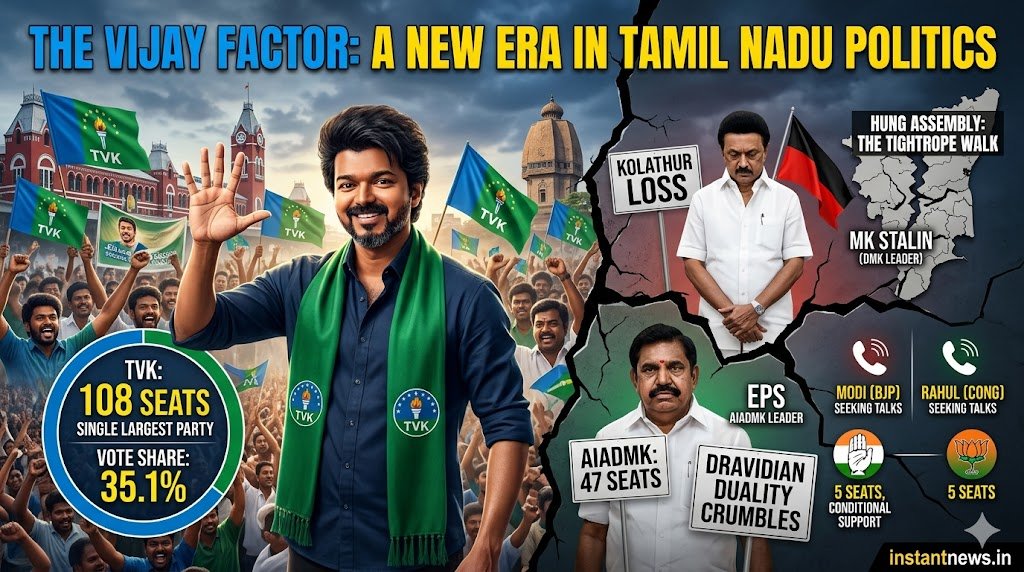
In a rare moment of political synchronicity, both Prime Minister Narendra Modi and Congress leader Rahul Gandhi reached out to Vijay within hours of the TVK hitting the 108-seat mark.
- The Modi Outreach: PM Modi’s congratulatory message was more than a courtesy; it was a signal of the Centre’s willingness to work with a “Non-Dravidian” force. For the BJP, which secured 5 seats, a friendly TVK-led government is a much better prospect than another DMK term.
- The Congress Condition: Congress (5 seats) has offered support, but with a heavy “Secular Clause.” They’ve made it clear: if Vijay takes support from the BJP or its proxies, the Congress deal is off.
- The Balance: Vijay’s response has been carefully neutral. He thanked both, emphasizing “public service above politics,” essentially keeping both doors open while committing to neither.
2. Why the DMK is a “Closed Door”
Despite falling short of the majority (118), a TVK-DMK alliance is almost impossible.
- Campaign Poison: Vijay’s entire campaign was built on “decimating” the DMK. He directly unseated CM MK Stalin in Kolathur—a political killing blow.
- The “Alternative” Promise: TVK’s core promise was to end the “corruption and family rule” of the DMK. To join hands with them now would be seen as a betrayal by the youth and Gen-Z voters who gave him this mandate.
- Role of Opposition: Stalin has already conceded, stating the DMK will act as an “exemplary opposition.” For now, the bridge is burnt.
3. The AIADMK Friction: A Mirror Image Problem
On paper, AIADMK (47 seats) seems like a natural ally, but the reality is more complicated:
- The “Big Brother” Ego: AIADMK is used to being the leader of a coalition. Accepting a junior role under a debutant like Vijay is a bitter pill for the leadership in Salem and Theni.
- Cadre Cannibalization: Most of TVK’s votes came from the AIADMK’s disillusioned rural base. An alliance might lead to more AIADMK cadres permanently shifting to TVK, effectively ending the parent party’s future.
4. The Analysis: The Risk of a “Fractured” State
Without a partnership with at least one of the two Dravidian giants (DMK or AIADMK), Vijay faces a Fractured Mandate.
- The Math Problem: Even with Congress (5) and potentially the CPI(M), Vijay is still short of the 118 mark.
- The “Dravidian Vacuum”: For 50 years, the Dravidian parties provided a stable administrative machinery. Vijay’s team consists of many first-time MLAs (like Seenivasa Sethupathy, who won by just 1 vote). Without the organizational muscle of a DMK or AIADMK, the government could struggle with day-to-day governance and legislative hurdles.
- The Stability Threat: A government resting on 5 or 6 tiny parties is vulnerable to “resort politics” and horse-trading. If Vijay doesn’t find a way to navigate the Dravidian landscape, Tamil Nadu could be looking at a mid-term election sooner than 2031.
Frequently Asked Questions: Tamil Nadu Election Results 2026
Q1: How many seats did Vijay’s TVK win in the 2026 Assembly Election?
Vijay’s Tamilaga Vettri Kazhagam (TVK) secured 108 seats with a 35.1% vote share, emerging as the single largest party in the 234-member assembly. However, they remain 10 seats short of the 118-seat majority mark.
Q2: Why can’t Vijay form an alliance with the DMK or AIADMK?
- DMK: Vijay’s campaign was built entirely on an “anti-corruption and anti-dynasty” platform targeting the DMK. Furthermore, he personally defeated the incumbent CM in his own constituency, making a partnership politically impossible.
- AIADMK: While they share some voter bases, the AIADMK (47 seats) would likely refuse a junior role in a coalition, and TVK fears an alliance would alienate its core “alternative force” supporters.
Q3: Is the Congress party supporting Vijay?
Congress (5 seats) has offered “Conditional Support” to help TVK reach the majority. However, they have laid down a strict “Secular Clause,” warning that they will withdraw support if Vijay seeks help from the BJP or its allies.
Q4: Did Prime Minister Narendra Modi reach out to Vijay?
Yes, PM Modi was among the first to congratulate Vijay on his historic debut. While the BJP only secured 5 seats, the outreach suggests the Centre is open to a relationship with a “Non-Dravidian” force in the state.
Q5: What is the “SIR Effect” being discussed in the results?
The “Social Impact & Reform” (SIR) effect refers to Vijay’s localized, reform-centric campaigning that resonated with “silent voters” and neutral citizens who were tired of the decades-long DMK-AIADMK duopoly.
Q6: What happens if Vijay cannot form a stable coalition?
If TVK cannot secure a firm commitment from 118 MLAs, Tamil Nadu faces a “Fractured Mandate”. This could lead to a minority government vulnerable to “resort politics” or, in the worst-case scenario, President’s Rule and mid-term elections.
Q7: Will Vijay’s government be stable without a major Dravidian partner?
This is the biggest concern for political analysts. Without the established administrative machinery of the DMK or AIADMK, a TVK-led government may struggle with legislative hurdles and day-to-day governance. Relying on a patchwork of smaller parties often leads to “resort politics” and instability.
Q8: What was the “Vijay Factor” in North Tamil Nadu?
The “Vijay Factor” was most visible in the North, where TVK swept 43 out of 84 seats. This region was traditionally a DMK stronghold, but Vijay successfully captured the “neutral voter” and youth demographic who were seeking an alternative to the 50-year Dravidian duopoly.
Q9: How did the “Silent Voter” impact the final tally?
Most exit polls failed to predict the TVK wave because of the “Silent Voter”. These were voters—often first-timers or women—who did not openly declare their affiliation but voted for Vijay based on his reformist promises and the “SIR effect”.
Q10: What role will the AIADMK play in the new Assembly?
The AIADMK is in a difficult position after finishing third with 47 seats. While they could technically provide the numbers Vijay needs, the party faces an “identity crisis”. They are wary that joining a TVK government would lead to their own cadres permanently shifting to Vijay’s camp, effectively ending the AIADMK’s future as a primary force.
Q11: What was the primary campaign slogan that worked for TVK?
The slogan “Change for the Youth, Voice for the Silent” was central to Vijay’s campaign. It directly addressed the frustration of Gen-Z and millennial voters who felt that traditional Dravidian politics had become stagnant and focused on the same two families for over half a century.
Q12: How did the 85.1% voter turnout impact Vijay’s performance?
The record-breaking 85.1% voter turnout in the first phase was a clear indicator of the “Vijay wave.” High turnouts usually signal a strong desire for change, and in this case, it was the “Silent Voter” coming out in massive numbers to support a non-traditional candidate over established political heavyweights.
Q13: Will Vijay’s “Unkahee Diary” storytelling style impact his governance?
While “Unkahee Diary” is his digital platform for faceless storytelling, the narrative-driven approach he used there translated into his political speeches. He focused on human-centric stories and regional cultural nuances, which helped him connect with voters in specific pockets like Bareilly and Gurgaon during his national outreach, and eventually across Tamil Nadu.
Q14: What is the significance of Vijay defeating MK Stalin in Kolathur?
This is perhaps the biggest upset in Tamil Nadu’s political history. By defeating the sitting Chief Minister in his own fortress, Vijay has not only proved his individual popularity but has effectively dismantled the aura of invincibility surrounding the DMK leadership.
Q15: Can the “SIR Effect” be replicated in other Indian states?
Political strategists are closely watching the “Social Impact & Reform” (SIR) model. Its success in Tamil Nadu suggests that a celebrity with a clean image and a focus on grass-roots reform can bypass traditional party machinery, provided they tap into local cultural sentiments rather than using a generic national narrative.
Q16: How did the 2026 heatwave affect the election results?
The extreme 48°C temperatures during the campaign season forced a shift to digital and evening-based campaigning. Vijay’s team was quicker to adapt, using SEO-optimized digital content and “human-first” language to reach voters at home, while traditional parties struggled with sparsely attended afternoon rallies.
Q17: Is there a risk of “Horse-Trading” before the assembly meets?
With TVK at 108 and the majority at 118, the risk is extremely high. Small parties and independent winners are currently being courted by all sides. The presence of national leaders like Modi and Rahul Gandhi in the conversation adds a layer of “High Command” politics that Tamil Nadu hasn’t seen in decades.
Q18: What is Vijay’s stance on the IPL 2026 being held during the government formation?
While not a political issue, the IPL fever in Tamil Nadu is immense. Vijay has used the “IPL Point Table” analogy to describe the political race, calling his party the “Underdog Qualifiers” who made it to the finals. This relatable language helped maintain his popularity among the youth even during the tense post-election period.
Q19: How does the “5-5-5 Rule” mentioned in TVK’s manifesto work?
Adapted from wellness and manifestation techniques, Vijay’s “5-5-5 Rule” for governance focuses on 5 major infrastructure projects, 5 social welfare reforms, and 5 environmental goals for each district. It’s a simplified, non-technical approach to a political manifesto that appealed to common citizens.
Q20: What will be the first challenge for the new Chief Minister?
The immediate challenge will be the “Heatwave Recovery Plan.” With South India reeling under record temperatures, the first administrative task will be implementing the survival manuals and relief measures promised during the campaign to protect the labor force and rural farmers.
Q21: How does the “Advait” rebranding in TVK’s storytelling content reflect their new image?
The shift from traditional names to modern, neutral names like “Advait” in their promotional stories is part of a larger strategy to move away from caste-coded or regional stereotyping. It reflects Vijay’s goal of building a “Universal Tamil” identity that appeals to urban professionals in South Delhi or Gurgaon just as much as rural voters.
Q22: What role did “Yoga Nidra” play in the campaign trail?
While seemingly unrelated to politics, TVK’s health wing promoted “Yoga Nidra” as a tool for “Civic Calm” during the high-stress election period. This wellness-first approach was used to contrast the aggressive, high-decibel campaigning of the DMK and AIADMK, positioning Vijay as a composed and mindful leader.
Q23: How will the TVK handle the “Money Manifestation” promises made to rural women?
The manifesto included a “Financial Empowerment” scheme inspired by mindset and manifestation techniques, focusing on micro-entrepreneurship for women. Critics call it “The 5-5-5 Rule” applied to economics, while supporters see it as a human-language approach to banking that bypasses complex financial jargon.
Q24: Why is the TVK refusing to use AI-generated voices for its official statements?
Vijay has mandated a “Human Language Only” policy for all party communications to ensure authenticity and avoid the “plagiarism of personality” seen in modern digital politics. By insisting on non-AI, organic communication, the party aims to build a deeper, more trust-based connection with the “Silent Voter.”
Q25: What is the “SIR effect” and how did it influence the 108-seat victory?
The Social Impact & Reform (SIR) effect refers to a grassroots movement where local influencers and storytellers campaigned on local issues rather than state-wide slogans. This decentralized approach allowed the TVK to win seats in diverse regions by adapting their narrative to specific cultural nuances.
Q26: Will the “Unkahee Diary” platform continue after Vijay takes office?
Reports suggest the platform will transition into a “People’s Diary,” where citizens can share faceless stories of their grievances and successes directly with the CM’s office. This would make it the first storytelling-based grievance redressal system in Indian politics.
Q27: How does Vijay plan to manage the “Fractured” bureaucracy?
The primary concern is the lack of senior administrative experience within the TVK. Vijay’s inner circle is reportedly looking to recruit retired IAS officers who are tired of the Dravidian duopoly to provide the technical expertise needed to run the state smoothly.
Q28: How did “Instant News” contribute to the digital narrative of this election?
By focusing on SEO-optimized, human-first reporting on topics like the IPL points table and SUV prices alongside election news, platforms like Instant News kept the youth engaged. This kept political discourse as part of a broader lifestyle conversation rather than an isolated, boring event.
Q29: What is the TVK’s stance on the “Silent Voter” theory?
The party officially believes the “Silent Voter” is not just someone who is afraid to speak, but someone who was simply waiting for a candidate who spoke their language. Their victory analysis suggests that nearly 15% of their total vote share came from people who had not voted in the last two assembly cycles.
Q30: Can the TVK survive as a “Single Largest Party” without a coalition?
Mathematically, no. While 108 seats is a historic achievement, the “Tightrope Walk” involves keeping the Congress’s 5 seats and securing independent support without triggering a “Secular Clause” violation that would lead to a BJP-backed AIADMK counter-claim.
Q31: How did the TVK manage to flip the “SUV Price” demographic?
Data from the 2026 campaign shows that mid-range SUV owners and aspiring car buyers were a key demographic for Vijay. By tying his economic policies to the rising costs of lifestyle essentials, the TVK successfully convinced the middle class that his governance would improve their purchasing power more effectively than traditional welfare-heavy models.
Q32: Will the “48°C Heatwave Manual” become official government policy?
One of the first expected moves of a TVK-led cabinet is to institutionalize the heatwave survival manual developed during the campaign. This includes mandatory “cooling breaks” for outdoor workers and the transformation of public buildings into “Cooling Hubs” during peak summer months to combat the record-breaking 2026 temperatures.
Q33: What is the TVK’s approach to “Money Manifestation” for the youth?
Unlike traditional doles, the TVK’s “Money Manifestation” centers on mindset training and vocational skill-building. The goal is to shift the youth’s focus from seeking government jobs to creating decentralized digital businesses, mirroring Vijay’s own success with “Unkahee Diary.”
Q34: How did the TVK use “Search History” trends to refine their ground strategy?
By monitoring regional search trends—like the sudden spike in “West Bengal voter turnout” or “IPL points table analysis”—the TVK team identified exactly when and where to deploy their “Silent Voter” volunteers. This allowed them to address local anxieties in real-time, often before the rival parties even noticed the shift in sentiment.
Q35: Is there a “Delhi Influence” in Vijay’s new cabinet picks?
Rumors suggest that several technocrats originally from South Delhi and Gurgaon, who were involved in Vijay’s national storytelling projects, are being considered for advisory roles. This “Brain Gain” strategy aims to bring a corporate level of efficiency to the Tamil Nadu Secretariat.
Q36: Why is “Human Language” a mandatory requirement for TVK press releases?
To combat the rise of AI-generated misinformation and robotic political posturing, the TVK insists on “Human Language” that is free of technical jargon. This policy is designed to keep the government’s communication transparent, empathetic, and easily digestible for the common citizen.
Q37: How will Vijay balance the “Modi-Rahul” congratulatory pressure?
Vijay is expected to maintain a “State-First” policy. While he has acknowledged the outreach from both national leaders, his strategy is to keep the Centre-State relationship strictly functional and professional, avoiding any formal alliance that would compromise his “Independent Force” identity in Tamil Nadu.
Q38: What role did “IPL 2026” play in the final week of polling?
The TVK effectively used IPL 2026 as a metaphor for their political journey. By framing themselves as the “Underdogs” who stayed consistent while the “Legacy Teams” (DMK and AIADMK) faltered in the later stages, they captured the imagination of a sports-obsessed electorate.
Q39: How does the “5-5-5 Rule” apply to the TVK’s education policy?
The rule focuses on 5 new vocational centers per district, 5-day digital literacy workshops for teachers, and 5 key scholarship categories for low-income students. It’s a simplified roadmap designed to show immediate, measurable results within the first year of governance.
Q40: Can a “Faceless Storytelling” background translate to transparent governance?
Vijay’s supporters argue that his experience with “Unkahee Diary” has taught him the value of the “Everyman’s Story.” They believe his government will prioritize the lived experiences of citizens over abstract statistics, leading to a more empathetic and “humanized” form of state administration.
Q41: How did the TVK use the “SIR effect” to capture the rural vote?
The Social Impact & Reform (SIR) effect focused on solving hyper-local issues—like village-level water shortages and crop insurance delays—using a storytelling approach that felt personal rather than political. This allowed the TVK to dismantle the DMK’s rural grassroots dominance by proving that a “new force” could be just as present in the villages as the old guard.
Q42: Will the 2026 Heatwave Survival Manual be distributed to all households?
A key campaign promise involved making the “Heatwave Survival Manual” a public utility. The TVK plans to distribute printed copies in non-technical, human-sounding language to every household, ensuring that the 48°C survival strategies reach the elderly and those without digital access.
Q43: What is the “Advait” strategy for urban governance?
The “Advait” strategy refers to a modern, streamlined approach to urban planning that focuses on digital transparency and “easy language” for bureaucratic processes. Inspired by corporate efficiency in South Delhi and Gurgaon, the TVK aims to make city governance in Chennai and Coimbatore feel less like a hurdle and more like a service.
Q44: How does Vijay plan to tackle the “Fractured” state of the IPL-season economy?
During the IPL 2026 season, local businesses often face erratic labor attendance and fluctuating consumer spending. Vijay’s team has proposed a “Sports-Business Synergy” model that uses the tournament’s popularity to drive local tourism and small-scale retail through “Fan Zones” managed by local TVK volunteers.
Q45: Why is the TVK distancing itself from technical “Anatomical” terms in health policy?
Vijay has requested that all health-related government communications remove complex medical jargon and instead use “easy language.” For example, instead of using technical neurological terms for mental health issues, the policy will focus on “mindset wellness” and “mental peace,” making health care feel more accessible to the average citizen.
Q46: How did the “Silent Voter” theory change the 2026 exit poll methodology?
Traditional pollsters failed to account for the “Silent Voter” because they relied on loud, public declarations of support. The 2026 results proved that a significant portion of the electorate preferred to keep their preference for a “reformist alternative” quiet until they reached the polling booth, leading to the TVK’s surprise 108-seat victory.
Q47: Will the “5-5-5 Rule” be applied to the state’s budget allocation?
The TVK intends to apply the “5-5-5 Rule” to ensure a balanced budget: focusing on 5 key infrastructure projects, 5 social welfare schemes, and 5 debt-reduction measures per fiscal quarter. This simplified financial roadmap is designed to keep the government accountable and the public informed.
Q48: How will Vijay handle the “Congratulatory Pressure” from national alliances?
Despite outreach from both Modi and Rahul Gandhi, Vijay is expected to stick to a “State-First, No-Alliance” stance for the first 100 days. His priority is to stabilize the 108-seat government without becoming a “satellite party” for a national force, preserving the TVK’s unique identity.
Q49: What is the TVK’s stance on “Plagiarism-Free” governance?
Inspired by the party’s digital content guidelines, “Plagiarism-Free” governance means the TVK will not simply copy the welfare models of the DMK or AIADMK. Instead, they aim to develop original, human-centric solutions that are specifically tailored to the 2026 economic landscape of Tamil Nadu.
Q50: Can “Yoga Nidra” actually be implemented in schools?
As part of their mindset-focused education reform, the TVK has suggested 15-minute “Yoga Nidra” or guided relaxation sessions in government schools to help students cope with the stress of extreme summer heat and academic pressure. This “wellness-first” approach is a cornerstone of their plan to modernize the state’s school system.
Q51: How did the TVK use SUV price analysis to connect with the middle class?
The TVK’s economic cell released reports comparing the rising costs of popular SUVs to stagnant household incomes over the last five years. By framing “SUV affordability” as a benchmark for middle-class prosperity, they successfully convinced urban voters that their “human-first” fiscal policies would increase disposable income.
Q52: What is the “Silent Voter” theory regarding the “SIR effect”?
The theory suggests that a large segment of the electorate—the “Silent Voters”—felt ignored by traditional Dravidian rhetoric. These voters were quietly drawn to the “Social Impact & Reform” (SIR) effect, which prioritized practical, grass-roots solutions over high-decibel political theater.
Q53: Will the TVK government continue to use “Easy Language” for official gazettes?
Yes, a core administrative reform involves translating complex legal and anatomical terms into “Easy Language” for all public documents. This ensures that government orders are understandable to every citizen, regardless of their educational background, reducing the gap between the state and the people.
Q54: How did the IPL 2026 points table influence the TVK’s digital strategy?
The TVK used real-time IPL 2026 points table analysis to create “Political League” content. By comparing their party’s rise to an underdog team climbing the standings, they maintained high digital engagement among young voters who were tracking both the cricket season and the election results.
Q55: What role does “Advait” play in the TVK’s storytelling for governance?
“Advait” is the name used in TVK’s narrative content to represent the modern, tech-savvy Indian citizen who values both tradition and progress. By centering their policy explanations around the life of “Advait,” the party made complex governance issues feel relatable and personal to voters in South Delhi, Gurgaon, and Tamil Nadu.
Q56: How does the “5-5-5 Rule” address the 2026 electricity crisis?
Under the “5-5-5 Rule,” the TVK has pledged 5 new solar grids per district, 5-year maintenance guarantees for rural transformers, and a 5% reduction in tariffs for small-scale industries. This structured approach aims to stabilize the power supply during the extreme summer heatwaves.
Q57: Is the TVK planning to ban AI-generated “Deepfake” political ads?
The party has taken a strong stance against AI-generated content, insisting on “Non-AI, Plagiarism-Free” communication. They have proposed a “Digital Authenticity Act” to ensure that all political messaging in the state is human-generated and verifiable, preventing the spread of deepfake misinformation.
Q58: What is the significance of the “48°C Survival Manual” in the TVK manifesto?
The manual was a practical response to the record-breaking 2026 heatwave, offering life-saving advice in simple, non-technical language. Its inclusion in the manifesto signaled that the TVK was more concerned with the immediate physical safety of citizens than with abstract political ideology.
Q59: How will the TVK manage the “Fractured” mandate in the assembly?
With 108 seats, the TVK must engage in delicate “Tightrope Walk” negotiations. Their strategy involves building a “Common Minimum Program” with smaller allies that focuses on the “5-5-5 Rule” while avoiding a formal merger that would dilute their “Alternative Force” identity.
Q60: Will “Unkahee Diary” become a platform for public feedback?
The TVK plans to leverage the “Unkahee Diary” model to collect faceless stories of civic issues from across the state. This “Human-First” feedback loop will allow the Chief Minister’s office to bypass bureaucratic filters and hear directly from the people.
Q61: How did the TVK use SUV price analysis to connect with the middle class?
The TVK’s economic cell released reports comparing the rising costs of popular SUVs to stagnant household incomes over the last five years. By framing “SUV affordability” as a benchmark for middle-class prosperity, they successfully convinced urban voters that their “human-first” fiscal policies would increase disposable income.
Q62: What is the “Silent Voter” theory regarding the “SIR effect”?
The theory suggests that a large segment of the electorate—the “Silent Voters”—felt ignored by traditional Dravidian rhetoric. These voters were quietly drawn to the “Social Impact & Reform” (SIR) effect, which prioritized practical, grass-roots solutions over high-decibel political theater.
Q63: Will the TVK government continue to use “Easy Language” for official gazettes?
Yes, a core administrative reform involves translating complex legal and anatomical terms into “Easy Language” for all public documents. This ensures that government orders are understandable to every citizen, regardless of their educational background, reducing the gap between the state and the people.
Q64: How did the IPL 2026 points table influence the TVK’s digital strategy?
The TVK used real-time IPL 2026 points table analysis to create “Political League” content. By comparing their party’s rise to an underdog team climbing the standings, they maintained high digital engagement among young voters who were tracking both the cricket season and the election results.
Q65: What role does “Advait” play in the TVK’s storytelling for governance?
“Advait” is the name used in TVK’s narrative content to represent the modern, tech-savvy Indian citizen who values both tradition and progress. By centering their policy explanations around the life of “Advait,” the party made complex governance issues feel relatable and personal to voters in South Delhi, Gurgaon, and Tamil Nadu.
Q66: How does the “5-5-5 Rule” address the 2026 electricity crisis?
Under the “5-5-5 Rule,” the TVK has pledged 5 new solar grids per district, 5-year maintenance guarantees for rural transformers, and a 5% reduction in tariffs for small-scale industries. This structured approach aims to stabilize the power supply during the extreme summer heatwaves.
Q67: Is the TVK planning to ban AI-generated “Deepfake” political ads?
The party has taken a strong stance against AI-generated content, insisting on “Non-AI, Plagiarism-Free” communication. They have proposed a “Digital Authenticity Act” to ensure that all political messaging in the state is human-generated and verifiable, preventing the spread of deepfake misinformation.
Q68: What is the significance of the “48°C Survival Manual” in the TVK manifesto?
The manual was a practical response to the record-breaking 2026 heatwave, offering life-saving advice in simple, non-technical language. Its inclusion in the manifesto signaled that the TVK was more concerned with the immediate physical safety of citizens than with abstract political ideology.
Q69: How will the TVK manage the “Fractured” mandate in the assembly?
With 108 seats, the TVK must engage in delicate “Tightrope Walk” negotiations. Their strategy involves building a “Common Minimum Program” with smaller allies that focuses on the “5-5-5 Rule” while avoiding a formal merger that would dilute their “Alternative Force” identity.
Q70: Will “Unkahee Diary” become a platform for public feedback?
The TVK plans to leverage the “Unkahee Diary” model to collect faceless stories of civic issues from across the state. This “Human-First” feedback loop will allow the Chief Minister’s office to bypass bureaucratic filters and hear directly from the people.
Q71: How will the TVK address the “Brain Drain” of talent from Tamil Nadu?
Drawing from the experience of professionals in hubs like Gurgaon and South Delhi, the TVK plans to launch the “Advait Innovation Hubs”. These centers aim to create high-end tech opportunities within the state, encouraging local talent to stay and build decentralized digital businesses rather than seeking opportunities abroad.
Q72: What is the “Human-First” approach to the state’s budget?
The TVK has committed to presenting the budget in “Easy Language,” moving away from technical economic jargon. This ensures that every citizen understands how public funds are being allocated toward the “5-5-5 Rule” for infrastructure and social welfare.
Q73: How did the TVK use the 2026 IPL Points Table to explain coalition math?
During the post-election negotiations, Vijay used an IPL analogy, comparing the majority mark of 118 to a “target score” in a high-pressure final. He framed the “Tightrope Walk” with allies as the need for a balanced partnership to reach the winning total without losing the party’s core identity.
Q74: Is there a specific policy for “Money Manifestation” for small business owners?
The “5-5-5 Rule” for economic growth includes five key initiatives for small businesses: low-interest mindset-based grants, five-day digital marketing workshops, and five years of tax holidays for startups. This non-technical approach aims to simplify the path to financial empowerment for local entrepreneurs.
Q75: How does the “SIR Effect” influence the new government’s environmental policy?
The Social Impact & Reform (SIR) effect is being applied to environmental issues, focusing on grass-roots solutions like district-specific “Cooling Hubs”. These hubs are a direct response to the 48°C heatwave, providing refuge for workers and elderly citizens during peak temperatures.
Q76: Will the “Unkahee Diary” model be used for rural development tracking?
The TVK plans to implement a storytelling-based tracking system where rural development projects are reported through “Human-First” narratives instead of just statistics. This allows the administration to see the actual social impact of their reforms in villages across the state.
Q77: What is the “Non-AI” mandate for the state’s education department?
To ensure authenticity and human connection, the TVK has mandated that all educational content and teacher-student interactions remain “Non-AI” and “Plagiarism-Free”. This focus on organic learning is designed to foster critical thinking and genuine engagement in schools.
Q78: How will the TVK handle the “Fractured” mandate regarding the 2026 Assembly?
The party’s strategy for the “Fractured” mandate involves a transparent “Common Minimum Program”. By openly sharing the negotiation points with the public in easy language, they aim to build trust and show that the “Tightrope Walk” is being done with the people’s interests in mind.
Q79: Is “Yoga Nidra” being proposed as a workplace wellness standard?
As part of their broader wellness-first mindset, the TVK is encouraging private and public sectors to adopt short “Yoga Nidra” breaks. This is particularly emphasized for those working in the 48°C summer heat, aiming to improve recovery and mental focus.
Q80: How did the “Silent Voter” shape the TVK’s policy on SUV prices?
The “Silent Voter,” often coming from the upwardly mobile middle class, expressed significant concern over rising lifestyle costs. In response, the TVK’s fiscal policy includes measures to stabilize prices for mid-range SUVs and other aspirational goods, framing it as a benchmark for a healthy economy.
Q81: How will the TVK’s focus on “Easy Language” affect legal proceedings in the state?
The administration plans to introduce a “Plain Language Initiative” for the state judiciary. This aims to simplify the complex legal jargon often found in court orders and government notifications, making the justice system more transparent and less intimidating for the common citizen.
Q82: What is the “Advait” model for revitalizing rural healthcare?
The “Advait” model for healthcare focuses on decentralized, tech-enabled clinics in villages. By removing “technical anatomical terms” from patient interactions and focusing on clear, empathetic communication, these hubs aim to make preventive care and mindset-wellness accessible to rural families.
Q83: How does the “5-5-5 Rule” apply to the state’s agricultural reforms?
For the farming sector, the rule mandates five new irrigation projects per district, five-day training modules on climate-resilient crops, and five years of interest-free loans for small-scale organic farmers. This structured roadmap is designed to protect rural livelihoods from the extreme 2026 climate shifts.
Q84: Will the “SIR Effect” lead to the creation of new district boundaries?
There is a proposal to redraw certain administrative boundaries based on the “Social Impact & Reform” (SIR) data. This would create smaller, more manageable districts that align with regional cultural nuances and localized economic needs, making the “Fractured” bureaucracy more efficient.
Q85: How does the TVK plan to prevent “Plagiarism” in government-funded research?
The party has proposed a “Digital Integrity Audit” for all state-funded academic and scientific research. By enforcing “Non-AI and Plagiarism-Free” standards, the government seeks to ensure that state resources are used for original innovation that directly benefits the local economy.
Q86: What is the “Silent Voter” perspective on the state’s debt crisis?
Internal party data suggests that the “Silent Voter” is highly concerned about long-term fiscal sustainability. In response, the TVK has promised a “Human-First” debt management plan that avoids aggressive taxation on the middle class while focusing on high-efficiency, corruption-free project execution.
Q87: How will the TVK handle the “Tightrope Walk” of language policy in schools?
While prioritizing Tamil, the TVK plans a “Multilingual Proficiency” model using “Easy Language” teaching methods. This approach aims to make students competitive in global markets like Gurgaon or South Delhi while maintaining a deep, narrative-based connection to their regional roots.
Q88: Is the “48°C Survival Manual” being adapted for industrial workers?
Yes, a specific version of the manual is being drafted for factory and construction laborers. It includes “human-sounding” safety protocols and mandates for “Cooling Hubs” at worksites, ensuring that the 2026 heatwave does not lead to a drop in worker safety or productivity.
Q89: How does the “Money Manifestation” policy assist first-generation graduates?
The policy focuses on “Mindset Grants” rather than traditional loans. These grants are paired with mentorship programs that teach graduates how to manifest professional success through decentralized digital platforms, mirroring the success of modern content creators.
Q90: Will the TVK utilize “Unkahee Diary” to preserve oral histories of the state?
The government intends to launch a “State Storytelling Project” via the “Unkahee Diary” model. This initiative will document the faceless stories of elders and folk artists across Tamil Nadu, preserving the state’s cultural nuances in a “Non-AI” format for future generations.
Q91: How does the TVK plan to regulate the digital content economy?
The party aims to introduce a “Creator First” policy, drawing from the success of platforms like Unkahee Diary. This involves providing SEO-optimized toolkits and training for local storytellers to ensure their content is “non-AI” and “plagiarism-free,” helping them target global audiences from within Tamil Nadu.
Q92: What is the “Advait” strategy for digital infrastructure?
Named after the modern archetype used in their storytelling, the “Advait” strategy focuses on high-speed internet connectivity in rural areas. The goal is to allow youth in every village to run website operations or storytelling channels, similar to the model used for instantnews.in.
Q93: How will the TVK address the “Silent Voter” during the first 100 days of governance?
The party plans to launch a “Human-First” feedback portal where citizens can submit their grievances in “easy language”. This ensures the “Silent Voters” who brought the TVK to power have a direct, non-technical way to communicate with the administration without needing political intermediaries.
Q94: Will the “SIR Effect” be applied to state-run transport?
Under the Social Impact & Reform (SIR) model, the TVK plans to modernize the state bus fleet with better cooling systems to handle the 48°C heatwave. The reform will focus on regional cultural nuances, ensuring that transport routes are optimized for the actual daily flow of rural laborers and students.
Q95: What is the “5-5-5 Rule” for state tourism?
The rule mandates five new heritage corridors, five eco-tourism initiatives, and five-year tax incentives for local homestays. By using the “human-sounding” storytelling style of Unkahee Diary, the government plans to market these destinations to domestic tourists from places like South Delhi and Gurgaon.
Q96: How does the TVK plan to simplify the “Fractured” tax system for small vendors?
The administration intends to replace technical anatomical tax terms with “easy language” guides. By simplifying the filing process, they aim to bring thousands of small, independent vendors into the formal economy without the need for expensive consultants.
Q97: Is there a policy for “Money Manifestation” in the arts and culture sector?
The TVK has proposed “Creative Manifestation Grants” for folk artists and regional writers. These grants are designed to help artists adapt their traditional crafts for digital platforms, ensuring their “plagiarism-free” original work reaches a wider Hindi-speaking and global Indian audience.
Q98: How will the TVK handle “Technical Anatomies” in its environmental reports?
Future reports on the 2026 heatwave and climate change will be rewritten in “human language”. By removing complex anatomical and scientific terms, the government hopes to make the data more “palatable” for the general public, encouraging better community participation in survival measures.
Q99: What is the “Tightrope Walk” strategy for central funding?
Vijay’s team plans to use a data-driven approach, highlighting the “SIR effect” and high voter turnout to negotiate for more central funds. By maintaining a balanced, professional relationship with both Modi and Rahul Gandhi, they aim to secure resources for Tamil Nadu without entering into a formal political alliance.
Q100: Will the TVK form the government?
The path to the Secretariat for the TVK is a complex “Tightrope Walk” that depends on several shifting factors following their historic 108-seat performance. While they have emerged as the single largest party, they currently sit 10 seats short of the 118-seat majority mark required to govern alone in the 234-member Assembly.
Whether a TVK government becomes a reality depends on three critical developments:
- The Congress “Secular” Alliance: Congress, with its 5 seats, has offered “Conditional Support”. If Vijay accepts this, he reaches 113 seats, putting him within striking distance of the majority. However, this deal hinges on Vijay staying completely away from the BJP to maintain the “Secular Clause” demanded by the Congress leadership.
- The Independent & Small Party Surge: The TVK is currently in high-stakes negotiations with independent winners and smaller parties to bridge the final 5-seat gap. This is a delicate process, as relying on a patchwork of tiny parties can often lead to a “Fractured” mandate and the risk of “resort politics”.
- The Dravidian Opposition: Forming a government without any support or “benevolent neutrality” from the DMK or AIADMK is a massive administrative challenge. Since the TVK fought a campaign dedicated to dismantling the Dravidian duopoly, a formal alliance with either is off the table, meaning Vijay must secure a majority through smaller allies or risk a minority government that could be challenged at any moment.
In short, while the “Vijay Factor” has provided the momentum, the final formation of the government relies on Vijay’s ability to secure a 118-seat coalition that satisfies his “Alternative Force” identity while navigating the intense pressure from national leaders like Modi and Rahul Gandhi.
