
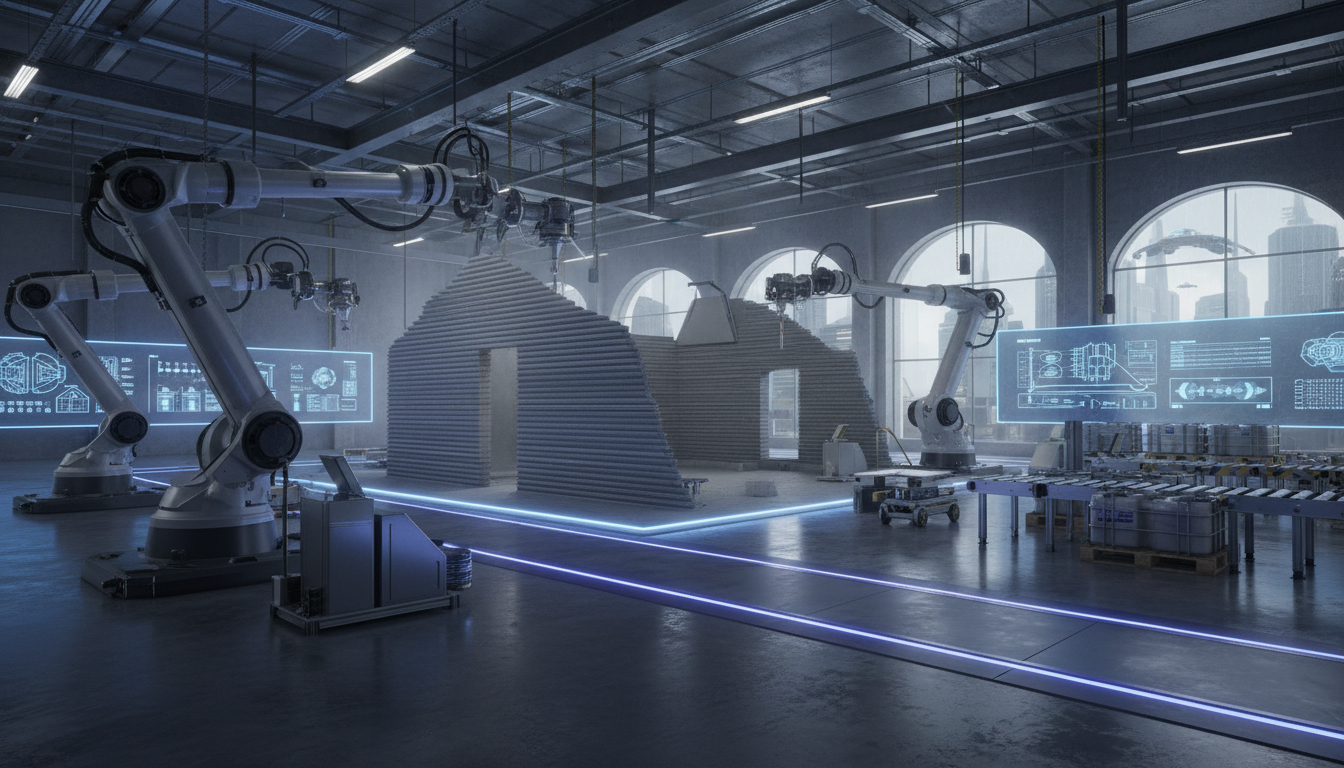
Robotic construction and 3D-printed homes are reshaping residential building in America as construction companies grapple with a labor crisis that costs the industry roughly $11 billion each year. The shortage has pushed project timelines two months longer than normal. Faced with these pressures, major homebuilders and construction startups are betting on automation—from factory-built 3D-printed walls to robotic microfactories—to fill the gap.
A Texas family recently purchased a 3D-printed home for approximately $200,000, a figure roughly a third lower than conventional construction quotes they had received. The deal signals what may be coming: faster builds, lower costs, and a partial solution to one of residential construction’s stickiest problems. Nearly 300,000 construction jobs remained open as of December 2025, according to housing industry forecasts.
The productivity numbers tell a stark story. Since 1993, residential construction productivity has risen just 16 percent. Compare that to the broader economy, which has posted productivity gains exceeding 50 percent over the same span. Construction has stagnated while other sectors leaped forward.
How robotic construction is filling the labor gap
Reframe Systems, a company focused on factory-based home manufacturing, raised $40 million in recent funding to scale robotic microfactories. These facilities will eventually produce up to 250 single-family homes per year each. The company announced a new facility opening in Billerica, Massachusetts on October 5, 2026. Similar ventures are now attracting major capital.
The appeal is straightforward: robots don’t call in sick. They don’t retire. They work in controlled factory environments where quality is easier to ensure and waste easier to manage.
According to reporting on the trend, homebuilders across the country are now seriously evaluating these options. Some are partnering with startups. Others are building their own facilities. The shift is no longer theoretical—it’s happening now, in 2026.
The advantages of 3D-printed homes beyond cost
Cost is the headline benefit. But 3D-printed and prefabricated homes offer other gains that matter to actual residents.
Energy efficiency improves because the printing process creates precise layers with fewer thermal leaks. Durability increases too. These structures hold up better against high winds and fire than conventionally framed homes. Mold and pest resistance also improve due to the material composition and build method.
For homeowners in regions prone to extreme weather, these features matter. For builders, they mean fewer callbacks and warranty claims.
The homes aren’t futuristic oddities, either. They look like ordinary houses from the street. Inside, the layouts and finishes can match what buyers expect from standard new construction. The 3D-printed Texas home is indistinguishable from its conventionally built neighbors in appearance.
Scaling challenges and reality checks
Rolling out robotic construction nationally won’t be seamless. Factory capacity is limited. Supply chains for specialized materials need strengthening. Building codes, which vary by state and municipality, must adapt to new construction methods. Some jurisdictions have already begun approving 3D-printed homes; others remain skeptical or haven’t yet written rules for them.
Labor unions have raised concerns about job displacement. The construction workforce is already aging. Many workers will retire over the next decade anyway, which creates an opening for automated solutions. Still, the transition will affect real workers and communities dependent on construction employment.
Financing also remains an obstacle. Lenders and insurance companies are learning to evaluate 3D-printed homes and prefabricated structures. Appraisals lag behind the technology. Interest rates for buyers purchasing these homes aren’t yet standardized across the industry.
What this means for homebuyers
For consumers, the immediate benefit is affordability. Shorter construction timelines mean faster move-ins. Reduced labor costs translate to lower prices or, in some markets, faster delivery of inventory that’s already in short supply.
Builders benefit from predictable timelines and fewer weather delays. A robotic facility can produce homes on schedule regardless of rain or snow. That reliability helps with project financing and contractor cash flow.
Regional variations will matter. In areas with acute labor shortages and high wages—parts of California, the Northeast, and the Southwest—robotic and 3D-printed solutions will likely scale fastest. In regions where construction labor is more available and affordable, adoption may be slower.
FAQ
How much can 3D-printed homes save compared to conventional construction?
The Texas family paid roughly one-third less for their 3D-printed home than conventional quotes. A $200,000 purchase price compared to quotes around $300,000 or more. Savings vary by region and building complexity.
How long does it take to 3D-print a house?
Factory printing of wall panels typically takes days to weeks depending on home size. On-site assembly and finishing—plumbing, electrical, roofing, interior work—still requires weeks or months. Total time is generally faster than conventional construction, contributing to the two-month average timeline savings the industry pursues.
Are 3D-printed homes as durable as traditionally built homes?
Yes, with some advantages. They resist mold, pests, and high winds better. Fire resistance improves due to material properties. Long-term data is limited since the technology is relatively new, but early results are positive.
Which states are approving 3D-printed homes?
Texas has approved several 3D-printed homes for residential sale. Other states are writing or revising building codes to accommodate the technology. Approval timelines vary; some municipalities act quickly while others move cautiously. Check local building department rules before purchasing.
Will robotic construction eliminate construction jobs?
The industry faces a shortage of nearly 300,000 workers. Automation will fill some gaps without necessarily eliminating jobs—rather, it will reduce hiring pressure and change the types of roles available. Skilled assembly, finishing, and site management work will remain necessary.
