
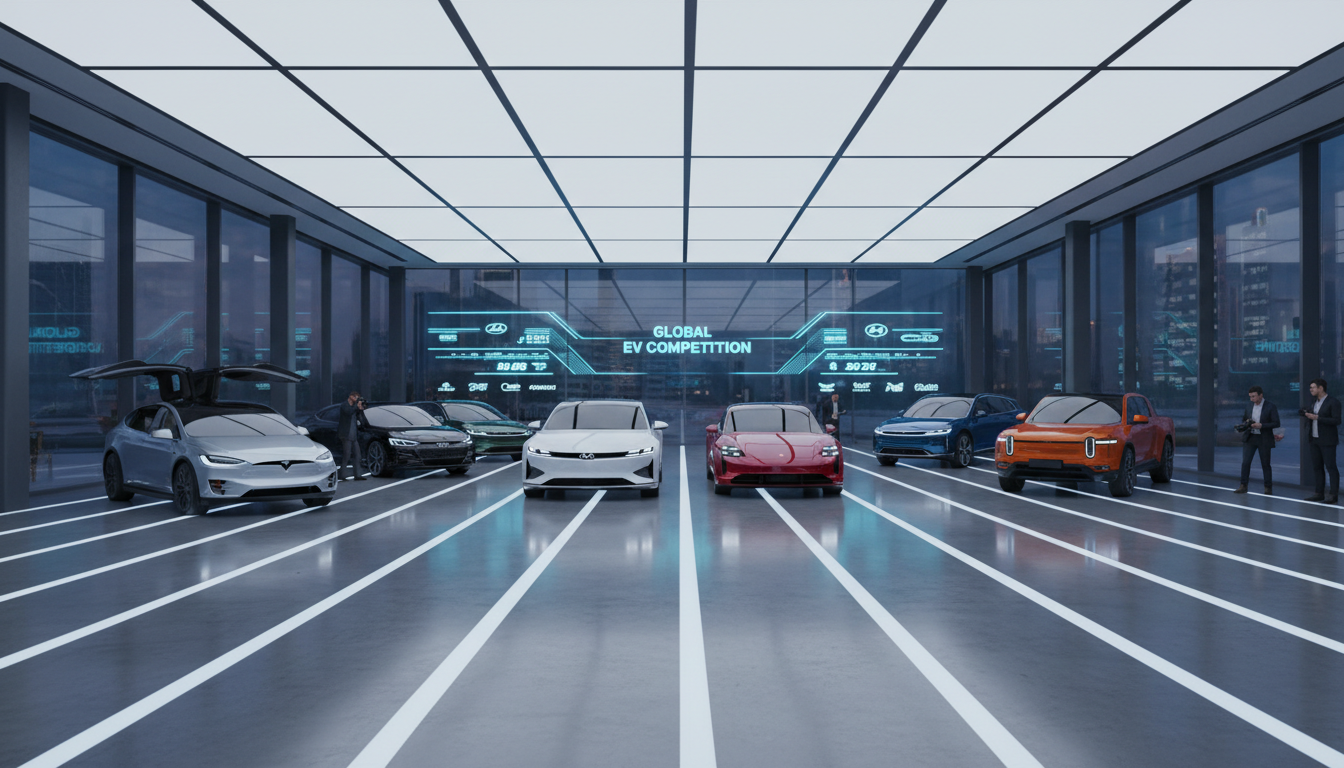
New electric vehicle launches across three continents in the past 72 hours signal a market heating up faster than anyone predicted. Xpeng’s Australian debut. Saudi Arabia’s homegrown CEER brand. Tesla slashing Indian prices. And a reshaped Mahindra Thar hitting Indian showrooms. The competition isn’t just intensifying—it’s fragmenting into distinct regional strategies.
The most aggressive move came from Tesla. The company slashed Rs 9 lakh off its Model Y price in India while adding Grok AI integration to the vehicle’s infotainment system. That’s not a tweak. That’s a clear signal that Tesla sees the Indian market as contested ground now.
But Tesla’s price war is only one thread in a much larger story.
Chinese EV makers test Western markets
Xpeng launched its L03 electric SUV coupe in Australia, starting at AUD $41,900. That’s a direct challenge to both Tesla and BYD in a market where Chinese EVs have been gaining traction.
The L03 sits in the coupe-SUV segment, a category that’s become crowded globally but still relatively niche. Xpeng’s move signals the company is ready to compete on price and styling simultaneously. Australian buyers now have a new option that undercuts equivalent Tesla offerings.
For Indian consumers watching from afar, this matters. Xpeng’s international expansion strategy suggests the brand is consolidating its position before potentially entering India—a market where Chinese EV makers have so far relied on local partnerships or avoided entirely.
Saudi Arabia enters the EV game with CEER
Saudi Arabia’s entry into EV manufacturing carries different weight. The Crown Prince unveiled CEER’s first models: an electric sedan and SUV, with top variants producing up to 1,111 horsepower.
That figure isn’t casual. It’s a statement about performance ambitions. A 1,111 hp electric vehicle puts CEER’s flagship in hypercar territory, signaling the brand won’t compete on affordability alone.
Saudi Arabia’s oil wealth backing an EV manufacturer is a geopolitical signal wrapped in automotive strategy. CEER vehicles aren’t expected to flood Indian roads anytime soon. But the brand’s emergence shows how capital-rich nations are investing in EV infrastructure and domestic manufacturing. It raises questions about where India’s domestic EV champions will position themselves in a market that now includes Chinese, American, European, and Middle Eastern competitors.
India’s traditional automakers adapt
Mahindra’s refresh of the Thar tells a different story. The updated OG three-door SUV launched with a new platform, stronger engines, and enhanced safety features, starting at ₹10.32 lakh.
This isn’t a radical departure. It’s defensive consolidation. Mahindra is keeping the Thar competitive in its segment by strengthening fundamentals rather than reimagining the vehicle. The price point—roughly one-quarter of the Tesla Model Y post-discount—shows Mahindra understands its buyers aren’t shopping in the premium EV space yet.
For Indian consumers, this creates a stark choice. Stick with combustion-engine SUVs from established brands. Or jump into premium electric vehicles from Tesla or, eventually, other global EV makers entering India.
What these launches mean for India
The real story isn’t any single launch. It’s the velocity of entry and the diversity of strategies.
Tesla’s price cut to Rs 68.99 lakh (post-reduction) makes the Model Y more accessible to upper-middle-class Indian buyers. The Grok AI integration is a feature play—differentiating not on raw specs but on user experience. It’s a sophisticated defensive move against new competition.
Xpeng’s Australian launch proves Chinese EV makers are methodical about market entry. They don’t rush. They pick regions where regulatory environments are favorable and brand perception is improving. India remains a harder play for Xpeng than Australia, given existing partnerships and brand familiarity with Tesla and BYD.
CEER’s Saudi launch is purely aspirational for now. But it signals venture capital and state backing for EV manufacturing at scale. When (not if) such brands look at India’s market size, they’ll come knocking.
Mahindra’s Thar refresh is the most cautious approach. The company is profitable in its segment. It’s adding features and technology. But it’s not pivoting to EVs aggressively for this model. That suggests Mahindra sees the traditional SUV market in India as stable enough to defend while building EV capacity elsewhere.
FAQ
Q: Will Xpeng cars come to India?
A: Xpeng hasn’t announced Indian plans, but the brand’s expansion strategy (Australia first, then likely other markets) suggests India is on the roadmap. Entry would likely depend on local partnerships or manufacturing infrastructure.
Q: How much cheaper is Tesla’s Model Y now in India?
A: Tesla reduced prices by Rs 9 lakh. The Model Y now starts at a lower price point, though exact current pricing varies by variant and configuration.
Q: Is CEER’s 1,111 hp sedan coming to India?
A: No confirmed plans exist. CEER is a Saudi domestic brand focused on the Middle Eastern market initially.
Q: Should I wait for new EV models before buying?
A: The EV market in India is accelerating, but options are still limited compared to petrol SUVs. If you need a vehicle now, current options (Tesla, Tata, BYD partnership models) are available. Waiting makes sense only if you’re flexible on timeline.
Q: Is Mahindra launching an electric Thar?
A: Mahindra hasn’t announced an electric Thar variant yet. The updated OG uses petrol engines only.
