
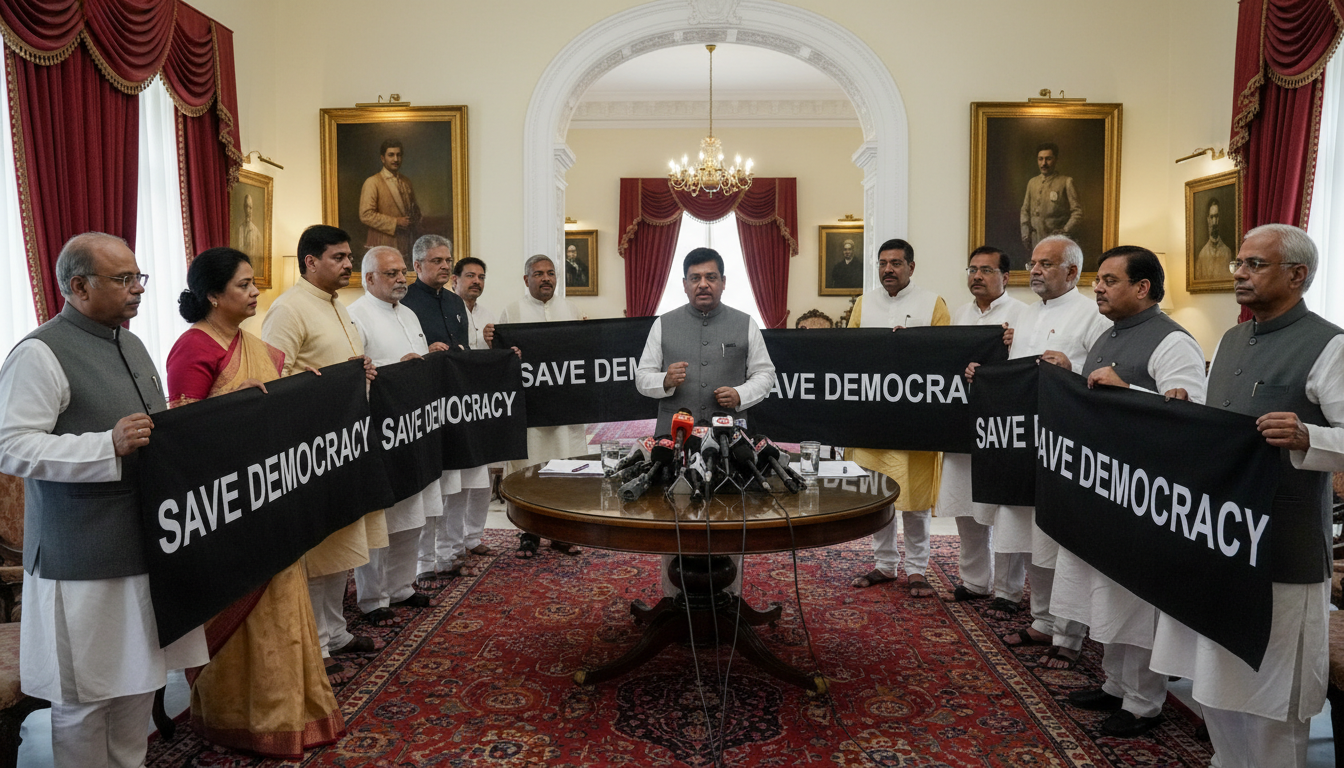
The INDIA bloc staged a public impeachment of Chief Election Commissioner Gyanesh Kumar on October 31, accusing him of orchestrating large-scale election irregularities that undermine democratic credibility.
Congress president Mallikarjun Kharge moved a resolution at the symbolic ceremony, held at his residence in New Delhi, seeking Kumar’s removal on charges of treason and conspiracy to steal elections. The gathering drew senior opposition figures including Rahul Gandhi and other INDIA coalition leaders.
The opposition’s move represents an escalation in tensions between the ruling BJP and the multi-party opposition alliance over the functioning of India’s electoral machinery. It also marks one of the sharpest public challenges to a sitting election commissioner in recent memory.
Six allegations in the public impeachment of CEC
The INDIA bloc levelled six specific charges against Gyanesh Kumar. Chief among them: the alleged deletion of 13.2 crore voters from electoral rolls. The opposition also accused him of manipulating electoral rolls to favour the ruling party.
According to The Hindu’s coverage of the event, the opposition presented documentation they claimed supported their allegations. However, the specifics of the remaining four charges were not fully detailed in public statements.
The deletion of voters has become a flashpoint in Indian electoral politics. Opposition parties have repeatedly raised concerns about large-scale removal of names from voter lists, particularly in states where the BJP performs strongly.
BJP dismisses the public impeachment of CEC
The ruling party struck back swiftly. BJP leaders, including Ravi Shankar Prasad and Sambit Patra, condemned the opposition’s action as a mockery of constitutional institutions.
Prasad and Patra called the symbolic impeachment a “mock Parliament.” They argued the opposition was attacking independent constitutional bodies rather than engaging in legitimate political discourse. The BJP’s position: only Parliament can impeach a constitutional functionary like the election commissioner.
The government has not directly responded to the specific allegations of voter deletion or electoral roll manipulation. Instead, BJP leaders framed the opposition’s move as an assault on institutional independence.
This mirrors broader friction between the ruling coalition and opposition over election administration. The Election Commission has faced criticism from multiple quarters—civil society groups have also raised concerns about electoral processes in recent years.
Constitutional and procedural questions
An actual impeachment of the election commissioner requires a formal motion in either house of Parliament. The motion must be supported by specified numbers of MPs and follow constitutional procedures laid out in Article 61 of the Constitution.
The INDIA bloc’s “public impeachment” carries no legal force. It is a political gesture. Yet such gestures matter in Indian politics—they signal organized opposition pressure and attempt to build public narrative around institutional failures.
Opposition parties have limited tools to challenge the election commissioner directly. The formal impeachment route requires parliamentary numbers they currently lack. A public ceremony, by contrast, generates media attention and keeps allegations in public view.
The last successful impeachment of an Indian constitutional official occurred decades ago. The politics of challenging the election commission directly remains rare and fraught.
Electoral roll deletion: The numbers and context
The claim of 13.2 crore deleted voters is substantial. India’s total voter base exceeds 90 crore. A deletion of this scale would represent roughly 14 percent of the entire electorate, though such figures require careful interpretation—the opposition may be citing cumulative deletions over time rather than a single mass removal.
Electoral rolls do require periodic cleaning. Duplicate entries, deaths, and relocations necessitate removals. Election Commission officials have argued previous deletions fell within normal administrative processes.
Yet civil society observers have flagged irregularities. Some deletions have occurred without adequate public notice. Others have disproportionately affected certain demographics or constituencies.
The opposition’s framing links voter deletion to electoral rigging. They argue systematic removal of voters tilts election outcomes by suppressing anti-incumbency votes. The BJP’s counter is that proper maintenance of rolls ensures election integrity.
The broader political context
This confrontation reflects deeper anxieties about electoral fairness in India. Since 2019, opposition parties have grown increasingly vocal about alleged election commission bias favouring the ruling party.
The INDIA bloc emerged as a formal coalition during the 2024 election cycle. Its public impeachment action suggests the coalition is willing to pursue confrontational strategies on electoral issues.
Such moves carry risks. If opposition overreaches on electoral charges without overwhelming public evidence, it risks alienating uncommitted voters. Conversely, the ruling party’s dismissal of concerns—without substantive response to specific charges—leaves allegations partially unanswered in public discourse.
Election administration remains a flashpoint in Indian democracy. Confidence in electoral processes underpins democratic legitimacy. When major political actors dispute whether elections are fairly conducted, the stakes extend beyond partisan advantage.
FAQ
Q: Can the opposition actually remove the Chief Election Commissioner through this public impeachment?
A: No. A public impeachment is symbolic only. Removing the election commissioner requires a formal impeachment motion in Parliament with constitutional procedures. The INDIA bloc lacks the parliamentary numbers for such a motion. This ceremony is a political statement, not a constitutional act.
Q: How many voters have actually been deleted from electoral rolls?
A: The INDIA bloc alleges 13.2 crore voters were deleted. The Election Commission has not officially confirmed this figure or addressed it directly. Normal electoral roll maintenance does involve deletions due to deaths, relocations, and duplicates. The opposition claims the scale and pattern of deletions suggest systemic manipulation.
Q: What specific powers does the Chief Election Commissioner have over electoral rolls?
A: The CEC oversees the Election Commission of India, which maintains electoral rolls and conducts elections. The commission decides policies on voter registration, conducts verification processes, and adjudicates disputes. However, the CEC does not unilaterally delete voters—state election commissions handle much of the ground-level work.
Q: Has the Election Commission responded to allegations of voter deletion?
A: The Election Commission has not directly addressed the 13.2 crore figure or the opposition’s specific charges. BJP leaders have rejected the allegations as baseless. The election commission typically maintains institutional distance from partisan disputes and has not issued public statements on this controversy.
Q: Why is the INDIA bloc holding this event now?
A: The timing reflects broader opposition strategy ahead of potential state elections and future national polls. Electoral fairness remains a central opposition talking point. The symbolic impeachment keeps allegations of election commission bias in public discourse and signals coalition unity on electoral issues.
