
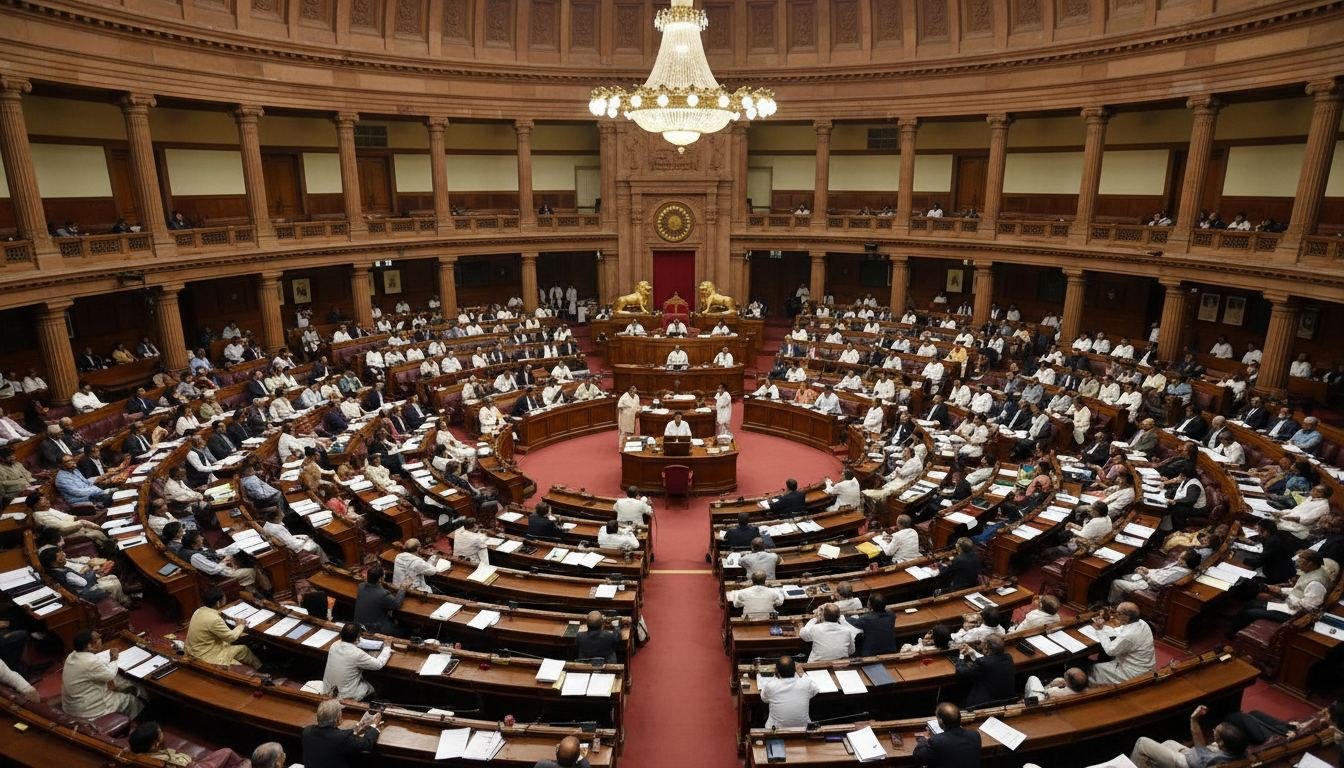
How a Bill Becomes Law in India: Overview
How a bill becomes law in India is a multi-stage process that spans both houses of Parliament and involves scrutiny at several points. The journey begins when a bill is introduced in either the Lok Sabha or Rajya Sabha and ends only when the President of India grants assent. Between these two points, the bill must survive three readings, potential committee review, and agreement between both houses.
The process protects legislation from being rushed through without debate. At each stage, members can propose amendments, raise objections, or vote against the bill. Understanding this journey helps citizens track pending legislation and see why certain bills take months or even years to become law.
Where a Bill Starts: Introduction in Parliament
Every bill must begin its life in one of the two houses. Ministers introduce government bills, while other Members of Parliament table private member’s bills.
The choice of house matters. Most bills start in the Lok Sabha because money bills—those dealing with government revenue or expenditure—must originate there under the Constitution. The Rajya Sabha cannot introduce or amend a money bill; it can only delay it by 14 days.
Once introduced, a bill receives a number and formal title. It is then published for public information. At this early stage, the bill’s supporters brief media and other members on its aims.
The Three Readings: How Parliament Examines a Bill
Every bill goes through three distinct readings in each house. This structure ensures the bill is examined from multiple angles before it becomes law.
First Reading: Introduction and General Debate
The first reading is mainly ceremonial. The bill is introduced, its purpose is explained, and members debate its general principles. No votes are held at this stage.
Members raise concerns about whether the bill is even needed. Opposition parties often oppose on principle here, setting the stage for battles in later readings. The first reading is often a quick affair unless the bill is controversial.
Second Reading: Clause-by-Clause Examination
The second reading is where detailed work happens. The bill is taken clause by clause. Members propose amendments to specific sections, and the house debates each change.
This is the most time-consuming reading. A complex bill might take days or weeks at this stage. Members can challenge the wording, ask for definitions to be clarified, or propose entirely new sections.
After all clauses are debated and amended, the house votes on whether to pass the bill or reject it. A simple majority of members present and voting is needed for ordinary bills. Constitutional amendment bills require a special majority—two-thirds of members present and voting, and more than half of all members of that house.
Third Reading: Final Passage
The third reading is the final vote. By this stage, amendments have already been made in the second reading, so debate is brief. Members vote for or against the bill in its final form.
If the bill passes the third reading, it moves to the other house.
Standing Committees: Expert Review (Optional but Important)
Before or after introduction, a bill may be sent to a Departmentally Related Standing Committee. These committees have members from both parties and study bills in detail, often hearing expert witnesses and holding public consultations.
The committee produces a report with recommendations. Parliament is not legally bound to accept these recommendations, but they carry weight. Many bills are amended based on committee suggestions because the committees include experienced lawmakers from both government and opposition.
Standing committee review is not mandatory for every bill. Bills dealing with budget or those declared urgent by the government can skip this step. But for complex legislation—on labour law, environment, or technology—committees often scrutinize the bill thoroughly, sometimes for weeks.
The Bill Moves to the Other House
Once a bill passes one house, it is sent to the other. The bill then goes through the same process: introduction, three readings, potential committee review, and a final vote.
The second house can pass the bill unchanged, pass it with amendments, or reject it. If the bill is passed with amendments, it returns to the first house for reconsideration.
This back-and-forth can go on for some time. A bill bounces between houses until both agree on identical wording, or until one house gives up.
When the Two Houses Disagree: Joint Sitting
If the Lok Sabha and Rajya Sabha cannot agree on a bill after sending it back and forth, a joint sitting can be called. Both houses meet together, and the bill is voted on once.
The Speaker of the Lok Sabha presides over a joint sitting. A simple majority of members present and voting in the joint sitting is needed to pass the bill. This power gives the Lok Sabha an advantage since it has more members.
Joint sittings are rare. The Constitution allows them only when the two houses persistently disagree on a bill. The government must ordinarily seek consensus between the houses rather than rush to a joint sitting.
Presidential Assent: The Final Hurdle
Once both houses pass a bill in identical form, it goes to the President of India. The President has three options:
- Give assent, making the bill an act (law).
- Withhold assent, effectively killing the bill.
- Return the bill to Parliament for reconsideration (not allowed for money bills).
In practice, the President usually gives assent. Withholding assent is extremely rare and would require grave constitutional concerns.
If the President returns a bill for reconsideration, Parliament debates and votes again. If Parliament passes the bill again—with or without amendments—the President must give assent. The President cannot withhold assent a second time.
Comparing the Two Houses in the Legislative Process
| Aspect | Lok Sabha | Rajya Sabha |
|---|---|---|
| Money bills | Can introduce and pass | Cannot introduce; can delay 14 days only |
| Members | 543 (elected directly) | 245 (mostly elected indirectly) |
| Term | 5 years | 6 years (1/3 retire every 2 years) |
| Ordinary bills | Can originate here or be received from Rajya Sabha | Can originate here or be received from Lok Sabha |
The Lok Sabha has final say on money bills and can override the Rajya Sabha in a joint sitting. The Rajya Sabha’s strength lies in detailed scrutiny and representation of states and minority interests.
Duration: How Long Does the Process Take?
There is no fixed timeline. A simple, non-controversial bill might pass all three readings in a single day. Complex bills take weeks or months.
As we reported earlier, even bills with broad support can face delays if they require special majorities or extensive amendment. Bills that provoke opposition see drawn-out debates at each reading.
Government can prioritize bills by allocating more parliamentary time or declaring them urgent. The monsoon and budget sessions run for several weeks, allowing time for multiple bills to be debated. The winter session is shorter.
Key Takeaways
- A bill must pass three readings in each house of Parliament and then receive Presidential assent to become law.
- Government ministers introduce government bills; other MPs introduce private member’s bills.
- Standing committees may review bills in detail and recommend changes, though Parliament is not bound by their views.
- If the two houses disagree on a bill’s wording, a joint sitting can be held where a simple majority decides.
- The President can give assent, withhold it, or return a bill for reconsideration (except money bills).
- Money bills must originate in the Lok Sabha and cannot be delayed by the Rajya Sabha beyond 14 days.
FAQ
Q: Can the President reject a bill passed by both houses of Parliament?
A: The President can withhold assent, but this is extremely rare. If Parliament passes the bill again after the President returns it for reconsideration, the President must give assent. For money bills, the President cannot return the bill—only assent or withhold it.
Q: What is a money bill, and why is it treated differently?
A: A money bill is one that deals with taxation, government spending, borrowing, or public accounts. Only the Lok Sabha can introduce money bills. The Rajya Sabha can delay a money bill by 14 days but cannot amend or reject it. The Speaker of the Lok Sabha decides whether a bill is a money bill.
Q: How long does a bill typically take to become law?
A: There is no fixed duration. Simple, non-controversial bills may pass in a day or two. Complex bills involving amendments and disagreement between houses can take weeks or months. If a bill requires a special majority (like a constitutional amendment), the process is often longer.
Q: What happens if one house passes a bill but the other rejects it?
A: The bill dies unless both houses agree to convene a joint sitting. In a joint sitting, both houses meet together and vote once on the bill. A simple majority in the joint sitting decides the matter. The Lok Sabha has an advantage in joint sittings because it has more members.
Q: Can a private member introduce a bill on any topic?
A: Private members can introduce bills on most topics, but bills involving taxation or government spending must be introduced by a minister. Additionally, bills that affect the President’s discretionary powers or the functioning of the President’s office face restrictions.
Q: What role do standing committees play in passing a bill?
A: Standing committees scrutinize bills in detail, call expert witnesses, and prepare reports with recommendations. Parliament is not legally bound to accept these recommendations, but they often influence amendments. Standing committee review can take several weeks and is a common step for complex legislation.
Q: What is the difference between a bill being introduced and a bill being passed?
A: Introduction means the bill has been formally tabled in a house and given a number. Passing means the house has voted and approved it, usually after three readings. A bill can be introduced but fail to pass at any of the three readings.
Also read
- PM Modi’s ‘Dimagi Naxals’ Remark Sparks Opposition Firestorm as Congress Accuses Him of Weaponizing Diwali
- Congress Escalates Attack on Election Commission’s SIR Process as 33 Lakh Delhi Voters Face Disqualification
Last updated: 18 November 2026
