
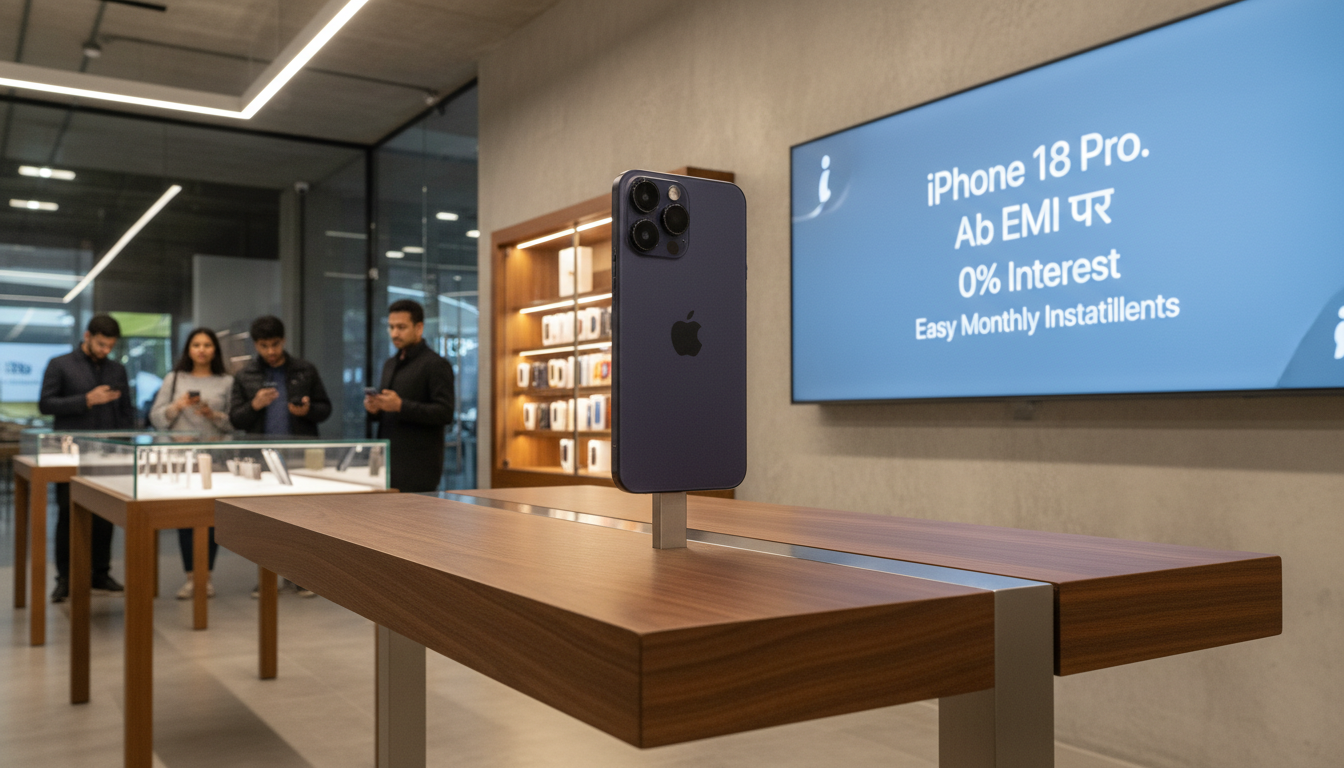
Apple iPhone sales India are on track to shatter the company’s previous record this fiscal year, as strong demand for premium Pro variants and aggressive financing schemes reshape buyer behaviour across the country.
The Cupertino giant is targeting revenues exceeding last year’s $10 billion benchmark. The push comes as Apple aims to break its own sales record in India this fiscal, capitalising on what appears to be a deliberate shift in its product strategy.
The numbers tell the story. Year-on-year demand for the iPhone 18 Pro and Pro Max has climbed as much as 28 percent. That’s not incremental growth. That’s a genuine surge that suggests something has shifted in how Indians are buying iPhones.
The Pro-Only Play
Here’s where the strategy becomes clear: there is no standard iPhone 18 model this year.
That’s the pivot. Apple has compressed its lineup, betting that customers will step up to the Pro range rather than opt for a cheaper base variant. In most markets, that move would risk alienating price-sensitive buyers. In India, the opposite appears to be happening.
The absence of a standard iPhone 18 has effectively funnelled demand toward the Pro and Pro Max models. It’s a deliberate bottleneck, and it’s working.
Apple iPhone sales India: Financing Changes Everything
But a product absence alone doesn’t explain the 28 percent surge. Retail financing is the other half of the equation.
Easy instalments and zero-interest EMI schemes have democratised access to the Pro range. Where a Rs 1.5 lakh device once required a lump sum payment, buyers now can spread the cost across 12 or 24 months with minimal friction.
Indian retailers—both online and offline—have aggressively promoted these schemes. The psychological shift is real. A ₹1,50,000 phone becomes ₹6,250 per month. Suddenly, it doesn’t feel impossible.
This is especially potent in metro markets and Tier 1 cities, where credit availability and smartphone penetration are highest. But the ripple effect is spreading.
Why Now? Why India?
India’s smartphone market has matured rapidly. Average selling prices are climbing. Consumers who bought their first iPhone five years ago are now repeat buyers with higher disposable income or credit access.
The iPhone 18 Pro, with its camera improvements and performance gains, has genuine appeal to that demographic. It’s not a marginal upgrade story. There’s substance to market.
At the same time, Indian consumers remain price-conscious relative to Western markets. The financing schemes work precisely because they acknowledge that reality. Apple isn’t pretending Indians will pay full price upfront. It’s making the Pro experience accessible through payment plans.
The Competitive Context
Samsung and OnePlus have both lost ground in the premium segment over the past two years. OnePlus shifted its focus toward the mid-range. Samsung’s premium line hasn’t captured the same aspirational pull.
Apple, by contrast, has benefited from brand consolidation at the top. The company owns the premium narrative in India now. Owning it, and then making it financially accessible, is a powerful combination.
The Rs 10 billion threshold last fiscal represented a milestone. Crossing it again this year wouldn’t just be a record. It would signal that Apple’s India strategy has crossed from experimental to structural.
Manufacturing Tailwinds
There’s one more factor worth noting: Apple has expanded local manufacturing in India through its suppliers. Higher local production means lower import duties, which translates to lower prices at retail.
That cost advantage feeds into the financing narrative. A cheaper device makes monthly instalments even more palatable.
What the Numbers Mean
A 28 percent year-on-year jump for Pro variants isn’t noise. It reflects genuine demand, not marketing hype or channel stocking.
The scale matters too. If Apple is targeting $10 billion-plus this fiscal, and the Pro models are driving the bulk of that growth, then the company has successfully reoriented India from a volume play to a margin play.
That’s a significant strategic success. India is now a high-value market for Apple, not just a growth market.
FAQ
Q: Why is there no standard iPhone 18 this year?
A: Apple has discontinued the base iPhone 18 model, making the Pro and Pro Max the entry points to the iPhone 18 lineup. This forces buyers choosing between older models and Pro variants, driving demand upward for premium devices.
Q: How much can I save with retail financing for the iPhone 18 Pro?
A: While savings depend on the lender and scheme, most Indian retailers offer zero-interest EMI options for 12 or 24 months. A ₹1,50,000 phone typically breaks down to ₹6,250–₹12,500 monthly depending on tenure. Check with retailers for current schemes.
Q: Is the 28 percent growth only in major cities?
A: The reported surge reflects year-on-year growth across tracked channels, with strongest uptake in metros and Tier 1 cities where credit access and smartphone penetration are highest. Tier 2 and Tier 3 cities are seeing slower but growing adoption, aided by retail financing options.
Q: How does Apple’s India sales record compare to other markets?
A: Apple doesn’t break out regional sales, but analysts note India is now among the top five growth markets globally. A $10 billion+ fiscal represents exceptional performance for the region, driven largely by Pro model demand and financing accessibility.
Q: Will Apple launch a cheaper iPhone 18 variant later this year?
A: There’s no indication Apple plans to introduce a standard iPhone 18 during this fiscal. The Pro-only strategy appears deliberate, intended to maintain pricing power and push buyers toward higher-margin devices.
