
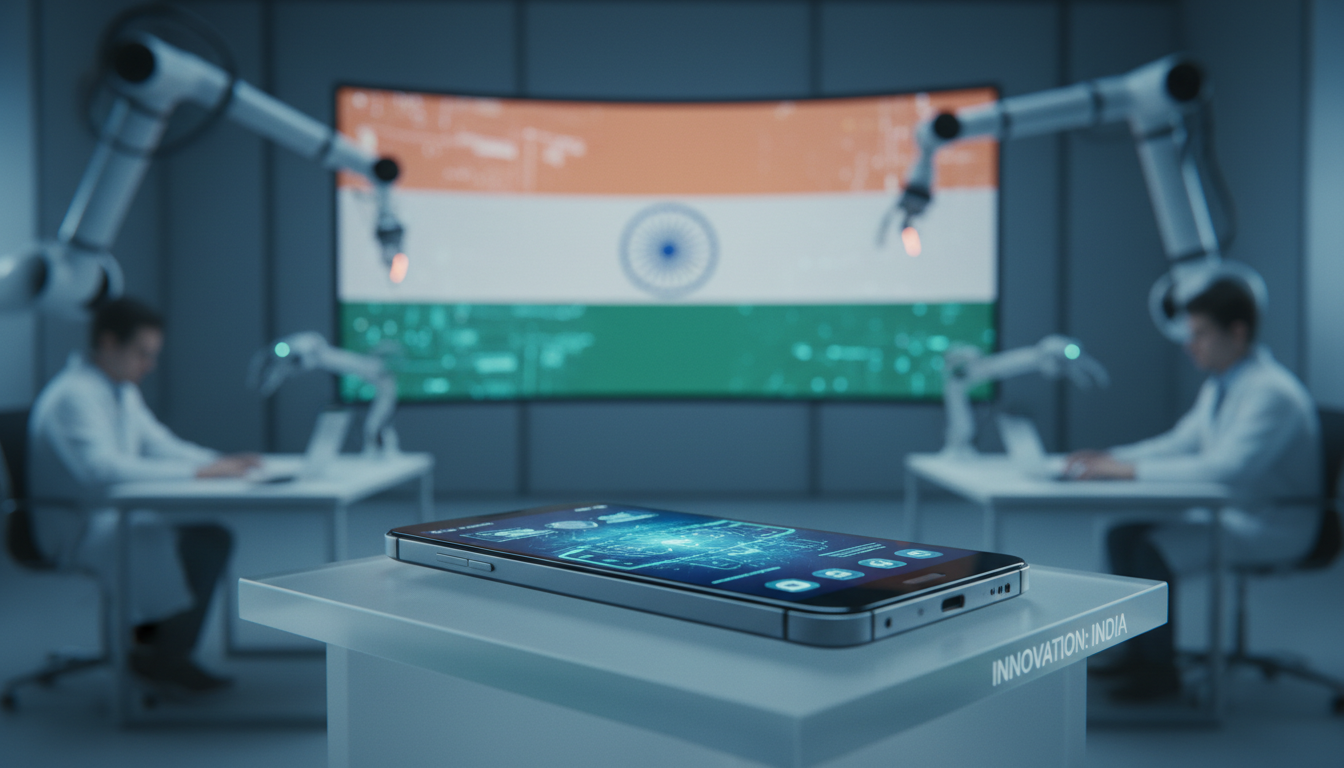
India’s domestically designed smartphone represents a strategic pivot that goes beyond the country’s existing strengths in assembly and contract manufacturing. Union IT Minister Ashwini Vaishnaw has set an ambitious deadline: October 23, 2028, for India to launch its own smartphone brand—one designed, made, and branded entirely within the country.
The announcement marks a departure from India’s current role as a manufacturing hub for global phone brands. Instead of merely assembling devices designed elsewhere, the government is now pushing for proprietary intellectual property and end-to-end control of the product, from silicon to software.
From Contract Manufacturing to Homegrown IP
India has been the world’s largest smartphone manufacturer by volume for several years, but most production happens under contract. Foxconn, Pegatron, and other Taiwanese firms design and own the intellectual property. Indian companies like Micromax and Lava have attempted branded smartphones before, but lacked the scale and deep R&D backing needed to compete.
The 2028 target signals a structural change. The government is not waiting passively for private industry to move first.
According to reporting on the minister’s announcement, Vaishnaw framed the deadline as part of India’s broader push toward technological sovereignty. The focus is on moving up the value chain—where the real profit and innovation happen.
Domestic Motherboard Design Already Underway
India is not starting from zero. The country has already developed capabilities in core smartphone component design. Most notably, domestic teams have designed smartphone motherboards. A 5G-plus mobile phone already designed and delivered to a US operator demonstrates that Indian engineers can create competitive, cutting-edge hardware.
This is significant because the motherboard—or system-on-chip—is where much of the innovation lives. Designing one requires deep expertise in processor architecture, power management, and signal processing. That India has cleared this hurdle suggests the 2028 target is not merely aspirational.
Private sector participation will be critical. But the government is creating conditions through schemes like the Mobile Phone Manufacturing Scheme (MPMS). These incentivize companies to invest in local design and R&D rather than relying on imported designs.
The Road to October 2028
Roughly three and a half years remain until the target date. That is a tight window for a company to build design teams, set up R&D labs, develop and test a smartphone, and scale production. But it is not impossible.
Several factors work in India’s favour. The country has a large pool of electronics engineers and software developers. Manufacturing capacity already exists. The government has shown it will support domestic technology initiatives with policy backing and subsidies. And global smartphone innovation has largely plateaued—a new entrant does not need revolutionary technology, just competitive performance at the right price point.
The challenge lies elsewhere: brand building, supply chain integration, and capital investment. A company aiming for the October 2028 deadline would need to announce plans and begin hiring within the next few months to stay on schedule.
Why This Matters for Indian Consumers and Industry
A domestically designed Indian smartphone brand would have ripple effects across multiple sectors. It would create high-skilled jobs in electronics design and R&D, sectors where India currently lags. It would reduce import bills and keep technology-related profits within the country. And it would establish India as not just a manufacturing destination but an innovation hub.
For consumers, it could mean more affordable flagship devices. An Indian company designing for the Indian market understands local needs—better battery life for power cuts, robust thermal design for heat, or features tailored to Indian software preferences.
The initiative also sends a message to the rest of the world. India is no longer content to remain a contract manufacturer. The country wants to own its technology future.
Government Support and Industrial Policy
The Mobile Phone Manufacturing Scheme has already attracted major investments from Samsung, Apple, and others into assembly capacity. The new focus on design IP represents the next phase of industrial policy.
Reports on India’s broader tech ambitions note that design and homegrown innovation form part of a wider shift in government strategy. This is not an isolated smartphone push. It is part of India’s effort to build AI capabilities, develop semiconductor design, and reduce reliance on foreign technology.
Subsidies for R&D, tax breaks for design centres, and preferential procurement policies are all on the table. The government understands that design IP requires sustained investment and cannot be built overnight.
The Realistic Challenge
Not everyone is optimistic. India’s attempts at creating global smartphone brands have largely failed in the past decade. Micromax, Yu, and others gained brief traction but could not sustain it against Samsung, Xiaomi, and Apple.
The difference this time is government backing and a clear 2028 deadline. Deadlines create urgency. They focus effort. But they can also lead to rushed products if the fundamentals are not sound.
A smartphone that hits the October 2028 date but is poorly designed or unreliable would damage India’s credibility far more than missing the deadline by six months.
FAQ
Q: What exactly does “domestically designed” mean?
A: It means the hardware design—especially the motherboard and system architecture—is done in India. The software stack and intellectual property also remain with an Indian company or entity. Assembly and manufacturing also happen domestically.
Q: Will the phone be affordable?
A: The government has not specified pricing. But the motivation is often cost-competitiveness. An Indian company making a phone for Indian consumers could potentially undercut international brands by reducing import duties and working with local supply chains.
Q: Can India really design a competitive smartphone by 2028?
A: India has already designed and delivered a 5G-plus motherboard to a US operator. The technical capability exists. The challenge is scaling production, building brand trust, and securing supply chains—not just design capability.
Q: Which companies might attempt this?
A: No company has been named yet. Candidates could include existing manufacturers with government backing, startups funded by venture capital or the government, or an Indian arm of a foreign company tasked with local design.
Q: What happens if the deadline is missed?
A: The government has not outlined penalties. The deadline is likely a target to focus industry effort. Missing it by a few months would not invalidate the initiative, though it would dim political claims about the achievement.
