
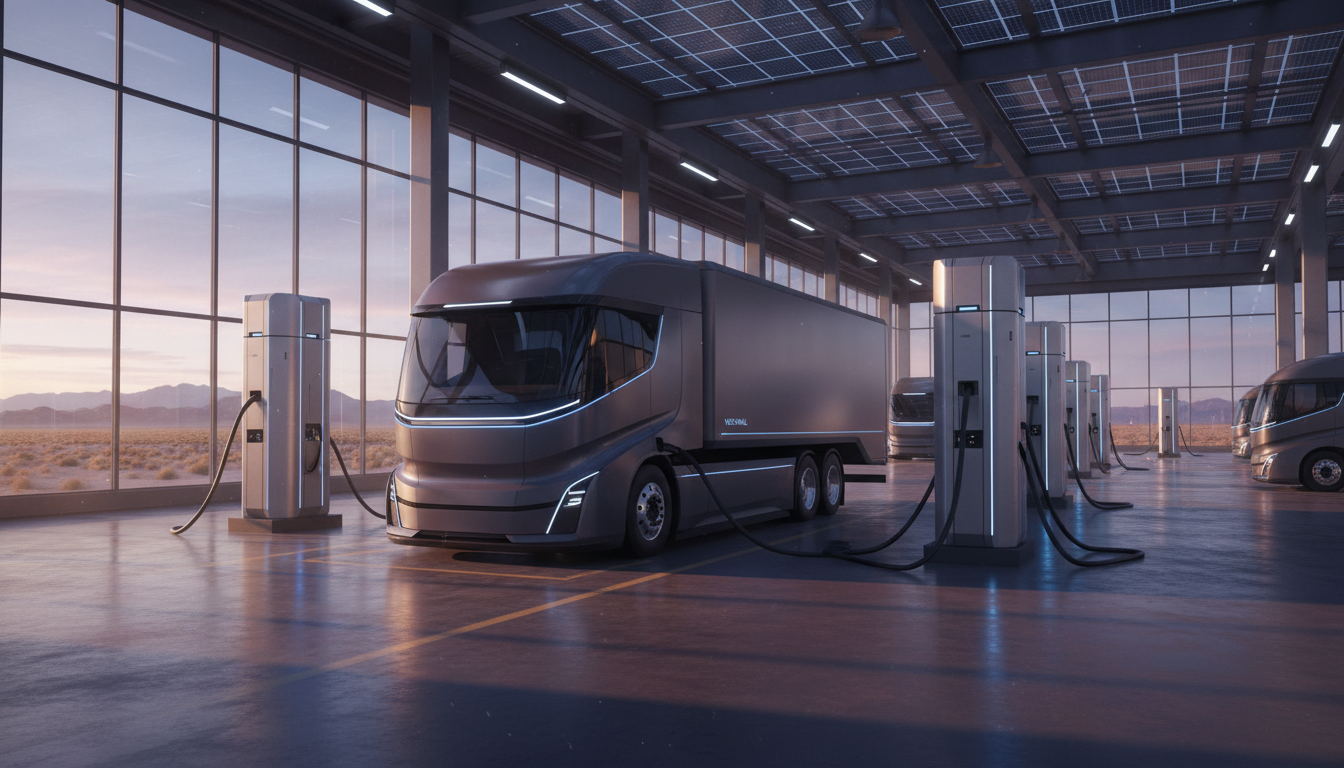
Tesla Semi production has officially begun, with the electric truck maker delivering its first units to major logistics and consumer goods companies including PepsiCo, DHL, and ABF Freight. The milestone comes nine years after Tesla introduced the Semi concept in 2017—a gap that underscores the complexity of bringing an entirely new class of commercial vehicle to market.
On 25 September 2026, Tesla held a delivery event announcing that volume production had commenced at its dedicated Semi factory in Sparks, Nevada. The facility is designed to produce 50,000 trucks annually, or roughly 1,000 per week. For a sector accustomed to long development cycles, the ramp represents a genuine inflection point: electric heavy-duty trucks are moving from vaporware to customer fleets.
What Tesla Semi Production Means for Freight
The Semi addresses a critical gap in the electrification story. While passenger cars have dominated media coverage of EV adoption, heavy-duty trucking—which accounts for a disproportionate share of transport emissions globally—has lagged behind. India’s own freight sector, heavily dependent on diesel trucks, faces mounting pressure to decarbonise, making international developments in electric heavy vehicles particularly relevant.
Tesla’s production model uses the company’s in-house 4680 battery cells, a design choice that gives the automaker tighter control over supply chains and cost structure. The production versions come in two variants: a Standard Range model offering 325 miles (523 kilometres) of range, and a Long Range version rated for 500 miles (805 kilometres). The Long Range variant is priced at an estimated $290,000 USD, positioning the Semi above the cost of equivalent diesel trucks but within the ballpark of total cost of ownership calculations when fuel savings are factored in over the vehicle’s lifetime.
Tesla Semi Production Reaches Major Customers
The delivery event revealed that Tesla has secured orders from a roster of heavy hitters: PepsiCo, US Foods, DHL, WattEV, ABF Freight, Einride, IMC, and OK Produce. Einride alone placed a 500-truck order. More significantly, a coalition of the world’s largest cargo-owning shippers selected 2,500 zero-emission freight trucks for deployment in California—an ambitious commitment that suggests fleet operators are willing to take regulatory and commercial risk on the new platform.
The California order is particularly telling. The state has become a de facto testing ground for EV regulation in the US, and shippers operating there face mounting pressure to reduce emissions. By committing to 2,500 Semis, they’re effectively signalling that the economics and performance profile of electric trucking have matured enough for enterprise-scale deployment.
Megacharger Infrastructure and the Charging Question
One of the stickiest problems with electric trucks has always been charging time. A diesel truck can refuel in minutes. If an electric truck required hours at a plug, the business case collapses immediately.
Tesla has built out Megacharger infrastructure to address this. The company’s charging posts are capable of delivering 1.2 megawatts per stall—extraordinary power delivery designed to minimise downtime. By year-end 2026, Tesla had installed over 30 charging stations with a total capacity exceeding 200 megawatts. The scale here matters: it’s the difference between a handful of early adopter trucks scattered across a region and an actual logistics network capable of supporting hundreds or thousands of vehicles.
Charging times and real-world efficiency remain the ultimate test. Fleet operators will tolerate the higher upfront cost of a Semi only if it can complete day-to-day routes reliably and with minimal delays at charging stops. The Megacharger rollout suggests Tesla believes it can deliver that promise, but verification will come only as units spend months and years in commercial service.
Why This Took So Long
The gap between the 2017 concept reveal and 2026 production isn’t unusual for a new vehicle platform, but it reflects real constraints. Developing a heavy truck is vastly more complex than an SUV. The Semi must meet stringent safety and regulatory requirements across multiple jurisdictions. Battery cells capable of delivering the range and power needed while fitting within weight and space constraints didn’t exist until recently. Supply chains for components like electric motors scaled to truck duty had to be built from scratch.
Tesla’s decision to invest in a dedicated Semi factory rather than leveraging existing gigafactory capacity also delayed matters. The Sparks facility was purpose-built for the Semi’s specific production requirements and represents another significant capital commitment. For a company that has spent years managing cash flow carefully, such bets carry real risk.
Market Timing and Competition
The Semi’s arrival into production coincides with growing urgency around truck electrification globally. European manufacturers like Volvo and Scania have been shipping electric trucks for several years, though primarily in shorter-haul applications. Chinese makers including BYD have likewise moved into the space. The Tesla Semi, with its long-range variants and proprietary charging infrastructure, enters a market that is no longer nascent but not yet crowded.
For logistics companies, the calculus is shifting. Fuel costs remain the largest variable operating expense for trucking fleets. Even with today’s electricity prices, electric trucks offer meaningful savings. Regulatory incentives in various markets sweeten the proposition further.
FAQ
How long does a Tesla Semi take to charge?
Tesla has not released exact charging times for the Semi. The 1.2-megawatt Megacharger infrastructure is designed to minimise downtime, but precise figures depend on battery state of charge and ambient conditions. Real-world data will emerge as the trucks enter service.
What is the range of the Tesla Semi?
The Standard Range model offers 325 miles of range per charge. The Long Range version is rated for 500 miles, sufficient for most long-haul trucking operations in developed markets without a mid-route charge.
How much does a Tesla Semi cost?
The Long Range variant is estimated at $290,000 USD. The Standard Range model’s price has not been officially stated, though it is expected to be lower.
Which companies have ordered the Tesla Semi?
Major customers include PepsiCo, DHL, US Foods, ABF Freight, Einride (500-truck order), WattEV, IMC, and OK Produce. A coalition of major shippers also committed to 2,500 units for California deployment.
What production capacity does the Sparks factory have?
Tesla’s dedicated Semi factory in Nevada is designed for 50,000 trucks per year, or approximately 1,000 per week.
