
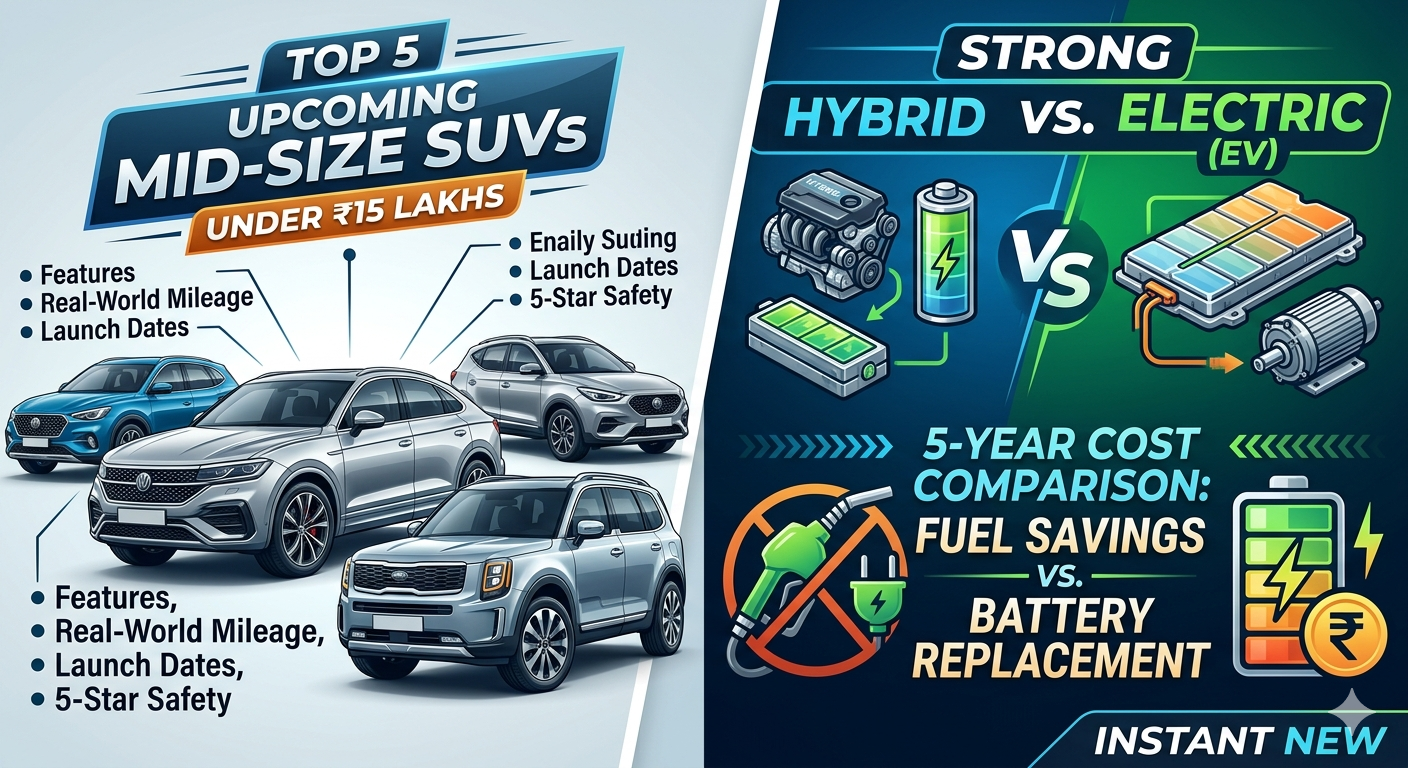
The Indian automotive landscape is experiencing a massive shift as consumer preferences firmly anchor in the mid-size SUV segment. Buyers are no longer satisfied with just basic transportation; they demand a commanding road presence, premium cabin features, high fuel efficiency, and uncompromised safety ratings, all wrapped up in an affordable pricing structure. Navigating this hyper-competitive market requires looking closely at upcoming vehicles that manage to balance luxury with financial practicality. Five highly anticipated mid-size SUVs are preparing to disrupt the market under the fifteen lakh rupee mark.
1. The Next Generation Hyundai Creta Facelift Turbo and CNG Variants
Hyundai has long held a dominant position in this segment, and the upcoming updates aim to solidify that status by directly addressing fuel economy and performance. The new iterations introduce refined powertrain options, including a highly anticipated factory-fitted dual-cylinder CNG kit paired with their entry-level engines, alongside a punchy one point five liter turbo petrol motor for performance enthusiasts.
- Premium Features: The cabin boasts a dual-screen integrated infotainment and digital cluster setup, a panoramic sunroof, ventilated front seats, and a comprehensive level two Advanced Driver Assistance Systems suite.
- Real-World Mileage Expectations: The turbo petrol variants are expected to deliver around twelve to fourteen kilometers per liter in dense city traffic and up to eighteen kilometers per liter on open highways. The dual-cylinder CNG variants will revolutionize running costs, targeting a real-world efficiency of twenty-two kilometers per kilogram without sacrificing boot space.
- Safety Ratings: Built on a reinforced global structural platform, Hyundai aims for a full five-star adult and child safety rating in the Bharat NCAP crash tests, equipped with six airbags as standard.
- Expected Launch Date: Scheduled for an official rollout in late autumn, making it a prime contender for festive season buyers.
2. Tata Curvv Internal Combustion Engine Versions
Tata Motors is set to challenge traditional body styles by introducing the Curvv, a striking coupe-styled SUV that brings high-end luxury aesthetics to the mass market. By blending the high ground clearance of an SUV with the sloping roofline of a sports coupe, this vehicle targets a younger, design-conscious demographic.
- Premium Features: It features a minimalist dashboard design, a massive twelve-point-three-inch touchscreen by Harman, a touch-enabled climate control panel, sequential LED indicators, and a powered tailgate.
- Real-World Mileage Expectations: Powered by a new one point two liter direct-injection turbo petrol engine and a refined one point five liter diesel engine, fuel economy is highly competitive. The petrol version expects to yield thirteen kilometers per liter in the city, while the highway-friendly diesel variant will easily clear twenty-one kilometers per liter.
- Safety Ratings: Following Tata’s established trajectory, the Curvv is engineered to comfortably secure a definitive five-star Bharat NCAP rating, utilizing high-strength steel and electronic stability control across all trim levels.
- Expected Launch Date: Dealership dispatches are projected to begin around mid-August.
3. Mahindra XUV500 Reborn
Mahindra is reviving the iconic XUV500 moniker to plug the crucial gap between the compact XUV300 and the larger XUV700. This mid-size contender is designed to offer a rugged, authentic SUV experience with sophisticated mechanicals.
- Premium Features: Anticipate a twin-spoke steering wheel, a premium skyroof, dual-zone automatic climate control, and flush-fitting door handles that give it a clean, modern aesthetic.
- Real-World Mileage Expectations: Utilizing detuned versions of the mStallion petrol and mHawk diesel engines, the focus is tuned heavily toward mid-range torque and efficiency. Expect eleven to thirteen kilometers per liter from the petrol version and a robust fifteen to sixteen kilometers per liter from the diesel engine under mixed driving conditions.
- Safety Ratings: Mahindra continues to prioritize structural integrity, designing the vehicle around a rigid ladder-frame-inspired monocoque chassis meant to easily clear five-star safety testing benchmarks.
- Expected Launch Date: Industry insiders point toward a major commercial launch in October.
4. Skoda Compact SUV and Kushaq Refresh
Skoda is aggressively expanding its footprint by bringing European driving dynamics to a more accessible price point through localized manufacturing. The upcoming refresh and its compact sibling focus heavily on structural rigidity and driver engagement.
- Premium Features: High-quality interior plastics, a crisp play infotainment system with wireless smartphone integration, an electric sunroof, and the signature सिंपली क्लेवर smart storage solutions throughout the cabin.
- Real-World Mileage Expectations: The acclaimed one point zero liter TSI three-cylinder engine returns with software updates to optimize thermal efficiency. This results in an impressive fourteen kilometers per liter in urban environments and up to nineteen kilometers per liter during highway cruising.
- Safety Ratings: Skoda maintains a zero-compromise approach to safety, confidently retaining its perfect five-star Global NCAP pedigree with active rollover mitigation and electronic differential locks.
- Expected Launch Date: Expected to hit showroom floors by November.
5. Toyota Urban Cruiser Taisor Hybrid Extension
Toyota is capitalizing on its acclaimed hybrid technology by introducing its signature self-charging strong hybrid powertrain into a more compact, affordable mid-size framework.
- Premium Features: Head-up display, a 360-degree parking camera, wireless charging pad, elegant dual-tone cabin themes, and connected car tech with smartwatch compatibility.
- Real-World Mileage Expectations: This vehicle stands as the undisputed mileage champion of the list. The strong hybrid system allows the vehicle to run on pure electric mode during city stop-and-go commuting, yielding an unprecedented real-world city mileage of twenty-four to twenty-six kilometers per liter.
- Safety Ratings: Built on a heavily rigidized platform with six airbags, vehicle stability control, and hill hold assist, it aims for a strong four to five-star rating structure.
- Expected Launch Date: Anticipated to be available for booking by September.
Hybrid vs. Electric: Which Fuel-Efficient Car Should You Buy?
As conventional fuel prices remain volatile, car buyers are standing at a critical crossroads: do they opt for the transitionary convenience of a Strong Hybrid vehicle, or do they leap directly into the future with a Battery Electric Vehicle? Making the correct choice requires looking past initial showroom marketing and analyzing the mathematical reality of long-term ownership over a typical five-year lifecycle.
Understanding the Technological Divide
A strong hybrid vehicle utilizes a conventional internal combustion engine paired with a small electric battery and an electric motor. The system charges itself automatically through regenerative braking and engine power, requiring no external plug-in infrastructure. It seamlessly switches between fuel and electricity to maximize efficiency.
Conversely, a battery electric vehicle completely eliminates the internal combustion engine, relying solely on a massive lithium-ion battery pack and electric motors. It requires external charging from a home wall-box or public fast-charging stations.
Initial Acquisition Costs and Subsidies
The financial equation begins at the dealership. Electric vehicles generally attract a lower Goods and Services Tax rate of five percent in India, alongside various state-level road tax exemptions. Strong hybrids, however, are treated similarly to luxury petrol vehicles, facing a steep tax structure of up to forty-three percent. Despite this tax disparity, the massive cost of raw lithium-ion materials means that an electric vehicle still commands a premium upfront cost that is often fifteen to twenty-five percent higher than a comparable strong hybrid vehicle.
The Five-Year Fuel and Energy Calculator
To understand the real-world financial implications, let us calculate the operating expenses of an average individual driving fifteen thousand kilometers per year, totaling seventy-five thousand kilometers over five years.
For a strong hybrid vehicle averaging a real-world efficiency of twenty-two kilometers per liter, the owner will consume approximately three thousand four hundred nine liters of petrol. Assuming an average petrol price of one hundred rupees per liter, the total five-year fuel expenditure amounts to approximately three lakh forty thousand nine hundred rupees.
For a battery electric vehicle averaging an efficiency of seven kilometers per kilowatt-hour, the owner will consume approximately ten thousand seven hundred fourteen units of electricity. Assuming an average domestic electricity tariff of eight rupees per unit, the total five-year charging cost amounts to just eighty-five thousand seven hundred twelve rupees. This represents a staggering direct operational savings of over two point five lakh rupees in favor of the electric vehicle.
The Reality of Maintenance and the Battery Replacement Shadow
Maintenance schedules vary dramatically between these two propulsion systems. A strong hybrid retains all the moving complexities of a traditional vehicle, meaning it still requires routine engine oil changes, spark plug replacements, air filter updates, and transmission fluid service. Over five years, traditional maintenance costs will average around fifty thousand to seventy thousand rupees.
An electric vehicle features a fraction of the moving parts, completely eliminating oil changes, pistons, and exhaust systems. Maintenance is largely limited to brake pad changes, cabin air filter replacements, and coolant top-ups, keeping five-year servicing costs under twenty-five thousand rupees.
However, a major financial factor looms in the distance: battery replacement. Most manufacturers offer an eight-year or one lakh sixty thousand kilometer warranty on electric vehicle batteries, meaning the initial five-year window is financially protected. However, if the vehicle is driven aggressively or subjected to constant fast-charging, the health of the battery pack will degrade. Out-of-warranty battery replacement for a mid-size electric vehicle currently costs anywhere from three lakh to six lakh rupees. A strong hybrid uses a much smaller battery pack that rarely fails, and even if it does require replacement, the financial impact is limited to around sixty thousand to eighty thousand rupees.
Infrastructure and Resale Value Considerations
The ultimate decision often rests on a buyer’s specific living situation. Electric vehicles require a dedicated parking spot with a reliable charging setup. For individuals who frequently undertake long-distance interstate journeys, range anxiety remains a genuine concern due to inconsistent public fast-charging networks along major highways. A strong hybrid offers total peace of mind, functioning normally on any highway network via standard petrol pumps while maintaining extreme efficiency.
Furthermore, the resale market currently favors hybrids. Because hybrid technology relies heavily on traditional mechanical systems, used car buyers feel more confident purchasing a five-year-old hybrid than a five-year-old electric vehicle, where the remaining lifespan of the expensive battery pack is difficult to verify.
The Final Verdict
If your daily commute consists primarily of city driving, you have a dedicated home charging setup, and you intend to keep the vehicle well beyond the five-year mark to fully amortize the initial premium, the battery electric vehicle wins on pure running cost efficiency. However, if you are a one-car family that frequently drives long distances, lacks reliable charging access at home, and prioritizes a higher resale value with minimal long-term technological risks, the strong hybrid stands as the most practical, stress-free investment for the modern era.
Frequently Asked Questions: Mid-Size SUVs and Hybrid vs. Electric Vehicle Mobility
Part 1: Mid-Size SUVs Under 15 Lakhs
Q1: What defines a mid size SUV in the current Indian automotive market context?
A mid size SUV generally refers to a vehicle measuring between four point two and four point four meters in total length. These vehicles provide a higher seating position, substantial ground clearance usually exceeding one hundred ninety millimeters, and enhanced cabin space compared to sub four meter compact SUVs. They are engineered to offer a balance between urban maneuverability and comfortable long distance highway cruising capabilities for five passengers.
Q2: Why is the fifteen lakh budget considered a critical sweet spot for car buyers?
The fifteen lakh budget represents a transitional price point where buyers can choose between the top tier, fully loaded variants of sub compact SUVs or the entry to mid level variants of larger, more prestigious mid size SUVs. This financial bracket allows consumers to prioritize either maximum features and advanced tech in a smaller footprint or better road presence, superior cabin width, and enhanced mechanical refinement in a larger vehicle class.
Q3: How do real world mileage figures typically deviate from official ARAI testing claims in this segment?
The Automotive Research Association of India tests vehicles under controlled laboratory environments with optimal temperature, zero wind resistance, and a standardized driving cycle. Real world driving conditions involve heavy traffic, frequent idling, varying fuel quality, and constant air conditioning usage. Consequently, a vehicle with an official petrol rating of eighteen kilometers per liter will often deliver twelve to fourteen kilometers per liter in actual daily city commuting.
Q4: What are the main benefits of the dual cylinder CNG technology being introduced in modern SUVs?
Traditional factory fitted CNG kits utilize a single large cylinder placed horizontally across the trunk, which effectively consumes the entire available luggage capacity. The dual cylinder layout replaces the single tank with two smaller, transversely mounted cylinders positioned beneath the luggage floor board. This clever packaging optimization allows the vehicle to retain a highly usable boot area while offering the exceptionally low running costs associated with compressed natural gas.
Q5: What features are typically included in a Level 2 Advanced Driver Assistance Systems package for affordable SUVs?
A Level 2 Advanced Driver Assistance Systems suite utilizes a combination of forward facing cameras and radar sensors to actively assist the driver. Key functionalities include autonomous emergency braking, forward collision warning, lane keep assist, lane departure warning, adaptive cruise control, and high beam assist. These features actively intervene by applying braking force or steering corrections to prevent accidents rather than just offering passive alerts.
Q6: How does the new Bharat NCAP testing protocol affect safety standards for budget mid size SUVs?
The Bharat New Car Assessment Program provides a localized crash testing framework aligned with global standards. It subjects vehicles to frontal offset impacts, side impacts, and pole side impacts while evaluating adult and child occupant protection. The system awards star ratings from one to five. This localized testing forces manufacturers to reinforce structural bulkheads, utilize high tensile steel, and offer electronic stability control and multiple airbags as standard across all trim levels to remain competitive.
Q7: What makes a coupe styled SUV layout structurally different from a traditional upright SUV?
A traditional SUV features a boxy, vertical rear tailgate design that maximizes headroom for rear passengers and increases vertical stacking space in the cargo hold. A coupe styled SUV introduces a sweeping, aerodynamic roofline that slopes down sharply from the B pillar toward the trailing edge of the trunk. While this drastically enhances visual aesthetics and reduces aerodynamic drag, it slightly compromises absolute rear headroom and vertical cargo loading volume.
Q8: Why are direct injection turbo petrol engines becoming more common than naturally aspirated variants?
Naturally aspirated engines rely entirely on the downward stroke of the pistons to draw air into the combustion chambers, limiting peak power output relative to engine displacement. Direct injection turbo petrol engines utilize an exhaust driven turbine to force compressed air into the cylinders alongside precisely pressurized fuel. This enables a smaller displacement engine to produce substantially higher torque at much lower engine revolutions, delivering brisk acceleration and optimized fuel efficiency simultaneously.
Q9: What are the specific advantages of choosing a diesel powered mid size SUV over a petrol variant?
Diesel engines operate on a higher compression ratio and inherent fuel density, which translates directly into superior low end torque production. This makes a diesel variant exceptionally well suited for frequent hill driving, carrying heavy passenger loads, and effortless high speed highway cruising. Furthermore, diesel engines retain excellent thermal efficiency under load, delivering consistently superior highway mileage that drops far less than petrol engines when driven aggressively.
Q10: How do localized car platforms help European brands price their vehicles under fifteen lakhs?
Historically, importing completely knocked down kits or utilizing global platforms resulted in high manufacturing costs due to expensive specialized materials and import duties. Localized platforms utilize locally sourced high strength steel, regional component suppliers, and regional engineering resources. This strategic industrial shift allows brands to maintain European ride dynamics, structural safety, and handling characteristics while eliminating premium pricing barriers.
Q11: What is a self charging strong hybrid powertrain and how does it function inside an SUV?
A self charging strong hybrid system features a internal combustion petrol engine coupled with a high output electric motor and a secondary lithium ion battery pack. Unlike a plug in hybrid, it cannot be charged from an external electrical grid outlet. Instead, the vehicle automatically recaptures kinetic energy during decelerating and braking through a process known as regenerative braking. It stores this power in the battery, allowing the vehicle to drive on pure electricity during low speed urban commuting.
Q12: Why do top spec sub compact SUVs sometimes represent a smarter purchase than base model mid size SUVs?
A base variant of a mid size SUV provides a larger body shell and greater road presence, but often sacrifices critical comfort and safety features, offering basic halogen headlights, steel wheels, and minimal infotainment connectivity. A top spec sub compact SUV within the same budget provides advanced safety equipment like six airbags, a 360 degree camera, ventilated seating, premium audio systems, and superior engine options, creating a more luxurious daily ownership experience.
Part 2: Hybrid vs. Electric Vehicles Ownership Analysis
Q13: What is the mechanical difference between a mild hybrid and a strong hybrid vehicle?
A mild hybrid vehicle features a small integrated starter generator connected to a compact battery that merely assists the engine with a slight electrical power boost during initial acceleration and handles auto stop start functions to conserve minor amounts of fuel. The vehicle can never drive solely on electrical energy. A strong hybrid incorporates a significantly larger high voltage battery pack and an electric motor capable of independently propelling the vehicle on pure electricity over short distances at lower urban speeds.
Q14: Why do electric vehicles enjoy lower taxation rates compared to strong hybrid vehicles?
Government regulatory policies categorize battery electric vehicles as zero emission transport options at the tailpipe, incentivizing their adoption with a flat five percent Goods and Services Tax rate and extensive state level registration waivers. Strong hybrid vehicles, despite delivering exceptional fuel economy, still rely on fossil fuels and utilize an internal combustion engine, leading policymakers to tax them at standard internal combustion vehicle rates which can reach up to forty three percent including luxury cesses.
Q15: How do public EV charging networks vary across different geographic regions?
The development of public electric vehicle charging infrastructure is highly correlated with regional economic industrialization and EV sales density. Western and southern urban regions often feature dense networks of operational DC fast chargers along major highways and corporate real estate developments. Conversely, eastern and semi urban regions exhibit much lower charger penetration, and existing stations frequently suffer from poor maintenance, software connectivity failures, or physical locking restrictions, heightening long distance range anxiety.
Q16: What is range anxiety and how can a driver mitigate it during long distance travel?
Range anxiety is the persistent psychological stress experienced by an electric vehicle driver regarding the risk of the battery depleting fully before reaching a functional charging station. To mitigate this issue, drivers must carefully pre plan routes using charging aggregator applications, maintain conservative highway cruising speeds usually between eighty and ninety kilometers per hour, utilize maximum regenerative braking settings, and verify the live operational status of upcoming chargers via community forums.
Q17: Why do strong hybrid vehicles deliver their highest fuel efficiency figures inside congested cities?
Conventional internal combustion vehicles consume excessive amounts of fuel in heavy traffic due to continuous idling, low gear operation, and constant energy loss during braking. Strong hybrids thrive in these environments because low speed bumper to bumper crawling allows the vehicle to shut down the petrol engine completely and operate almost exclusively on the electric motor using stored battery power. The frequent braking continuously recharges the battery via regeneration, maximizing efficiency where standard cars perform at their worst.
Q18: What is the expected lifespan of a modern electric vehicle battery pack under typical conditions?
Modern automotive lithium ion battery packs are engineered with advanced liquid cooling thermal management systems that prevent extreme temperature degradation. Most manufacturers provide an explicit eight year or one lakh sixty thousand kilometer warranty ensuring the battery retains at least seventy to eighty percent of its original capacity. Under typical driving conditions and with proper charging habits, a modern EV battery pack can easily last between ten and twelve years before experiencing significant range reduction.
Q19: How do fast charging habits affect the long term health of an electric vehicle battery?
Routine charging via a standard alternating current home wall box charger transfers power at a slow, gentle rate that generates minimal internal heat, preserving battery cell chemistry. Utilizing high output direct current fast chargers forces large amounts of electrical current into the battery cells at rapid speed, creating significant internal thermal stress. Frequent, exclusive reliance on DC fast charging accelerates the degradation of the internal cell structure, permanently reducing the maximum energy capacity over time.
Q20: Why are routine maintenance costs inherently lower for electric vehicles than hybrid options?
An internal combustion engine vehicle contains thousands of rapidly moving parts subject to friction and high thermal stress, requiring regular oil changes, filter updates, spark plug replacements, belt adjustments, and exhaust system maintenance. An electric vehicle simplifies this architecture by replacing the engine with electric motors that feature only one moving part. This eliminates the necessity for conventional engine servicing, leaving maintenance limited to tires, suspension components, and cabin air filters.
Q21: Why do apartment dwellers face unique challenges when transitioning to electric vehicles?
Unlike independent homeowners who can easily install a dedicated charging box in their private garage, apartment residents must secure explicit permissions from housing society management boards to draw high voltage wiring to their designated parking slots. Issues regarding inadequate society electrical transformer capacities, lack of shared visitor charging infrastructure, and resistance from non EV owning residents often create substantial hurdles for installing personal overnight charging stations.
Q22: What factors influence the higher resale value of hybrid vehicles over electric cars?
The second hand car market prioritizes long term mechanical predictability and ease of evaluation. A five year old strong hybrid relies on an easily serviceable petrol engine, and its small battery is relatively inexpensive to replace if it fails. A five year old electric vehicle presents an uncertain financial risk for used car buyers who worry about the health of the large, highly expensive out of warranty battery pack. This collective hesitation causes steeper depreciation rates for early generation electric cars.
Q23: How does ambient temperature affect the performance and range of electric vehicle batteries?
Lithium ion battery chemistry relies on the movement of ions through a liquid or gel electrolyte medium. Extreme ambient temperatures alter these chemical dynamics. In intense summer conditions exceeding forty degrees, the vehicle must divert significant battery energy to run the active liquid cooling systems and cabin air conditioning, which can reduce total driving range by fifteen to twenty percent. Similarly, extreme cold slows down ion mobility, temporarily reducing battery capacity and slowing down fast charging speeds.
Q24: What is the concept of total cost of ownership and why is it crucial for car buyers?
Total cost of ownership is an analytical financial evaluation that looks past the initial showroom purchase price to calculate every expense incurred over a fixed period of usage. This comprehensive equation sums up the initial down payment, vehicle loan interest rates, annual insurance premiums, scheduled maintenance expenses, emergency repair costs, real world fuel or electricity bills, and subtracts the projected final resale value. This metric prevents buyers from choosing a car with a low purchase price but unsustainably high running costs.
Q25: How should a buyer evaluate their specific lifestyle to choose between a hybrid and an EV?
A buyer should choose a battery electric vehicle if their daily commuting distance is consistently high, they possess verified access to a reliable overnight charging point at their primary residence, and their highway travel is predictable and limited to developed charging corridors. Conversely, a buyer should choose a strong hybrid if they live in an apartment without personal charging provisions, frequently undertake spontaneous long distance interstate trips into remote regions, and prefer a vehicle that can be easily refueled at any standard fuel station while maintaining high urban efficiency.
