
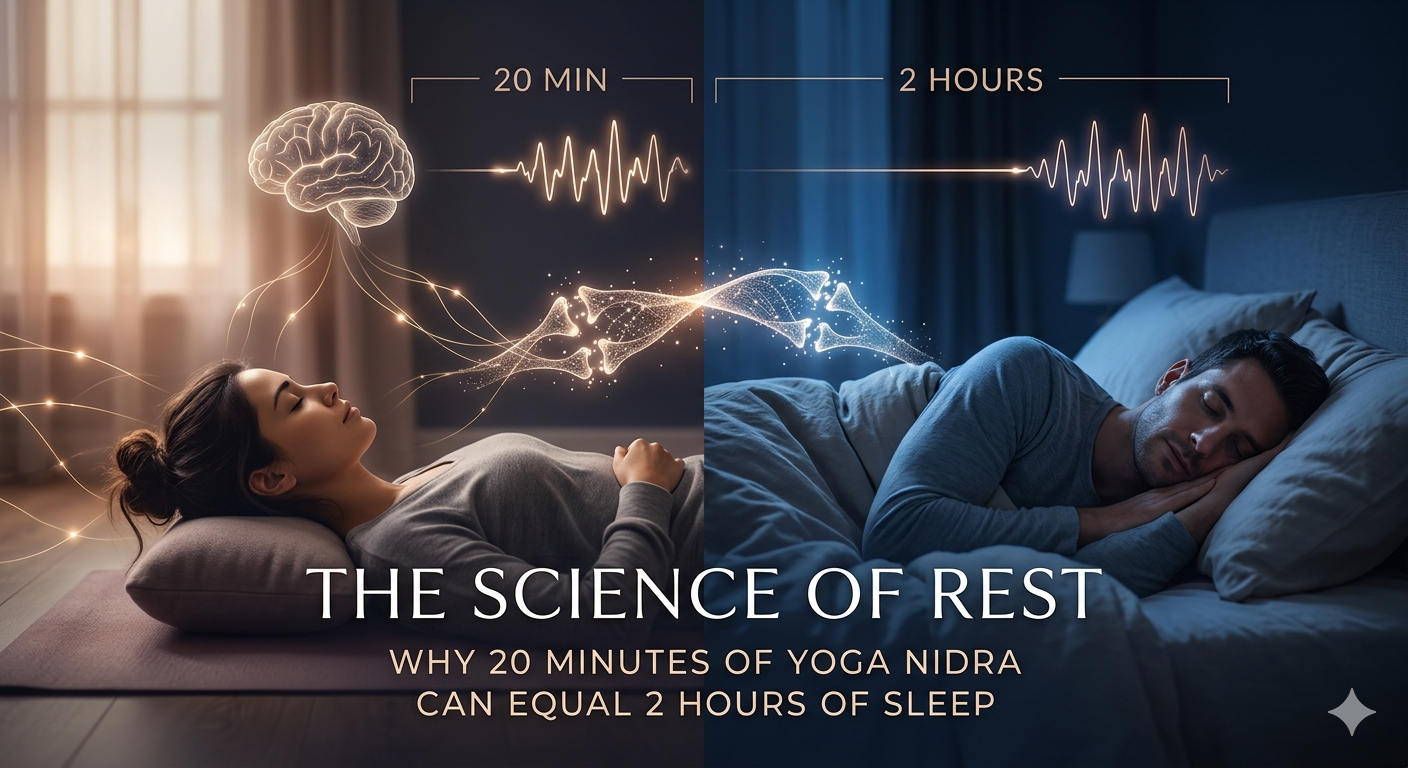
The modern solution to exhaustion is almost always linear: if you are tired, you need more sleep. Yet, millions of people wake up feeling remarkably unrefreshed despite getting their recommended eight hours of nocturnal rest. This disconnect occurs because traditional sleep addresses physical exhaustion, but often fails to soothe a hyper-activated nervous system. When the mind remains locked in a state of low-grade, perpetual survival mode, standard sleep becomes fragmented and shallow.
To achieve genuine rejuvenation, cognitive and physiological systems require a distinct state of conscious relaxation. This is precisely where Yoga Nidra operates. While often translated as psychic sleep, this ancient practice is actually a systematic method of inducing complete physical, mental, and emotional relaxation. Emerging neurological research confirms what practitioners have claimed for centuries: a brief, twenty-minute session of structured Yoga Nidra can mimic the profound restorative depth of a two-hour sleep cycle. Understanding this phenomenon requires looking directly at the brain chemistry, brainwave mechanics, and nervous system shifts that occur during the practice.
The Neurological Bridge Between Wakefulness and Deep Sleep
The primary reason YogNidra feels so intensely restorative lies in its ability to deliberately guide the brain through various brainwave frequencies. Under normal circumstances, the human brain transitions through four primary states during a twenty-four-hour cycle.
In active daily life, the brain operates in the beta frequency, which ranges from fourteen to thirty hertz. This state is characterized by logical thinking, analysis, and often stress. When you close your eyes and begin to relax, the brain shifts down into the alpha state, which ranges from eight to thirteen hertz. This is the realm of daydreaming and light relaxation.
Standard sleep requires a further descent into theta waves, which range from four to seven hertz, and finally into delta waves, which range from one to three hertz. Delta sleep is the holy grail of physical recovery. It is during deep, slow-wave delta sleep that the body releases human growth hormone, repairs damaged tissues, regulates immune function, and clears metabolic waste from brain tissues.
In normal sleep patterns, it takes the average person anywhere from sixty to ninety minutes of continuous sleep to reach the deep delta state. Yoga Nidra provides a biological shortcut. By utilizing a highly specific, structured sequence of internal awareness points, the practice bypasses the lengthy transitions of standard sleep. It rapidly lowers the brainwave frequency from beta, through alpha, and directly into the borderland between theta and delta.
During a twenty-minute session, the practitioner remains fully awake and conscious, yet their brain begins to exhibit the slow, high-amplitude delta waves typically reserved for the deepest stages of non-rapid eye movement sleep. Because the mind does not drop into the unconsciousness of normal sleep, the brain is able to access this deeply restorative delta state with incredible efficiency, maximizing cellular repair and mental decompression in a fraction of the time.
Downregulating the Nervous System and Cortisol Clearance
The human body cannot heal or rest effectively while the sympathetic nervous system is dominant. Modern life triggers the fight or flight response constantly. Micro-stressors like unread notifications, traffic, and tight deadlines keep the body in a state of high alert, causing a steady, damaging drip of cortisol and adrenaline into the bloodstream. Elevated cortisol levels fragment night-time sleep, making it impossible to stay in deep recovery states for long periods.
Yoga Nidra acts as an immediate off-switch for this chronic sympathetic activation. The practice structured around a systematic body scan, breath awareness, and emotional pairing systematically activates the parasympathetic nervous system, often called the rest and digest response.
When the parasympathetic nervous system takes over, several physiological changes occur simultaneously:
- The heart rate slows down and heart rate variability increases, indicating a resilient, relaxed cardiovascular system.
- Blood vessels dilate, lowering systemic blood pressure and improving oxygen delivery to vital organs.
- The production of stress hormones drops sharply, allowing the liver to process and clear existing cortisol from the blood.
Because the physical body is completely immobilized and the mind is anchored to the instructor’s voice, the brain realizes there is no immediate threat. This complete lack of perceived danger allows the amygdala, the brain’s fear center, to quiet down. The energy normally spent on hyper-vigilance is immediately redirected toward cellular repair, immune system enhancement, and neurotransmitter replenishment.
Neurochemical Rebalancing and Dopamine Reset
The restorative power of Yoga Nidra extends deep into the brain’s chemical ecosystem. Chronic exhaustion and digital overstimulation leave the brain starved of calming neurotransmitters while simultaneously exhausting dopamine receptors. This chemical imbalance manifests as a persistent sense of mental fatigue, emotional volatility, and brain fog.
Clinical studies using positron emission tomography scans have shown that during a session of Yoga Nidra, dopamine levels in the brain rise naturally. Specifically, the practice stabilizes and regulates dopamine release in the ventral striatum, a key component of the brain’s reward pathway. This is highly unusual because dopamine is typically associated with action, consumption, and external stimulation. Yoga Nidra provides a rare mechanism for the brain to replenish its dopamine reserves through pure stillness.
Furthermore, the practice stimulates the production of gamma-aminobutyric acid, which is the primary inhibitory neurotransmitter in the central nervous system. This chemical acts as the brain’s natural sedative, slowing down overactive neural firing and quietening anxious thoughts. The combined surge of this inhibitory transmitter and balanced dopamine creates a profound state of mental clarity, leaving the practitioner feeling deeply anchored, calm, and mentally sharp immediately following a session.
The Structural Flow of a Session
The efficiency of Yoga Nidra is not accidental; it relies on an exact psychological blueprint designed to disarm the ego and quieten the conscious mind. A standard practice follows a strict sequence that systematically peels back layers of tension.
The process begins with the formulation of a Sankalpa, a short, positive statement of intent or resolve stated in the present tense. Setting this intention while the brain transitions into the highly receptive alpha state allows the concept to bypass conscious resistance and seed itself directly into the subconscious mind.
Next comes the rotation of consciousness, a rapid mental scan across specific points of the physical body. The practitioner is guided to move awareness from the right thumb, through the fingers, up the arm, and across the entire body in a fixed pattern. This rapid movement keeps the conscious mind too occupied to engage in associative thinking or worrying, while simultaneously mapping the brain’s motor cortex, forcing the nervous system to drop its physical defenses.
Following the body scan, the practice introduces breath awareness, counting regressions, and the simulation of opposite sensations, such as experiencing extreme heat followed by extreme cold. This deliberate pairing of opposing stimuli balances the hemispheres of the brain, severing emotional attachments to physical sensations and completing the transition into the deeply restorative theta-delta border state.
Integrating the Practice into Modern Routines
Understanding that Yoga Nidra does not completely replace night-time sleep is crucial. The body still requires regular, long-form sleep for memory consolidation and complex hormonal regulation. Instead, Yoga Nidra should be viewed as a highly sophisticated tool for nervous system maintenance and acute recovery.
For professionals, students, and creators, the afternoon represents a significant biological dip. Around two or three in the afternoon, the circadian rhythm naturally drops, causing a slump in focus and energy. The typical response is to consume caffeine or sugar, both of which further stress the nervous system and ruin subsequent night-time sleep.
Replacing that afternoon caffeine fix with a twenty-minute Yoga Nidra session creates a profound shift in daily productivity and well-being. By stepping away from stimulation and entering conscious rest, you clear the accumulated cognitive debris of the morning, reset your nervous system, and return to work with the mental clarity of a brand-new day. It is an investment in biological efficiency, proving that sometimes the fastest way to progress is to master the art of deliberate stillness.
