
We’ve all had those months where life feels like a constant uphill climb—where the coffee spills, the emails pile up, and “good vibes” feel like a distant memory. When you’re stuck in a rut, the advice to “just stay positive” can feel dismissive and, frankly, exhausting.
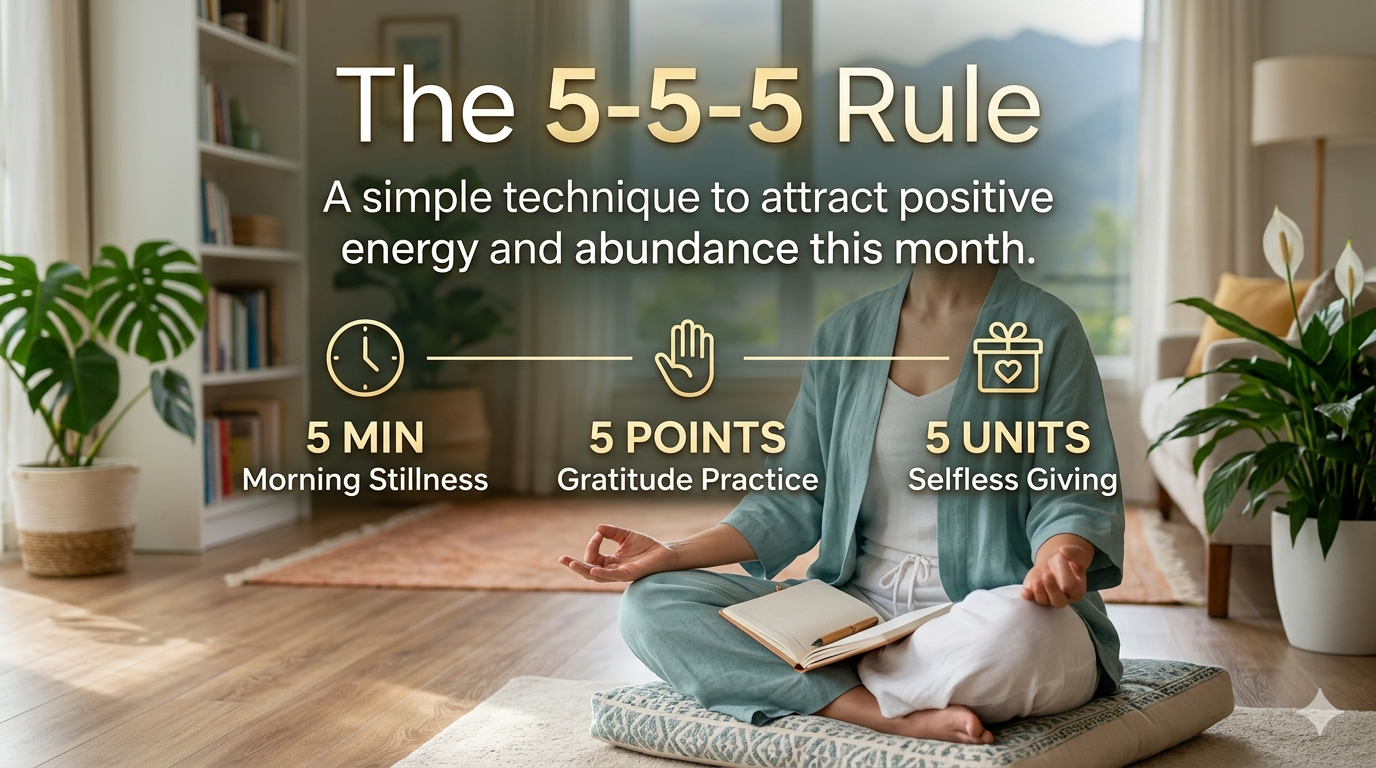
But what if shifting your trajectory didn’t require a total lifestyle overhaul? Enter the 5-5-5 Rule. This isn’t a complex financial strategy or a grueling workout plan; it’s a psychological and energetic reset designed to help you reclaim your focus and invite abundance back into your life.
Here is how you can use this simple framework to make this month your best one yet.
1. The First 5: Minutes of Morning Stillness
How you start your day often dictates how the universe responds to you. If you spend your first five minutes scrolling through stressful news or social media, you are training your brain to look for chaos.
The Practice: Before you touch your phone, spend five minutes in intentional silence.
- Visualize: Imagine one specific good thing happening today.
- Breath: Focus on deep, rhythmic breathing to lower cortisol.
- The Goal: You are setting a “baseline” of calm. By claiming these five minutes, you tell yourself—and the world—that your peace is the priority.
2. The Second 5: Daily Gratitude “Hits”
Abundance isn’t just about getting more; it’s about recognizing what is already flowing toward you. The “lack” mindset is a magnet for more lack. To flip the switch, you need to find five things to be genuinely grateful for every single day.
The Practice: Write down or say out loud five specific things you appreciate.
- Avoid the generic: Instead of “I’m grateful for my job,” try “I’m grateful for the way my coworker helped me with that project today.”
- The Science: This practice trains your reticular activating system (RAS)—the part of your brain that filters information—to scan your environment for opportunities and wins rather than threats and failures.
3. The Third 5: Five Dollars (or Five Minutes) of Giving
Energy is meant to circulate. When we hoard our time, money, or kindness out of fear, we create a “blockage” in our own abundance. The 5-5-5 Rule encourages a small, symbolic act of outflow to keep the cycle moving.
The Practice: Once a day (or even once a week if you’re starting slow), commit to five dollars of generosity or five minutes of selfless service.
- Examples: Buy a coffee for the person behind you, donate five dollars to a local shelter, or spend five minutes truly listening to a friend who is struggling.
- The Shift: This small act reinforces the belief that you have enough to share. That feeling of “enough-ness” is the cornerstone of attracting real wealth and positive energy.
Why It Works
The 5-5-5 Rule works because it is low-friction. Most New Year’s resolutions fail because they are too big to sustain. This rule is different because it fits into the cracks of your existing schedule.
By the end of the month, you won’t just have practiced a technique; you will have built a new habit of mind. You’ll find yourself noticing the “lucky” break at work or the “random” positive encounter at the grocery store—not because the world changed, but because you finally tuned your frequency to receive them.
Try it starting tomorrow morning. Five minutes of stillness, five points of gratitude, and five units of giving. Watch how the energy in your room—and your life—begins to shift.
Frequently Asked Questions about the 5-5-5 Rule
- What exactly is the 5-5-5 Rule for abundance?It is a daily mindfulness practice involving five minutes of morning silence, identifying five things you are grateful for, and performing a small five-unit act of giving (time or money).
- How long does it take to see results?While some feel an immediate shift in mood, most people notice significant changes in their outlook and “luck” after practicing consistently for 21 to 30 days.
- Do I have to do the five minutes of stillness as soon as I wake up?Ideally, yes. Doing it before checking your phone prevents external stress from “hijacking” your brain’s morning neurochemistry.
- Can I combine the gratitude and stillness steps?It’s better to keep them separate. Stillness is about clearing the mind, while gratitude is about active focus. Separating them gives your brain two distinct positive resets.
- What if I can’t find five things to be grateful for?Start very small. Be grateful for the air in your lungs, the warmth of your blanket, or the fact that you have clean water. The scale doesn’t matter; the feeling does.
- Does the “five units of giving” have to be money?Not at all. If $5 is tight, give five minutes of your time. Helping someone carry groceries or sending a supportive text counts as shifting your energy from “hoarding” to “flowing.”
- Is this a religious practice?No. It is a secular technique rooted in positive psychology and habit-stacking. You can, however, adapt it to your spiritual beliefs if you wish.
- Can I do this at night instead of in the morning?The morning is recommended to set the tone for the day, but if your mornings are chaotic, doing it at night is better than not doing it at all.
- Do I need to write my gratitude list down?Writing is more effective for “wiring” the brain, but if you’re on the go, saying them out loud or thinking them deeply still works.
- What is the “abundance” this rule attracts?Abundance isn’t just money. It can manifest as new opportunities, better health, stronger relationships, or simply a consistent feeling of peace and joy.
- Why is it called a “rule” if it’s just a habit?The word “rule” helps provide structure. It serves as a mental framework to ensure you don’t skip the small steps that lead to big changes.
- Can I use the 5-5-5 Rule for weight loss or fitness?Yes. You can adapt it: 5 minutes of stretching, 5 healthy meals/snacks, and 5 sets of an exercise. The 5-5-5 structure is highly versatile.
- What happens if I miss a day?Don’t beat yourself up. Just resume the next morning. The goal is consistency, not perfection.
- Is there a scientific basis for the 5-5-5 Rule?Yes. It utilizes “habit stacking,” mindfulness (which lowers cortisol), and the “Broaden-and-Build” theory of positive emotions.
- Can children or teenagers practice this?Absolutely. It’s an excellent way to teach younger people emotional regulation and the value of generosity.
- How does the 5-5-5 Rule differ from the 5×55 manifestation method?The 5×55 method involves writing one affirmation 55 times for 5 days. The 5-5-5 Rule is a broader, long-term lifestyle habit rather than a one-time manifestation ritual.
- Does the giving step require me to give to a stranger?No. Giving 5 minutes of undivided attention to a spouse or child is a powerful way to move energy within your own home.
- Can I do “more” than five?You can, but the beauty of the 5-5-5 Rule is its simplicity. Doing too much too soon can lead to burnout. Master the “fives” first.
- Will this rule help with anxiety?The morning stillness and gratitude portions are specifically designed to ground the nervous system and reduce the “fight or flight” response.
- How do I remember to do it every day?Set a reminder on your phone or put a sticky note on your bathroom mirror that simply says “5-5-5.”
