
How a Fake Paper Leak Scam Led India to Block 150 Million Users — and Why Durov Says It Won’t Work
On June 16, 2026, India hit the block button on one of the world’s biggest messaging apps. The government banned Telegram. All 150 million Indian users lost access overnight. The reason? A NEET-UG paper leak scandal — one that, ironically, never involved a real leaked paper at all.
And within hours, Telegram’s founder Pavel Durov fired back publicly. He was not quiet about it.
What Actually Happened With NEET 2026
The NEET-UG 2026 exam was held on May 3, 2026, for over 2.27 million students seeking admission to medical and dental colleges across India. The exam was cancelled on May 12 following investigations that revealed overlaps between a pre-circulated guess paper and the actual question paper.
A re-examination was then scheduled for June 21, 2026. That is where Telegram entered the picture — and where things got messy.
Fraud networks exploited a specific feature of Telegram: its ability to silently replace the contents of previously posted messages while keeping the original timestamp intact. Channel administrators posted placeholder messages before the exam window. Then they edited them afterward to insert exam-related content. The trick made their posts appear to be genuine pre-exam leaks.
However, the NTA confirmed that no genuine NEET 2026 re-exam paper was in circulation, and every channel claiming to offer one was running a scam. Students were not accessing real papers. They were being extorted — paying money for nothing.
Still, the government moved fast. MeitY imposed a strict, temporary nationwide restriction on Telegram access until June 22, 2026, under Section 69A of the IT Act, acting on specific intelligence from the National Testing Agency and the Indian Cyber Crime Coordination Centre.
Furthermore, even after the app block is lifted, Telegram has been ordered to disable its message-editing feature in India until June 30, 2026, to prevent retroactive timestamp scams.
Durov Responds: “This Is a Rash Decision”
Pavel Durov did not stay silent. He took to X (formerly Twitter) almost immediately.
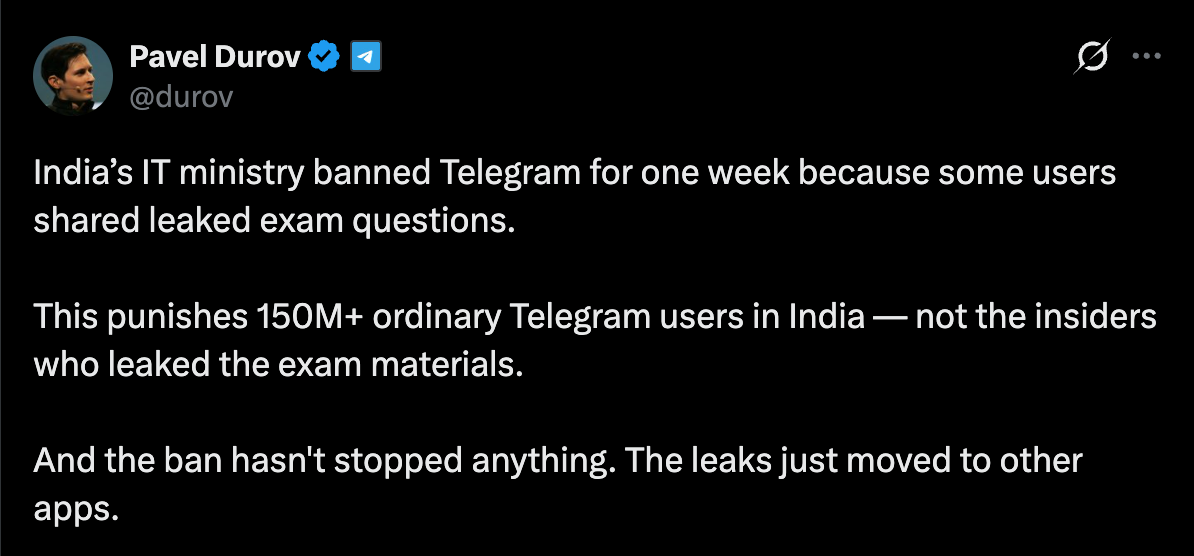
Durov called the ban a “rash decision,” arguing that it punishes ordinary users, not the insiders who leaked exam materials.
He went further. He pointed out that the ban failed to stop anything, as the leaks simply moved to other messaging apps like WhatsApp, raising doubts about its actual impact.
In his words: “This punishes 150M+ ordinary Telegram users in India — not the insiders who leaked the exam materials. And the ban hasn’t stopped anything. The leaks just moved to other apps.”
That was not trolling in a petty sense. It was a pointed, public embarrassment of India’s digital policy. And the numbers back him up.
Is the Ban Even Legal?
The government says yes. The Internet Freedom Foundation says no.
Section 69A permits MeitY to block access to specific “information” on a computer resource. However, the IFF argues that the law does not authorize blocking an entire platform used by 150 million people, and that ordering Telegram to disable a product feature for all Indian users goes beyond what Section 69A covers.
This is not a small legal debate. It sets a precedent for how India can treat global platforms going forward. Consequently, the ban has triggered a wider conversation about digital rights, government overreach, and whether blocking a tool actually stops the crime — or just moves it elsewhere.
This Is Not Durov’s First Fight With a Government
Durov has a long history of pushing back against state pressure. He has done it before — and loudly.
When Russia tried to ban Telegram in 2018 over its refusal to hand over encryption keys, Durov held firm. He famously compared Iran’s failed Telegram ban to Russia’s attempt, writing: “8 years ago, Iran tried the same strategy — and failed. It banned Telegram on made-up pretexts, trying to force people onto a state-run alternative. Despite the ban, most Iranians still use Telegram and prefer it to surveilled apps. Freedom prevails.”
Additionally, Durov was arrested in France in August 2024 as part of a preliminary investigation into allegedly allowing a wide range of crimes due to a lack of moderators on Telegram and a lack of cooperation with police. He was released on bail. The charges did not soften his stance.
His pattern is consistent: governments threaten, Durov talks back.
The Real Problem India Is Ignoring
Here is the uncomfortable truth. Prior to every major examination in India, there are messages in one or more Telegram groups claiming to have the leaked copy of the exam question paper. When a student shows interest, criminals scam them by asking for payment in gift cards to remain anonymous, and once payment is secured, will either stop responding or send an old question paper.
This scam is not new. It is not unique to Telegram. In 2025 alone, NTA identified 106 Telegram and 16 Instagram channels engaged in spreading misinformation about NEET-UG, and formally escalated these cases to the Indian Cyber Crime Coordination Centre.
The channels moved. They came back. They will keep coming back — because the root problem is exam integrity, not the app students use to talk about it.
Blocking Telegram is like banning the telephone because scammers use phones.
What Comes Next
The ban is set to lift on June 22, 2026. The NEET re-examination is scheduled for June 23, with high-security measures including IAF involvement for question paper transport.
Whether the ban achieves anything lasting remains doubtful. The leaks already moved to WhatsApp. The scammers already adapted. And Durov has already made the Indian government look reactive on the global stage.
For 150 million Indian students, creators, journalists, and everyday users, the ban was a week of disruption — for a problem that was never really about Telegram in the first place.
Instagram Creators Covering This Story (creators, not aggregators):
- @socialketchup — viral moments and internet culture in India
- @thekamleshvyas — digital rights and tech policy explained simply
- @thetechcreator — tech news breakdowns for Indian audiences
Internal Links:
- What is Section 69A of the IT Act and how is it used?
- NEET 2026: Everything that went wrong
- Pavel Durov’s arrest in France — what happened and why it matters
- India’s history of banning apps: TikTok, PUBG, and beyond
Source Credits: Deccan Herald, TechTimes, College Simplified, Careers360, Sunday Guardian Live, Wikipedia – 2026 NEET Controversy
