
The sharp rise in precious metals has turned global attention toward the ongoing battle between silver and gold. After an extraordinary surge over the past year, investors are now questioning whether silver can continue outperforming gold or if the rally is nearing exhaustion.
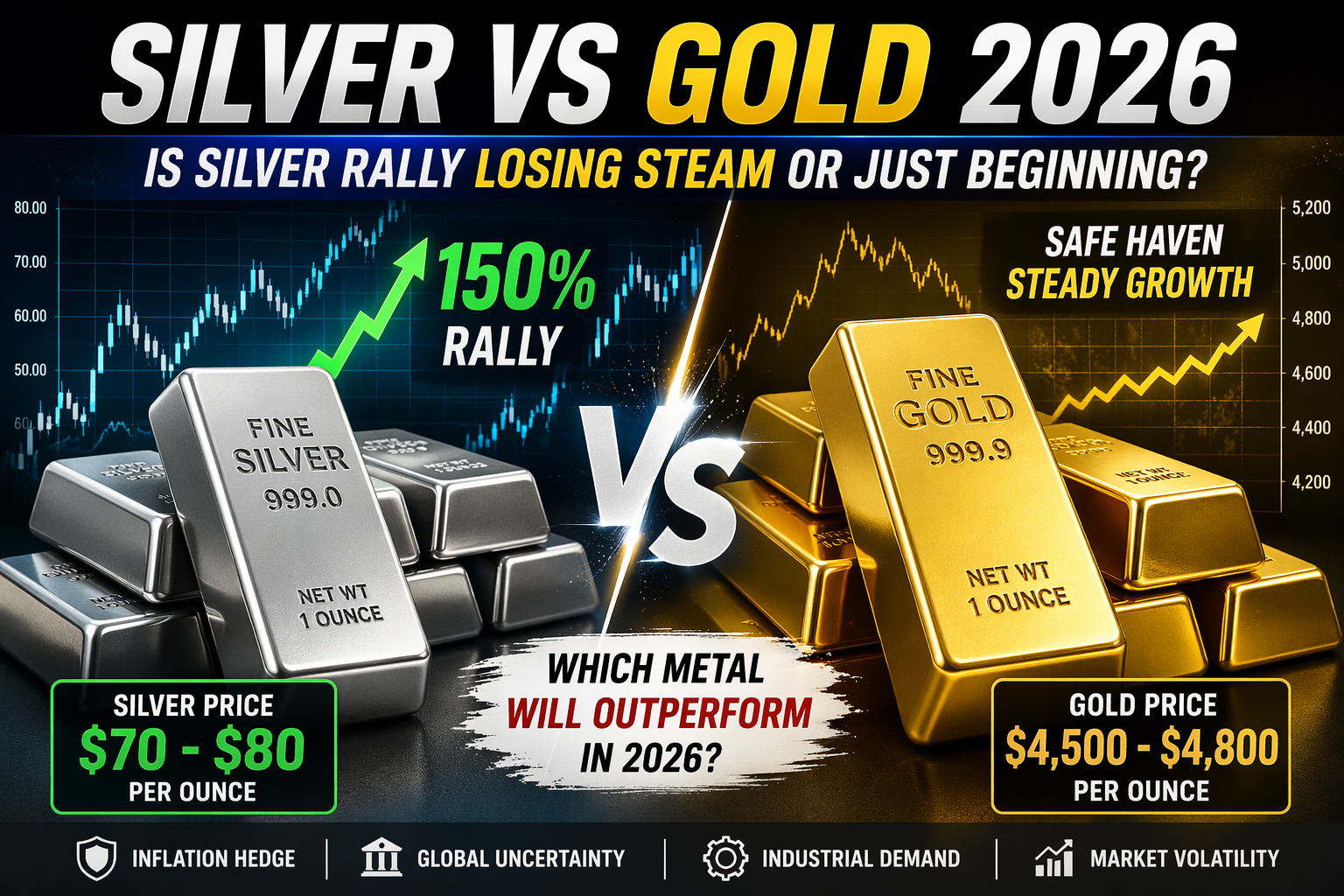
Silver has delivered one of the most aggressive runs in recent history, rising nearly 150 percent and briefly approaching the $80 mark. In comparison, gold has also performed strongly, crossing $4,800 and maintaining its position as a reliable store of value. (The Economic Times)
This divergence in performance has reignited the long-standing debate about which metal offers better returns, especially in a volatile global environment marked by inflation concerns and geopolitical uncertainty.
Why Silver Outpaced Gold
The reason behind silver’s outperformance lies in its unique nature. Unlike gold, which is primarily a safe-haven asset, silver has a dual identity. It is both a precious metal and an industrial commodity. This makes it more responsive to economic optimism and speculative demand.
During strong bullish phases, investors often shift toward silver after gold establishes the trend. Its lower price makes it more accessible, especially for retail investors, leading to faster price movements. (The Economic Times)
Additionally, silver markets are smaller in size compared to gold. As a result, even moderate inflows can trigger significant price spikes. This dynamic has been clearly visible in the recent rally.
Signs of Fatigue Emerging
Despite the impressive gains, current indicators suggest that momentum may be weakening. Silver has struggled to hold levels above $80, while gold has faced resistance near its recent highs. (The Economic Times)
Technical signals point toward overbought conditions, and repeated failures at key resistance levels indicate that buyers are becoming cautious. The easing of geopolitical tensions has also reduced the urgency for safe-haven assets, removing one of the major drivers behind the rally.
Market experts now believe that both metals may enter a consolidation phase rather than continuing their rapid upward trajectory.
Volatility Remains Silver’s Biggest Risk
While silver offers higher upside during rallies, it also carries greater risk. Its dependence on industrial demand makes it more sensitive to economic slowdowns. When sentiment shifts, silver tends to fall faster than gold.
Analysts often describe silver as a high-beta version of gold. It amplifies gains during bullish periods but also accelerates losses during corrections. This characteristic makes timing extremely important for investors.
What Lies Ahead for 2026
The outlook for precious metals in 2026 appears mixed. Gold is expected to remain relatively stable due to strong institutional demand and its role as a hedge against inflation. On the other hand, silver could experience sharper fluctuations due to its volatile nature.
Rather than another immediate surge, markets may move sideways in the near term as they absorb recent gains. (The Economic Times)
However, the long-term outlook remains supported by persistent inflation risks, supply constraints, and ongoing global uncertainties. These factors continue to provide a strong foundation for both metals.
Investment Strategy: Patience Over Panic
For investors, the key takeaway is clear. Chasing rallies at peak levels can be risky. Instead, experts suggest waiting for corrections and focusing on long-term accumulation.
Diversification across multiple assets, including other commodities, can also help reduce risk. With volatility rising, disciplined investing and proper timing are likely to matter more than ever.
Conclusion
The silver versus gold debate is far from settled. While silver has clearly outperformed in the recent rally, signs of exhaustion are beginning to appear. The market is entering a phase where strategy, patience, and timing will determine success more than momentum alone.
Investors who adapt to changing conditions rather than following trends blindly are likely to navigate the next phase of the market more effectively.
Frequently Asked Questions (FAQs)
1. What is the current price of silver and gold in 2026?
As of 2026, silver has been trading in the range of $70 to $80 per ounce after a sharp rally of nearly 150 percent. Gold, on the other hand, has been hovering around $4,500 to $4,800 per ounce, maintaining a steady upward trend.
While silver has shown explosive growth, gold continues to hold its position as a stable store of value.
2. Why has silver risen faster than gold recently?
Silver’s rapid rise is mainly due to its dual demand. It is used both as a precious metal and in industries like electronics and solar energy.
Because of this, when economic activity improves, silver demand increases sharply. Its smaller market size also means that even limited buying can push prices up quickly, unlike gold which moves more gradually.
3. Can silver cross $100 per ounce in 2026?
Crossing $100 per ounce is possible but not guaranteed. For this to happen, strong industrial demand, continued investor interest, and supportive global conditions must align.
However, after such a steep rally, markets often slow down or correct before making the next big move. So while $100 is achievable, it may not happen immediately.
4. Is gold still a better investment than silver in 2026?
It depends on the investor’s goal. Gold is considered a low-volatility, long-term safety asset, especially during inflation or global uncertainty.
Silver, on the other hand, offers higher growth potential but comes with increased risk. Investors looking for stability may prefer gold, while those seeking higher returns may consider silver with caution.
5. What are the price predictions for gold in 2026?
Many analysts expect gold to remain strong in the range of $4,500 to $5,200 per ounce in 2026.
The key drivers include inflation concerns, central bank buying, and global economic uncertainty. Gold is less likely to show sudden spikes but is expected to maintain a steady upward bias.
6. Is the silver rally over after 150 percent growth?
Not necessarily, but signs of slowdown are emerging. After such a massive rally, markets typically enter a consolidation phase, where prices move sideways or correct slightly before the next trend.
Silver may still rise further, but the pace is likely to be slower compared to the previous surge.
7. What is the gold-silver ratio right now and what does it indicate?
The gold-silver ratio in 2026 has dropped significantly due to silver’s strong performance and is currently estimated between 55:1 and 65:1.
A falling ratio indicates that silver is outperforming gold. However, when the ratio drops too quickly, it can also signal that silver may be overheating in the short term.
8. Should investors buy silver at current prices?
Buying at current levels carries some risk because prices are already elevated after a strong rally. A better approach could be buying on dips or investing gradually instead of entering at peak levels.
Timing plays a crucial role with silver due to its volatility.
9. What factors will decide future prices of silver and gold?
Several key factors will influence prices in the coming months:
- Inflation trends
- Interest rates and central bank policies
- Global economic growth
- Industrial demand for silver
- Geopolitical tensions
A combination of these factors will determine whether prices rise further or stabilize.
10. Which is more volatile: silver or gold?
Silver is significantly more volatile than gold. It tends to rise faster during bullish markets but also falls more sharply during corrections.
Gold, in comparison, shows more stable and predictable movements, making it suitable for conservative investors.
11. What is the ideal investment strategy between silver and gold right now?
A balanced strategy is often considered the safest. Investors can allocate a portion to gold for stability and another portion to silver for growth potential.
Instead of chasing rallies, focusing on long-term accumulation and diversification can help manage risk effectively.
12. Could silver outperform gold again in the future?
Yes, silver can outperform gold again, especially during strong economic growth phases where industrial demand rises.
However, such outperformance usually comes in cycles and is often followed by periods of correction. Investors need to be mindful of timing and market conditions.
If you want, I can also create a “People Also Ask” schema markup, or a Hindi FAQ version for higher traffic, or even convert this into a voiceover script for your YouTube channel.
Here is a detailed Hindi FAQ section written in a natural, human tone, perfect for boosting engagement and ranking on Instant News:
अक्सर पूछे जाने वाले सवाल (FAQs)
1. 2026 में सोना और चांदी की कीमत क्या चल रही है?
2026 में चांदी की कीमत लगभग $70 से $80 प्रति औंस के बीच देखी जा रही है, जिसमें पिछले समय में करीब 150 प्रतिशत की तेजी आई है। वहीं सोना $4,500 से $4,800 प्रति औंस के आसपास स्थिर रूप से ट्रेड कर रहा है।
दोनों में तेजी है, लेकिन चांदी ने ज्यादा तेज रफ्तार दिखाई है।
2. चांदी ने सोने से ज्यादा तेजी क्यों दिखाई?
चांदी की सबसे बड़ी खासियत यह है कि यह सिर्फ निवेश के लिए नहीं, बल्कि इंडस्ट्री में भी इस्तेमाल होती है, जैसे इलेक्ट्रॉनिक्स और सोलर सेक्टर में।
जब आर्थिक गतिविधियां बढ़ती हैं, तो चांदी की मांग तेजी से बढ़ती है। साथ ही इसका बाजार छोटा है, इसलिए थोड़ी सी खरीदारी भी कीमत को तेजी से ऊपर ले जाती है।
3. क्या चांदी 2026 में $100 तक पहुंच सकती है?
चांदी का $100 प्रति औंस तक जाना संभव है, लेकिन यह पूरी तरह बाजार की स्थिति पर निर्भर करेगा।
अगर इंडस्ट्रियल डिमांड मजबूत रहती है और निवेशकों का भरोसा बना रहता है, तो यह स्तर हासिल हो सकता है। लेकिन इतनी बड़ी तेजी के बाद थोड़ी गिरावट या ठहराव भी आ सकता है।
4. 2026 में निवेश के लिए सोना बेहतर है या चांदी?
यह पूरी तरह आपके निवेश के लक्ष्य पर निर्भर करता है।
- अगर आप सुरक्षित और स्थिर निवेश चाहते हैं, तो सोना बेहतर विकल्प है
- अगर आप ज्यादा रिटर्न चाहते हैं और जोखिम ले सकते हैं, तो चांदी आकर्षक हो सकती है
दोनों का संतुलन बनाना सबसे समझदारी भरा कदम माना जाता है।
5. 2026 में सोने की कीमत कहां तक जा सकती है?
विशेषज्ञों के अनुसार, सोना 2026 में $4,500 से $5,200 प्रति औंस के बीच रह सकता है।
महंगाई, केंद्रीय बैंकों की खरीद और वैश्विक अनिश्चितता इसके प्रमुख कारण हैं।
6. क्या चांदी की 150% की तेजी अब खत्म हो गई है?
पूरी तरह खत्म नहीं हुई है, लेकिन अब बाजार में धीमापन दिखने लगा है।
इतनी बड़ी तेजी के बाद आमतौर पर बाजार कुछ समय के लिए रुकता है या थोड़ा नीचे आता है, जिसे कंसोलिडेशन कहा जाता है।
7. गोल्ड-सिल्वर रेशियो क्या है और अभी क्या संकेत दे रहा है?
2026 में गोल्ड-सिल्वर रेशियो लगभग 55:1 से 65:1 के बीच है।
जब यह रेशियो कम होता है, तो इसका मतलब होता है कि चांदी सोने से बेहतर प्रदर्शन कर रही है। लेकिन बहुत तेजी से गिरता रेशियो यह भी संकेत दे सकता है कि चांदी ज्यादा गरम हो चुकी है।
8. क्या अभी चांदी खरीदना सही रहेगा?
इस समय चांदी की कीमत पहले ही काफी ऊपर है, इसलिए सीधे खरीदना थोड़ा जोखिम भरा हो सकता है।
बेहतर रणनीति यह है कि गिरावट में धीरे-धीरे निवेश किया जाए, ताकि जोखिम कम हो।
9. सोना और चांदी की कीमत किन चीजों पर निर्भर करती है?
इनकी कीमत कई महत्वपूर्ण कारकों पर निर्भर करती है:
- महंगाई (Inflation)
- ब्याज दरें (Interest Rates)
- वैश्विक आर्थिक स्थिति
- चांदी की औद्योगिक मांग
- राजनीतिक और युद्ध जैसी परिस्थितियां
इन सभी का सीधा असर बाजार पर पड़ता है।
10. सोना और चांदी में ज्यादा उतार-चढ़ाव किसमें होता है?
चांदी में उतार-चढ़ाव ज्यादा होता है।
यह तेजी में ज्यादा तेजी दिखाती है और गिरावट में ज्यादा तेजी से गिरती भी है। वहीं सोना अपेक्षाकृत स्थिर रहता है।
11. अभी के समय में सही निवेश रणनीति क्या होनी चाहिए?
सबसे अच्छी रणनीति संतुलन बनाना है।
कुछ हिस्सा सोने में रखें ताकि सुरक्षा बनी रहे और कुछ हिस्सा चांदी में रखें ताकि बेहतर रिटर्न मिल सके।
एक साथ बड़ी रकम लगाने के बजाय धीरे-धीरे निवेश करना ज्यादा सुरक्षित तरीका है।
12. क्या भविष्य में चांदी फिर से सोने से बेहतर प्रदर्शन कर सकती है?
हां, चांदी भविष्य में फिर से बेहतर प्रदर्शन कर सकती है, खासकर तब जब अर्थव्यवस्था तेजी से बढ़े और इंडस्ट्रियल डिमांड बढ़े।
लेकिन यह तेजी हमेशा स्थायी नहीं होती और इसके बाद गिरावट भी देखने को मिल सकती है।
