
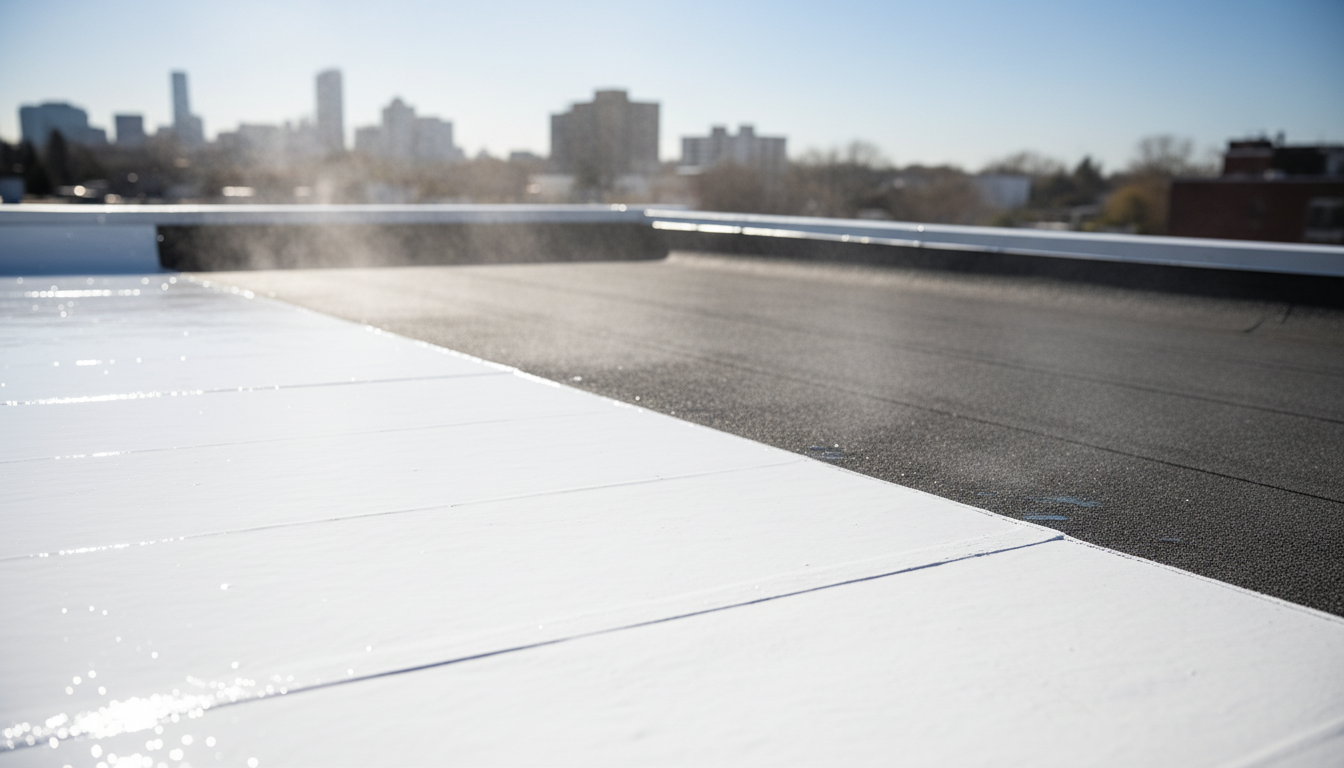
Reflective paint technology is about to change how homeowners tackle the summer heat—and their electricity bills. Researchers at the University of South Florida have developed a paint coating that reflects up to 98% of sunlight, keeping building surfaces significantly cooler without relying on air conditioning alone.
In outdoor tests, the paint cooled surfaces by as much as 13.5 degrees Celsius below the ambient air temperature. That performance is substantial enough to draw interest from both residential property owners and commercial building operators looking to trim energy consumption.
The innovation works through a simple premise: if you bounce sunlight away from your walls instead of letting them absorb it, your building stays cooler. The paint’s reflective properties mean less heat enters your home. Lower indoor temperatures follow. Air conditioners run less frequently. Your monthly power bill shrinks.
How Reflective Paint Technology Works
The paint achieves its high reflectance through careful material composition. By deflecting rather than absorbing solar radiation, it prevents heat buildup on exterior surfaces. Traditional paints absorb much of the sun’s energy. Dark paints do this more aggressively. White paints reflect some light, but this new formulation performs dramatically better.
The 98% reflectance rate puts it in a different category entirely. According to research detailed at TechXplore, the technology has already passed outdoor testing phases. Real-world performance data shows the cooling effect holds up when actually deployed on buildings, not just in laboratory conditions.
That 13.5-degree Celsius cooling margin creates meaningful savings. If your roof normally reaches 65 degrees Celsius on a hot day, this paint could keep it at around 51.5 degrees. The lower surface temperature reduces the heat that radiates into your living spaces. Your air conditioning system doesn’t have to work as hard to maintain comfortable indoor temperatures.
Energy Savings for Indian Homes and Businesses
For India’s climate zones, the implications are particularly relevant. During summer months in cities like Delhi, Mumbai, and Bangalore, roof and wall temperatures regularly exceed 60 degrees Celsius. Air conditioning already consumes roughly 40-50% of residential electricity use in urban households during peak summer.
A paint that cuts cooling requirements by even 10-15% translates to noticeable monthly savings. For a typical middle-class home running a 1.5-tonne air conditioner eight hours daily, that could mean 400-600 rupees less per month during summer. Scale that across India’s millions of homes, and the aggregate energy reduction becomes substantial.
Commercial buildings see even larger potential returns. Office complexes, warehouses, and retail spaces with extensive roof and wall exposure spend heavily on cooling systems. Installing reflective paint costs a fraction of upgrading HVAC equipment. The payback period for such a retrofit is typically measured in months, not years.
Where the Technology Stands Now
The researchers have filed a provisional patent. They’re now working on commercial availability, which means the paint isn’t yet on shelves at your local hardware store. The team needs to navigate manufacturing scale-up, regulatory approvals, and market partnerships before consumers can buy it.
That timeline varies by country and region. Indian markets may see availability through different channels than Western distributors. Local paint manufacturers could license the technology, or international firms could establish production here.
The development stage matters because early adopters—particularly commercial property developers and large facility managers—will likely be the first customers. Buildings under construction or undergoing renovation represent the ideal early market. Retrofitting existing structures works too, but requires removing old paint first.
Cost Considerations and Return on Investment
Reflective paint typically costs more than standard exterior coatings. The exact price remains undetermined until commercial production begins. However, early estimates suggest a premium of 20-40% over conventional paint.
That premium disappears quickly when you calculate energy savings. An air-conditioned building using reflective paint can reduce cooling hours by 15-25%, depending on climate, building design, and current insulation levels. In a hot climate like India’s, the savings accelerate.
Consider a 2,000-square-foot home in Hyderabad. If reflective paint reduces your air conditioning load by 20%, and you’re currently spending 5,000 rupees monthly on cooling during summer, you’d save roughly 1,000 rupees per month. Over a cooling season running May through September, that’s 5,000 rupees. A single coat of premium paint across your roof and walls might cost 15,000-20,000 rupees. Your investment recovers in three to four years—and the paint lasts longer than that.
Beyond Residential: Commercial and Industrial Applications
Office buildings, manufacturing facilities, and data centres represent major energy consumers. A data centre in Chennai maintaining server room temperatures burns through massive cooling budgets. Reflective paint on external surfaces reduces the baseline heat load. Cooling systems then operate more efficiently, cutting both energy costs and carbon footprint.
Warehouses storing temperature-sensitive goods—pharmaceuticals, electronics, food products—benefit similarly. Hospitals need reliable, efficient cooling for patient comfort and equipment operation. Schools and colleges with large roofed areas see immediate relief during peak summer months.
Government buildings and public institutions could reduce operational costs significantly. As India pursues energy efficiency targets and renewable energy goals, reflective paint represents a straightforward, low-tech complement to solar panels and LED upgrades.
Environmental Impact
Reduced air conditioning use means lower electricity demand. If that electricity comes from coal-fired plants—still true for much of India’s grid—lower demand directly reduces carbon emissions. Over the paint’s lifespan (typically 5-10 years depending on climate and maintenance), a single building could avoid releasing hundreds of tonnes of CO₂.
The environmental gain expands when multiplied across thousands of buildings. If even 5% of India’s commercial real estate adopted reflective paint, national cooling-related electricity consumption would drop measurably.
FAQ
Q: Will reflective paint make my home look white or industrial?
A: Not necessarily. Manufacturers are developing reflective paints in various colours by using infrared-reflective pigments invisible to the human eye. Your home can maintain its chosen aesthetic while still benefiting from cooling properties.
Q: How long does reflective paint last?
A: Like standard exterior paint, lifespan depends on climate and maintenance. In India’s harsh sun, expect 5-7 years before recoating becomes necessary. Regular washing removes dust and maintains reflectivity.
Q: Can I apply this paint myself?
A: Application resembles standard exterior painting. However, proper surface preparation and technique matter for achieving full reflectance. Professional application ensures optimal results, though experienced DIYers may handle it.
Q: Does reflective paint work in monsoon seasons or cloudy climates?
A: Yes. Even on overcast days, the paint reflects available sunlight. During monsoons, it reduces heat absorption when sun does appear. Cooling benefits diminish on heavily cloudy days, but average performance remains superior to standard paint.
Q: When will reflective paint be available in India?
A: The patent is still provisional and commercial production hasn’t begun. Expect 18-24 months before widespread availability, likely through paint manufacturers and building material retailers.
