
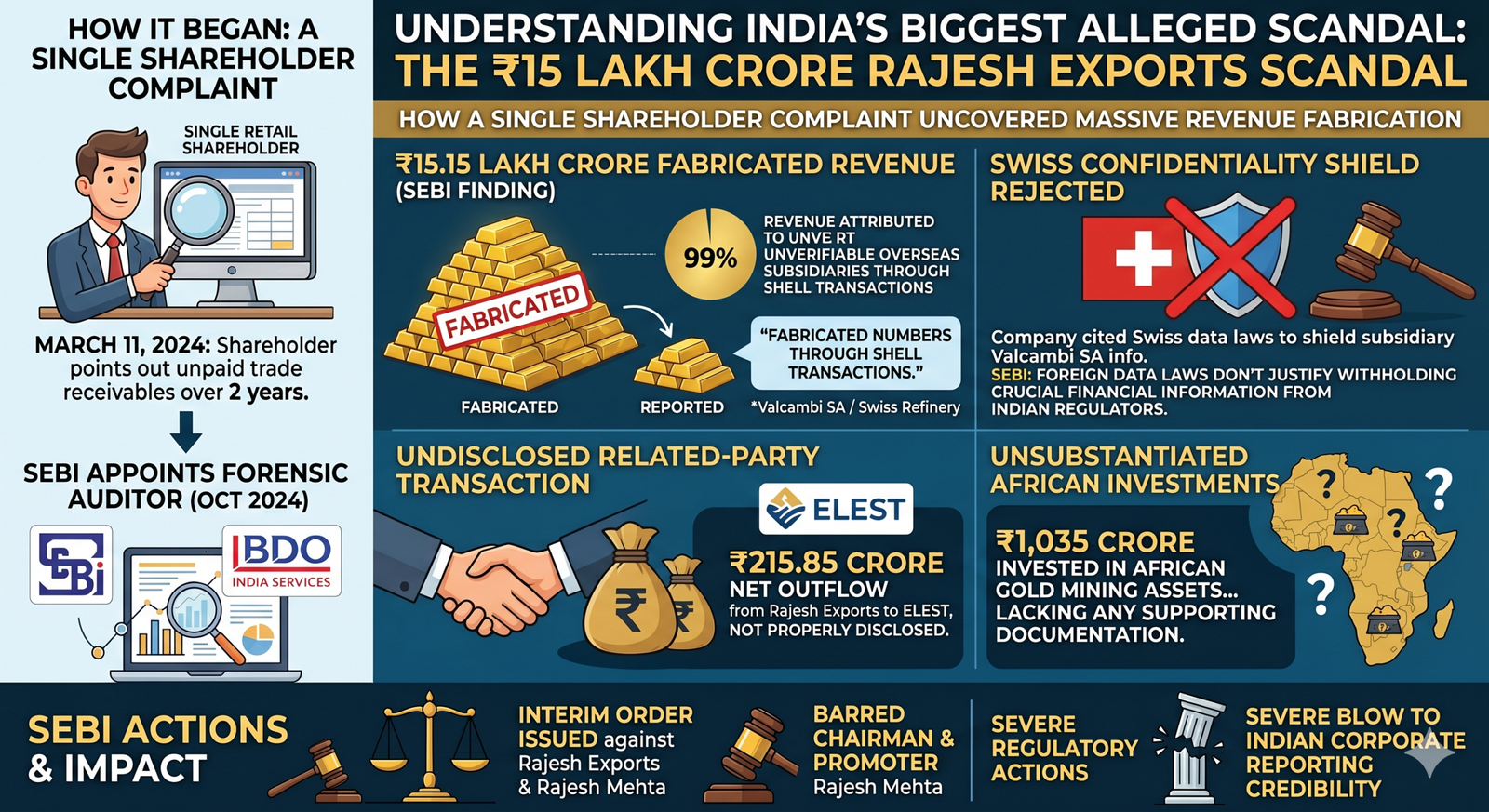
How a Single Shareholder Complaint Uncovered Massive Revenue Fabrication
The Indian financial markets have been rocked by what could be the country’s largest corporate governance scandal. The Securities and Exchange Board of India (SEBI) has issued a massive interim order against Bengaluru-based gold refining company Rajesh Exports Limited and its promoter, Rajesh Mehta. The regulatory action comes after the discovery of an astonishing ₹15.15 lakh crore revenue discrepancy.
The Root Cause: A Shareholder’s Suspicion
This massive investigation did not begin with an elaborate sting operation, but rather a simple email. On March 11, 2024, a retail shareholder filed a complaint with SEBI, pointing out that Rajesh Exports had trade receivables that remained unpaid for over two years. This red flag prompted the regulator to launch a formal investigation in October 2024, appointing BDO India Services to conduct a forensic audit.
The Overseas Subsidiary Web
As the auditors dug deeper, they uncovered a complex corporate structure designed to obscure the financial truth. Rajesh Exports reported consolidated revenues of approximately ₹15.45 lakh crore between FY21 and FY25. However, SEBI discovered that a staggering 97-99% of this revenue was attributed to overseas subsidiaries.
The company routed its business through entities like REL Singapore, which owns the Swiss-based Global Gold Refineries AG (GGR), which in turn owns the Swiss refinery Valcambi SA. When regulators tried to verify these transactions, they found that ₹15.15 lakh crore of the reported revenue could not be independently verified. SEBI noted that the company allegedly fabricated these numbers through shell transactions.
The company attempted to shield itself by citing Swiss data protection laws regarding its subsidiary Valcambi SA. However, SEBI strongly rejected this defense, stating that foreign data confidentiality laws do not justify withholding crucial financial information from Indian regulators.
Beyond the Revenue Gap
The alleged financial misconduct extends beyond inflated revenue numbers. The regulatory probe also revealed:
- A net outflow of ₹215.85 crore from Rajesh Exports to an entity named Elest, which was not properly disclosed as a related-party transaction.
- Unsubstantiated claims of ₹1,035 crore invested in gold mining assets in Africa, lacking any supporting documentation.
As a result of these findings, SEBI has barred the chairman and imposed severe regulatory actions against the company. This unprecedented ₹15 lakh crore alleged scam has dealt a severe blow to the credibility of Indian corporate reporting and continues to send shockwaves through Dalal Street.
The Rajesh Exports Controversy Explained
This video breaks down the rapid growth of Rajesh Exports, the Valcambi acquisition, and exactly what SEBI observed during its investigation of the ₹15 lakh crore revenue issue.
