
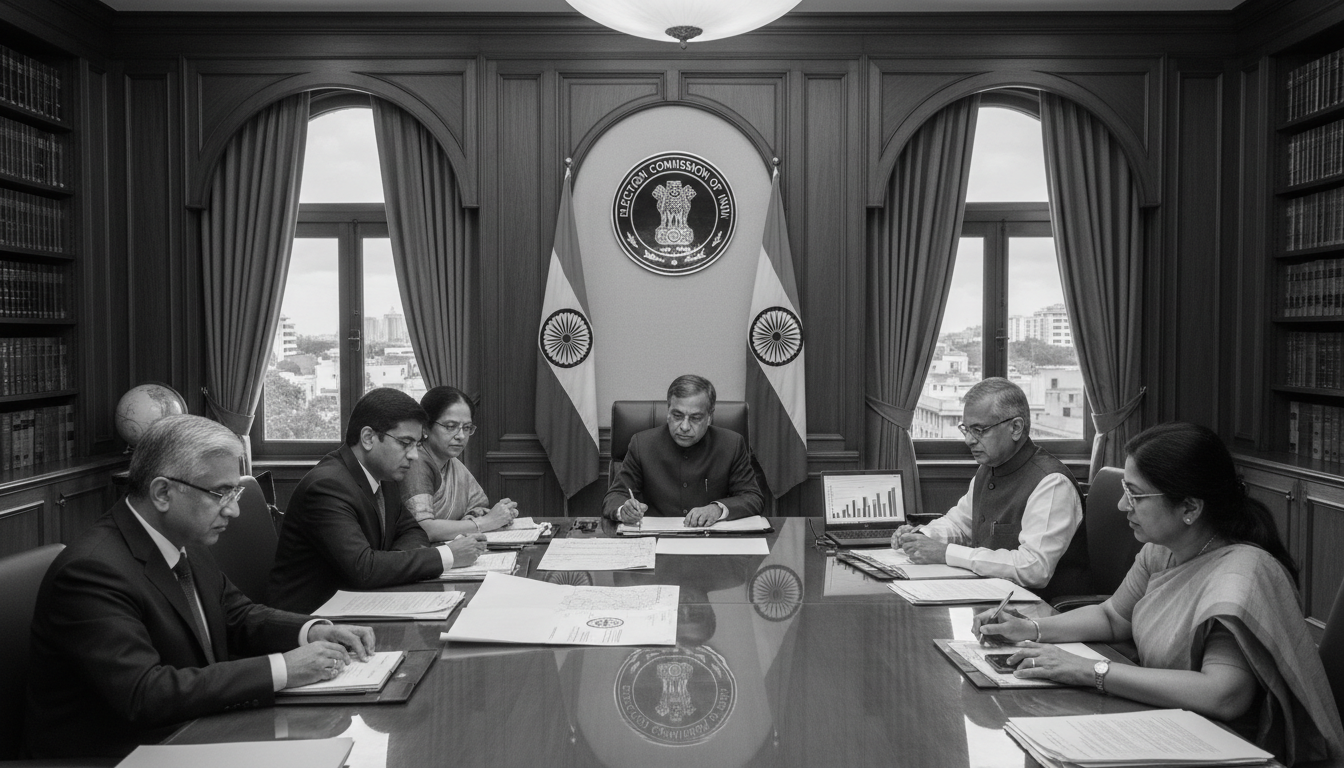
The Election Commission dissent row has escalated sharply, with opposition parties now demanding the arrest of Chief Election Commissioner Gyanesh Kumar and the cancellation of recent state elections. The demand follows reports that two Election Commissioners raised repeated objections to decisions concerning the Special Intensive Revision (SIR) of electoral rolls.
According to reporting on the controversy, the opposition has branded the internal friction within the poll body as a governance failure. They argue that decisions made without full consensus at the Election Commission warrant an overhaul of the recent electoral process.
The timing is significant. Electoral rolls are crucial—they determine who can vote. Any irregularities in their revision can swing electoral outcomes. The SIR process is meant to keep rolls accurate and current by adding new voters and removing those who have moved or passed away.
What triggered the Election Commission dissent row?
The core issue centres on how electoral rolls were revised ahead of recent state elections. Two Election Commissioners, according to reports, flagged concerns multiple times. The nature of their specific objections remains partially unclear, but the repetition suggests serious reservations about the approach being taken.
Electoral roll revisions are routine. What makes this different is the formal dissent. When senior poll officials register repeated objections, it signals disagreement over methodology, timing, or execution—not minor procedural quibbles.
The opposition has seized on this. They argue that if the Commission itself was divided, then the elections conducted under those revised rolls lack legitimacy. This is their central claim for demanding fresh polls and investigating the CEC.
The Election Commission’s defence
The Election Commission has pushed back firmly. The institution maintains that differing views are entirely normal during internal deliberations. Senior officials noted that all final decisions taken by the Commission were unanimous—meaning even commissioners who raised objections ultimately signed off.
This is a critical distinction. The EC argues that debate and disagreement during deliberation strengthen decision-making. Only when all commissioners agree does a decision become official policy. Internal discussion, by this logic, is not dysfunction but sound governance.
The BJP, according to reports, has characterised the episode as democracy in action. The ruling party sees the internal debate as evidence that the Commission functions independently and that officials aren’t afraid to voice concerns to the top leadership.
Opposition’s case for the CEC’s arrest
Opposition demands for arresting CEC Gyanesh Kumar rest on two pillars: that he suppressed dissent, and that he pushed through decisions that lacked full internal consensus despite raising concerns.
If the two commissioners objected multiple times and the CEC still proceeded, opposition figures argue, then either he ignored legitimate warnings or coerced unanimous approval after the fact. Both scenarios, they claim, warrant investigation and accountability.
The opposition has also questioned the timing of electoral roll revisions. They suggest that targeting certain constituencies or voter groups for revision could alter electoral arithmetic. Without seeing the technical details, they cannot prove this. But the existence of internal dissent has given their suspicion political credibility.
The demand for fresh elections follows logically from their position. If the rolls themselves were compromised, they argue, so were the elections held using them.
Electoral roll revisions and their political weight
Electoral rolls are not abstract bureaucratic lists. In Indian elections, they often become contested terrain. Voter registration drives, deletion procedures, and verification methods can all influence outcomes, especially in closely fought constituencies.
The SIR process is supposed to be technical and neutral. In practice, how it’s executed—which areas get intensive revision, how thoroughly, whether deletions or additions dominate—can have political consequences.
This makes internal agreement at the Election Commission crucial. When commissioners voice concerns, the public reasonably wonders whether the concerns reflect genuine technical issues or political pressure. The Commission’s statement that all decisions were ultimately unanimous does not fully address this worry.
What happens next?
The Election Commission has defended its functioning and shown no sign of acceding to demands for the CEC’s removal or arrest. The opposition lacks the power to compel either without a formal investigation or political intervention from the ruling coalition.
The BJP’s support for the CEC provides him substantial political cover. Without that backing, pressure could mount. With it, the episode may remain a political talking point rather than leading to concrete action.
However, the dissent row has damaged the Commission’s image of impartiality. Voters and opposition parties now have grounds—however disputed—to question whether recent elections were conducted fairly. That lingering doubt, even if unfounded, affects the legitimacy of the results.
Election commissions worldwide face credibility challenges when internal divisions become public. India’s EC is no exception. The institution prides itself on independence and fairness. These reports, whether fully accurate or not, have complicated that narrative.
FAQ
Q: What is the Special Intensive Revision (SIR) of electoral rolls?
A: The SIR is a process to update electoral rolls by adding eligible new voters and removing those who have died, moved away, or are otherwise ineligible. It’s meant to keep voter lists accurate and current before elections.
Q: Did the two Election Commissioners formally dissent from final decisions?
A: According to reports, they raised objections multiple times. However, the Election Commission states all final decisions were unanimous, meaning the commissioners ultimately approved them, even if they had earlier concerns.
Q: Why does the opposition want fresh elections?
A: They argue that if electoral rolls were revised without full internal consensus at the Election Commission, the elections conducted using those rolls lack legitimacy and should be held again.
Q: Can the opposition force the CEC’s arrest?
A: Not directly. The opposition can demand investigations and arrests through political channels, but without the ruling coalition’s support or evidence that leads to formal charges, such demands are unlikely to result in action.
Q: Is internal dissent at the Election Commission normal?
A: The Election Commission has said differing views during deliberations are routine. What distinguishes this case is that the dissent became public, raising questions about whether final unanimous decisions reflected genuine consensus or pressure to conform.
