
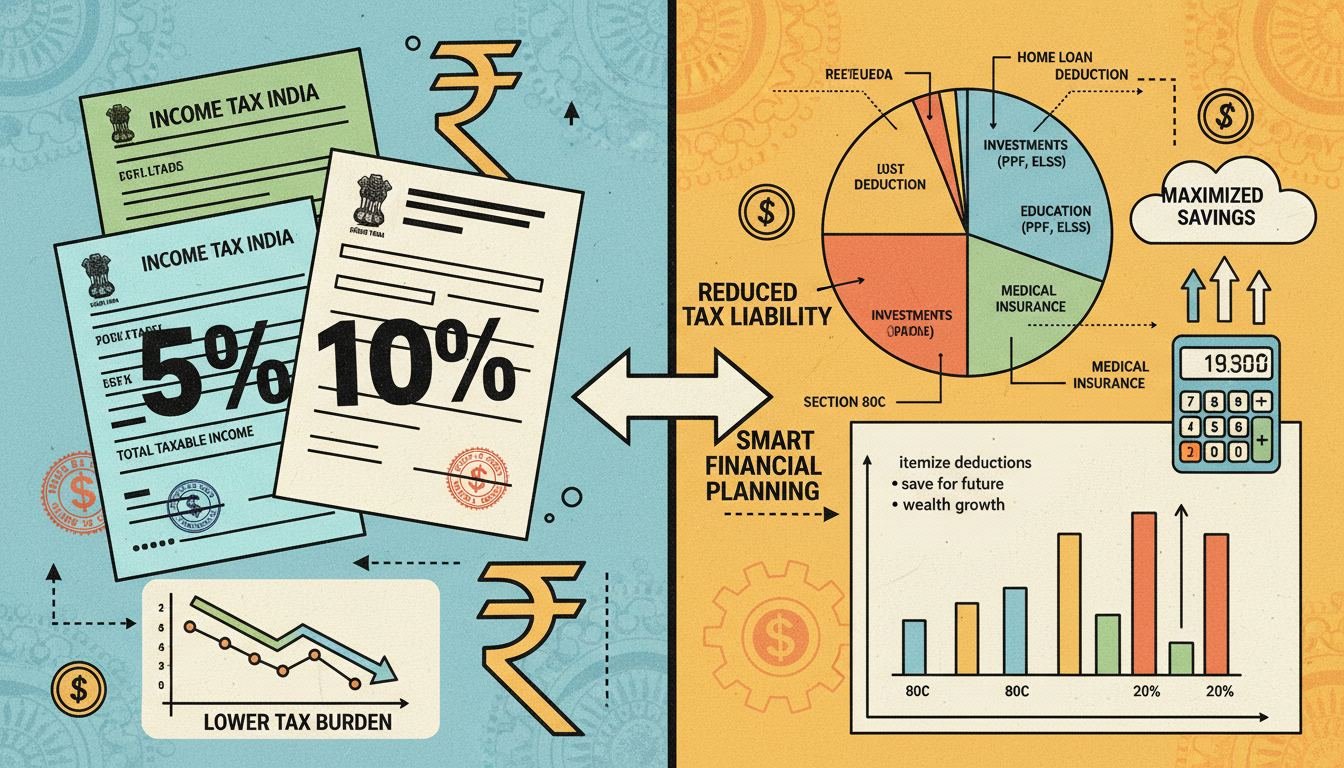
Understanding the new tax regime vs old tax regime for FY 2026-27
New tax regime vs old tax regime: the new regime is now the default option for FY 2026-27 under Section 202 of the Income Tax Act. You do not have to opt in. However, you can still choose the old tax regime if it benefits you more—you simply need to opt out of the new regime. The choice you make will shape how much tax you owe on your income, so it’s worth understanding both before you decide.
The core difference between the two regimes lies in tax rates and deductions. The new regime offers lower tax rates but fewer deductions. The old regime allows you to claim various deductions and exemptions that can significantly reduce your taxable income. Neither is universally better; it depends on your salary structure, investments, and life circumstances.
Standard deduction: a key advantage of the new regime
The new tax regime provides a standard deduction of Rs 75,000. This means Rs 75,000 of your income is not taxed. The old regime offers a standard deduction of only Rs 50,000. For salaried employees, this Rs 25,000 difference is immediate and often meaningful.
However, the standard deduction is just one piece of the puzzle. If you have significant housing costs, medical expenses, or investment commitments, the old regime’s deductions may outweigh this advantage. That’s where the choice becomes personal.
Tax rebates and income relief under each regime
| Aspect | New Regime | Old Regime |
|---|---|---|
| Rebate ceiling | Up to Rs 60,000 | Up to Rs 12,500 |
| Applies to income not exceeding | Rs 12 lakh | Rs 5 lakh |
| Eligibility | Applies automatically if income qualifies | Available if opted for and income qualifies |
The new regime’s rebate under Section 156 is significantly higher. If your total income does not exceed Rs 12 lakh, you can get a rebate of up to Rs 60,000. The old regime’s Section 156 rebate is capped at Rs 12,500 for income not exceeding Rs 5 lakh. For individuals earning between Rs 5 lakh and Rs 12 lakh, the new regime rebate is plainly superior.
This rebate applies automatically in the new regime. You do not need to claim it. In the old regime, you must file your return correctly to access it.
Deductions and exemptions: where the old regime shines
The old regime allows deductions that the new regime does not. Life Insurance Premium, Provident Fund contributions, and home loan principal repayment all fall under Section 80C. You can claim up to Rs 1.5 lakh in deductions annually. The new regime does not allow Section 80C deductions at all.
Health insurance premiums are covered under Section 80D in the old regime. Home loan interest on a second property is deductible under Section 24 of the old regime. HRA (House Rent Allowance) is fully deductible in the old regime but not in the new regime. For self-employed individuals, business-related deductions are simpler to claim under the old regime.
One exception applies to both regimes. Employer’s contribution to your NPS account under Section 124 is allowed in both the new and old regimes. This makes NPS a tax-efficient savings vehicle regardless of which regime you choose.
If you have strong commitments to life insurance, home loan repayment, or health insurance, the old regime may deliver lower overall tax even though the standard deduction is lower.
Which regime suits different income profiles?
High earners with low deductions: If you earn above Rs 12 lakh and do not make significant investments in life insurance, home loans, or health insurance, the new regime is likely better. The lower tax rates outweigh the missing deductions.
Salaried employees with HRA: If you receive HRA as part of your salary and can claim it as a deduction, the old regime is worth considering. Combined with health insurance premiums and life insurance, your total deductions could be substantial.
Self-employed professionals and business owners: The old regime generally favors business income. You can deduct a wider range of business expenses and claim Section 80C deductions for retirement planning.
Mid-income earners with family commitments: If you are paying for health insurance for yourself and dependents, funding a home loan, and contributing to life insurance, the old regime can be significantly advantageous even if your salary is in the Rs 8–12 lakh band.
The Rs 60,000 rebate in the new regime is attractive if you qualify, but it only applies if your total income does not exceed Rs 12 lakh. Many professionals cross this threshold with bonuses, rental income, or investment returns. Once you do, you lose the rebate entirely.
Capital gains taxation: rules that apply to both regimes
Capital gains taxation is independent of which income tax regime you choose. This matters if you are an active investor.
Short-term capital gains (STCG) on listed equities—shares held for less than one year—are taxed at 20%. Long-term capital gains (LTCG) on listed equities exceeding Rs 1.25 lakh are taxed at 12.5%. These rates apply whether you are under the new regime or the old regime.
One change relevant to active traders: the Securities Transaction Tax (STT) on options trading has increased from 0.10% to 0.15% of the premium value. This affects the cost of options strategies for FY 2026-27 onwards.
Capital losses can be set off against capital gains. If you have more losses than gains, you can carry forward the loss for up to 8 years, provided you file your return by the due date. This benefit applies regardless of your chosen tax regime.
Investment and payment deadlines for FY 2026-27
If you plan to claim deductions under the old regime—Section 80C investments, health insurance premiums, or home loan principal payments—you must complete these payments by March 31, 2027. This is a hard deadline. Any investment made on April 1, 2027, or later will not count toward FY 2026-27.
Advance tax payments follow a different schedule. The advance tax deadlines for FY 2026-27 are:
| Tranche | Due Date | Percentage of Annual Tax |
|---|---|---|
| First | December 15, 2026 | 30% |
| Second | December 15, 2026 | 45% (cumulative) |
| Third | March 15, 2027 | 75% (cumulative) |
| Final | March 31, 2027 | 100% |
If your income is variable or you receive a bonus late in the year, you can adjust your advance tax payments. The last opportunity to pay advance tax at full percentage is March 15, 2027.
How to decide: a practical framework
-
Calculate your likely deductions under the old regime. Add up all Section 80C investments, Section 80D health insurance, HRA (if applicable), and other old regime deductions you are eligible for. Be realistic about what you will actually pay by March 31, 2027.
-
Compare your taxable income under both regimes. Subtract the standard deduction from your gross income. Then subtract all old regime deductions from your gross income and compare the two. Use the applicable tax slab rates for each regime to calculate your final tax liability.
-
Factor in the rebate. If your income does not exceed Rs 12 lakh under the new regime, do not forget the Rs 60,000 rebate. It can erase a significant portion of your tax bill.
-
Consider employer NPS contributions. Since NPS contributions are allowed in both regimes, check if your employer offers this. It is a tax-efficient benefit regardless of your choice.
-
Think long-term. The old regime is not going away. Even if the new regime seems better this year, you can switch to the old regime next year if circumstances change. However, switching involves committing to deductions and planning more carefully.
As reported earlier, market volatility and economic uncertainty can affect your bonus and investment returns. Build some flexibility into your tax plan.
Key takeaways
- The new regime is the default for FY 2026-27, but you can opt for the old regime if you prefer.
- The new regime offers a Rs 75,000 standard deduction and a rebate up to Rs 60,000 for income not exceeding Rs 12 lakh.
- The old regime allows deductions under Section 80C (life insurance, PF, home loan principal), Section 80D (health insurance), and HRA that the new regime does not.
- Employer NPS contributions are allowed in both regimes.
- Investment and payment deadlines for old regime deductions end on March 31, 2027. Advance tax deadlines run through March 15, 2027.
- Capital gains tax rates are the same under both regimes: 20% for STCG on listed equities, 12.5% for LTCG above Rs 1.25 lakh.
FAQ
Q: Is the new tax regime compulsory for FY 2026-27?
A: No. The new tax regime is the default under Section 202. You are automatically in it. However, you can opt out and choose the old regime if you file your return accordingly. The choice is yours.
Q: Can I switch between regimes every year?
A: Yes. You can choose the new regime one year and the old regime the next, depending on which is more beneficial. You are not locked into one choice indefinitely. However, if you opt for the old regime, you must commit to making investments and payments by March 31 to claim deductions.
Q: What happens if I do not make my Section 80C investments by March 31, 2027?
A: They will not count toward FY 2026-27. Any investment made after March 31, 2027, will apply to FY 2027-28. This is why planning early matters if you are considering the old regime.
Q: If I earn Rs 13 lakh in FY 2026-27, can I still use the new regime rebate?
A: No. The Rs 60,000 rebate under Section 156 applies only if your total income does not exceed Rs 12 lakh. Once your income exceeds this threshold, you lose the rebate. This can make the old regime more attractive for higher earners.
Q: Are capital gains treated differently under the new and old regimes?
A: No. Capital gains taxation is independent of which income tax regime you choose. STCG on listed equities is taxed at 20%, and LTCG above Rs 1.25 lakh is taxed at 12.5% under both regimes.
Q: When are my advance tax payments due for FY 2026-27?
A: Advance tax is due in three tranches: 30% by December 15, 2026, 45% cumulatively by December 15, 2026 (the same date but covering more tax), and 75% cumulatively by March 15, 2027. The final 100% is due by March 31, 2027. These deadlines apply regardless of your chosen regime.
Q: Does my employer’s NPS contribution reduce my tax in both regimes?
A: Yes. Employer contributions to NPS are allowed under Section 124 in both the new and old regimes. This is one of the few deductions available in the new regime, making NPS a valuable tax-efficient savings tool for all employees.
The decision between the new tax regime and old tax regime ultimately depends on your personal circumstances. Run the numbers for your income, deductions, and investments. If the old regime saves you more tax, according to Skaga & Associates’ year-end planning guide, it is worth the extra planning. If the new regime with its higher standard deduction and rebate is simpler and delivers similar or better results, stick with it. Either way, do not leave money on the table by missing investment deadlines or overlooking eligible deductions.
Also read
Last updated: 22 November 2026
