
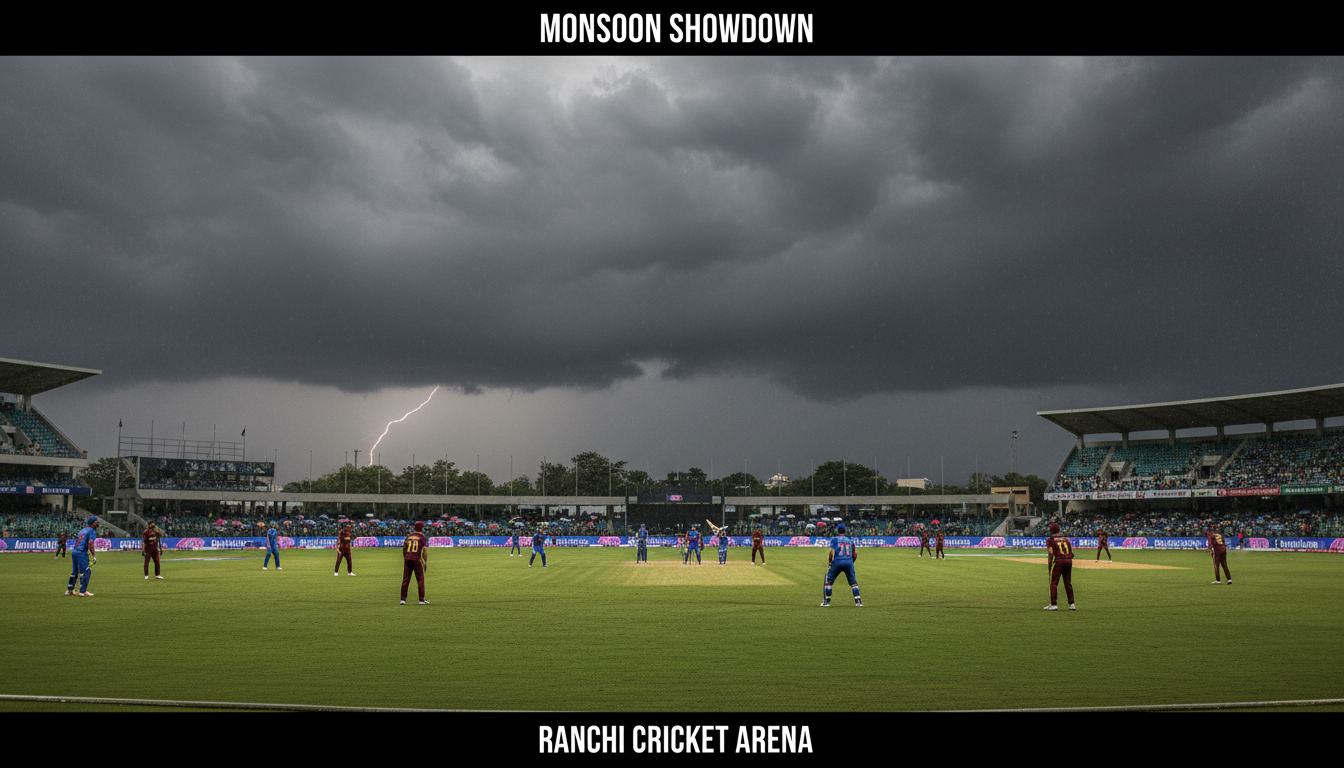
India vs West Indies 2nd T20I takes centre stage on October 9 in Ranchi, with the hosts looking to extend their series lead in what promises to be a contest shaped as much by the weather as by on-field tactics.
The series stands at 1-0 in India’s favour after a convincing win in the first match. A victory in Ranchi would put Rohit Sharma’s side in a commanding position in the five-match rubber. But rain clouds gathering over central India threaten to complicate matters—and possibly reduce what could be a full match into a curtailed affair.
Weather forecast clouds the India vs West Indies 2nd T20I
The meteorological department has flagged a genuine rain threat for Ranchi on match day. According to the match preview from India Today, showers are a real possibility. In T20 cricket, especially in a series decider scenario, even brief interruptions can shift momentum sharply.
A wet outfield could also affect the pitch behaviour. T20 matches in Ranchi tend to favour consistent pace and bounce. Rain can slow the surface and reduce swing opportunities early on. Either team’s bowling plans may need quick recalibration if conditions change mid-game.
The BCCI will monitor conditions through the day. If rain persists or threatens to truncate proceedings further, a reserve day isn’t an option in bilateral T20 series. Play reduced to fewer overs means batsmen take fewer risks. Death bowling becomes even more critical.
Playing XI selection headaches for India
Former India player Aakash Chopra has already waded into the selection debate ahead of the match. His analysis of India’s likely XI reflects broader concerns about balance and form in the squad.
Chopra’s assessment, cited across cricket media, underscores the tension between backing established names and experimenting with fresh talent. India’s middle order depth has been questioned in recent T20 cycles. The opening combination also invites scrutiny—particularly in unfamiliar conditions.
The possible playing XI analysis suggests India may tinker with the side. Rohit could opt for a specialist all-rounder in place of a pure batsman, or accelerate a young player’s T20I exposure. West Indies, meanwhile, will aim to exploit any discomfort in India’s setup.
One thing is certain: the team that settles on a balanced XI quicker will hold the edge psychologically.
Pitch and ground conditions in Ranchi
Ranchi’s Arun Jaitley Stadium (formerly JSCA International Stadium) has a reputation for hosting pacey, lively pitches. The venue sits at altitude, which aids pace bowling. Spinners also find assistance, particularly in the latter stages of an innings when footmarks develop.
The first T20I win gave India crucial momentum. Replicating that performance here means reading the pitch early and adapting batting depth accordingly. West Indies batsmen, many of whom play county cricket, are familiar with seaming conditions. They won’t be intimidated by India’s pace attack if the hosts don’t bowl tight lines.
A dry surface could favour India’s spinners, especially in the powerplay and at the death. Rain delays could reset the pitch dynamics entirely, nullifying any preparation advantage India has built.
West Indies’ comeback bid
Don’t mistake the West Indies for a pushover. Their history in T20 cricket, particularly in away series, shows resilience. They’ll approach Ranchi as a chance to level the series. A win here brings fresh belief to a squad that has struggled in recent bilateral T20s.
The Windies have some serious batting firepower. If India’s seamers aren’t disciplined early, a flurry of boundaries could put the hosts on the back foot. Their bowlers, too, have shown they can disrupt India’s rhythm if the ball is moving off the seam or in the air.
What India must do to extend the lead
Winning the toss will be a bonus, not a guarantee of victory. If India bats first and the sky clears, they should aim for 170-plus. That total is competitive on Ranchi’s pitch. Batting second offers a clearer read of conditions but demands clinical chasing in case of weather interruptions.
The powerplay is non-negotiable. A strong start sets the tone. India’s middle order—whoever plays—must prove they can build innings under varying pressure, not just hit sixes in the last three overs.
Bowling-wise, consistency matters more than pace. Dot balls, tight lines, and backing away from loose deliveries will starve West Indies of easy runs in the powerplay and at the death.
FAQ
Q: What time does the India vs West Indies 2nd T20I start in Ranchi?
A: The match is scheduled for October 9, 2026, in Ranchi. Specific start time depends on the broadcaster and venue, but T20I matches typically begin in the evening to cater to prime-time viewership.
Q: Will rain delay or cancel the match?
A: Rain is forecast but not guaranteed. The BCCI will make a call closer to match day. T20 matches can be reduced to fewer overs if rain interrupts play. There is no reserve day for bilateral T20 series.
Q: Who is leading the series after the first T20I?
A: India leads 1-0 after winning the first match. This is a five-match series, so four matches remain.
Q: What is Aakash Chopra’s take on India’s playing XI?
A: Chopra has flagged potential changes to India’s XI, suggesting the team may experiment with balance between batting depth and all-rounder options. His analysis highlights ongoing selection debates around middle-order stability.
Q: Is Ranchi a good venue for India’s cricket?
A: Ranchi’s pitch typically favours pace bowling and provides good bounce. The altitude aids fast bowlers. It’s considered a balanced venue where both bat and ball can dominate depending on conditions.
