
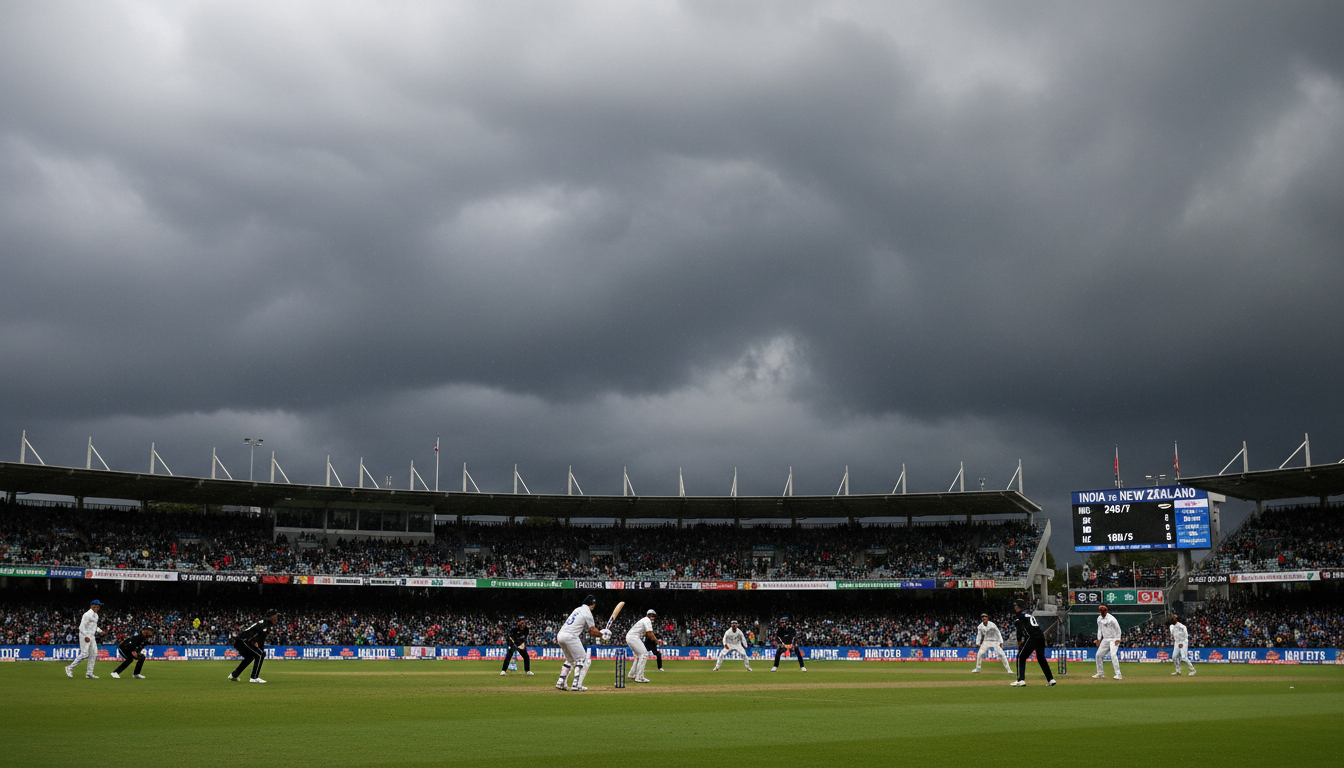
India aims for a commanding 2-0 series lead in the second ODI against New Zealand after securing a rain-affected victory in the opener. The second match, set for Wellington, will test India’s ability to maintain momentum while New Zealand grapples with a depleted batting lineup and the ever-present threat of inclement weather.
India’s 1-0 advantage comes with the caveat that rain shaped the first encounter significantly. The same weather pattern looms over Wellington, adding another variable to an already competitive series. Yet India holds the upper hand: their pace attack is about to strengthen further with Mohammed Siraj’s expected return.
Conway’s Concussion Reshapes New Zealand’s XI
Devon Conway will not play another match in the series after suffering a concussion in the first ODI. The absence of a batsman of his calibre leaves New Zealand’s middle order severely weakened. According to Indian Express analysis, New Zealand faces a genuinely difficult task in restructuring their batting lineup without their third-ranked ODI batter.
Conway’s removal from the squad isn’t merely a temporary setback. Five-match series can hinge on such injuries. New Zealand must now promote someone from the lower middle order or shuffle their entire batting strategy. This gives India a psychological edge heading into Wellington.
India’s bowlers, particularly the pace contingent, will sense vulnerability. Without Conway, New Zealand lacks a steady left-hander in the top six. The balance of their innings becomes precarious.
Siraj’s Return Bolsters India’s Pace
Mohammed Siraj is poised to slot back into India’s playing XI after his absence in the first match. His return strengthens India’s fast-bowling department considerably. Siraj brings variety and experience to an attack already putting New Zealand under pressure.
The predicted playing XI analysis suggests Siraj’s inclusion addresses any concerns about India’s pace depth. A three-pronged pace attack—bolstered by Siraj’s swing bowling—gives India a genuine edge on New Zealand pitches, where seam movement is often available.
New Zealand’s batting woes multiply when facing India’s enhanced bowling unit. The pressure mounts on their opening pair and middle order to rebuild quickly without Conway.
Rain: The Third Team in Wellington
Weather forecasts for Wellington show rain remains a significant concern. The first ODI already felt rain’s impact. If a similar pattern repeats, the second match could face interruptions, shortened overs, or even abandonment.
Rain-affected ODIs create unpredictable scenarios. Duckworth-Lewis calculations can swing momentum unexpectedly. Teams batting second often gain an advantage in reduced-overs cricket. This cuts both ways: India cannot assume their 1-0 lead translates automatically into a series win if rain forces a restart.
Wellington’s notorious weather means both captains must prepare contingency strategies. India’s batting unit needs to assess conditions quickly. New Zealand’s bowlers must capitalize if India bats first and faces rain delays mid-innings.
India’s Path to a 2-0 Lead
India’s victory in the first match followed a rain interruption that disrupted New Zealand’s momentum. The Rohit Sharma-led outfit showed composure in handling the disruption. Repeating that performance will be crucial.
A 2-0 lead would place India on the brink of series victory with three matches remaining. Psychologically, such a position is powerful. New Zealand would face immense pressure to avoid whitewash. India, meanwhile, could afford to rotate or rest key players in later matches.
The second ODI thus represents a potential turning point. India’s bowling attack now strengthens. New Zealand’s batting lineup weakens. Weather uncertainty affects both equally. These three factors converge on a single match in Wellington.
Predicted Playing XI and Team Strategy
India’s XI is expected to include Siraj, alongside their established pace bowlers. The batting order remains stable after a successful first-match chase. Continuity often matters in ODI series. India will likely resist wholesale changes.
New Zealand faces tougher decisions. Replacing Conway cannot be done seamlessly. Their selection committee must balance experience with form. A hasty reshuffle can backfire. Yet sticking with an unchanged XI (minus Conway) risks repetition of the first match’s shortcomings.
According to CricRadio’s reporting, India’s team composition is nearly settled, whereas New Zealand faces genuine selection headaches.
The Broader Series Context
This five-match series offers India a chance to assert dominance in ODI cricket away from home. New Zealand at home traditionally provides a stern test. Yet injuries and rain have already shifted the narrative.
India’s strength lies in their all-round depth. Their middle order bats deep. Their bowling combines pace and spin effectively. Siraj’s return addresses any perceived weaknesses in the fast-bowling unit.
New Zealand must rely on character and adaptability. Kane Williamson’s leadership will be tested. Their bowling can trouble India on green pitches. But without Conway, their batting blueprint requires urgent revision.
A 2-0 lead would validate India’s approach and execution thus far. It would also serve notice that India is not to be underestimated in New Zealand conditions.
FAQ
Q: Will Devon Conway play in the remaining ODIs?
A: No. Conway has been ruled out for the entire five-match series after his concussion in the first ODI. New Zealand cannot deploy him further.
Q: Is Mohammed Siraj definitely playing in the second ODI?
A: According to analysis of the predicted playing XI, Siraj is expected to return to India’s squad for the Wellington match. His inclusion strengthens India’s pace bowling.
Q: How does rain affect ODI series momentum?
A: Rain interruptions can truncate matches, alter run rates, and affect team morale. Wellington’s wet conditions mean the second ODI could face delays or shortened overs, similar to the first match.
Q: What does a 2-0 lead mean for the series outcome?
A: If India wins the second ODI and leads 2-0, they would be on the verge of series victory with three matches remaining. New Zealand would face extreme pressure to avoid a whitewash.
Q: How significant is Conway’s absence for New Zealand’s batting?
A: Very significant. Conway is a key batsman in New Zealand’s ODI lineup. His removal forces the team to restructure their middle order and weakens their overall batting depth considerably.
