
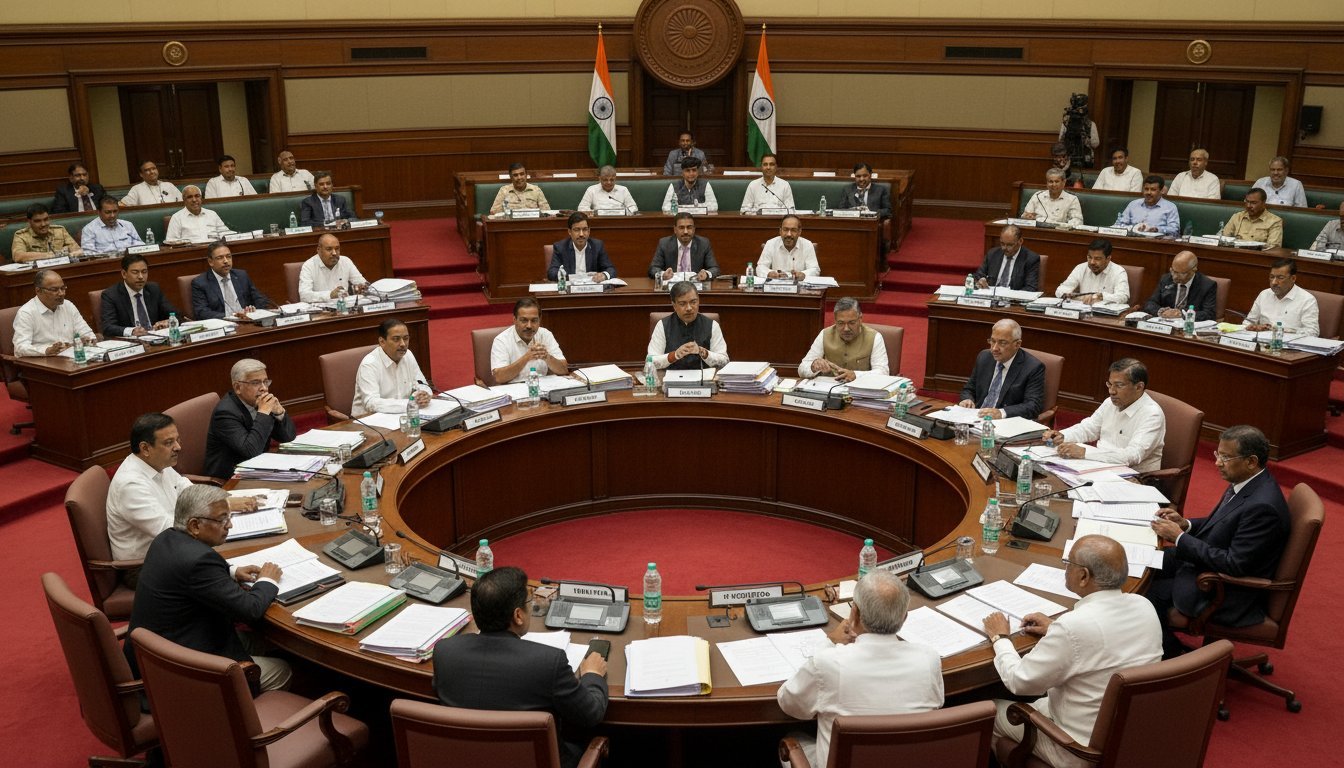
The delimitation bill discussion took centre stage as the Union Cabinet met on November 18, 2026, chaired by Prime Minister Narendra Modi, with the proposed legislation emerging as one of the meeting’s focal points. The government’s push to redraw constituency boundaries and expand parliamentary representation has already run into significant headwinds in the legislature.
The proposed bill aims to raise the maximum number of Lok Sabha seats from the current 550 to 850. This expansion would fundamentally reshape India’s electoral geography. But securing parliamentary approval has proven trickier than the government anticipated. A two-thirds majority—requiring 367 votes in the Lok Sabha and roughly 189 in the Rajya Sabha—remains elusive.
Opposition parties have mobilized quickly against the proposal. They argue the bill will disproportionately benefit Hindi-speaking states in the north while trimming representation for southern states. Regional parties from Tamil Nadu, Karnataka, and Andhra Pradesh view the changes as a threat to their constituencies’ voice in Parliament. Congress and regional allies have already signalled their intent to resist the measure, leaving the government several votes short of the constitutional threshold needed.
The Electoral Math Behind Delimitation Bill Discussion
The arithmetic is straightforward but unforgiving. The government currently holds 272 seats in the Lok Sabha with its coalition partners—well short of the 367 needed for a constitutional amendment. The Rajya Sabha presents its own challenge, where the government’s numbers are even tighter.
This explains why the Cabinet meeting was convened. Officials need to assess options for persuading fence-sitters and opposition legislators. Some reports suggest the government may explore side agreements with regional parties or attempt to build momentum through public messaging. Yet defections are unlikely to materialize quickly in the current political climate.
The opposition’s resistance is rooted in demographic and electoral history. The Lok Sabha’s seat allocation has remained frozen since 1976 under a constitutional provision that expires in 2026. Southern states have grown faster than northern ones since then, but their representation has stayed static. Expanding the total number of seats would theoretically allow the south more voices without explicitly reducing anyone else’s share. Opposition parties, however, fear the actual redistribution will still work against them.
Why States Are Divided on the Proposal
Hindi-speaking states view the expansion favourably. Uttar Pradesh, Bihar, Madhya Pradesh, and Rajasthan have seen significant population growth but hold roughly the same number of seats they did fifty years ago. An 850-seat Lok Sabha would allow these states to claim additional constituencies. Their support for the bill is fairly firm.
Southern states take the opposite view. Tamil Nadu, Karnataka, Telangana, and Kerala worry that the new seat allocation formula—typically based on population—will still shortchange them relative to their demographic weight. The fear isn’t irrational; historical data shows delimitation exercises have often benefited larger, more populous states at the expense of smaller or slower-growing ones.
Timeline and Next Steps
The government must now decide whether to pursue the bill aggressively or wait for a more auspicious political moment. A defeat on a constitutional amendment would be humiliating and could embolden opposition parties on other pending legislation.
As reported earlier on election preparations and political allegations, seat-sharing talks among alliance partners already dominate political conversations. The delimitation bill adds another layer of complexity to these negotiations. Some smaller coalition partners may extract concessions in exchange for supporting the measure.
One possibility is a modified version of the bill that addresses southern concerns more explicitly. Another is a delay of several months to allow behind-the-scenes negotiations to proceed. The Cabinet will likely authorize further consultations with opposition leaders and state governments before any legislation is formally introduced.
The Broader Constitutional Question
At its core, the delimitation bill touches on fundamental questions about how India distributes political power. A state’s Lok Sabha representation shapes its influence over national policy, budgets, and ministerial posts. No state willingly accepts what it perceives as a diminution of its clout.
The proposal also reopens old regional tensions. The Hindi heartland versus southern divide has simmered in Indian politics since the independence era. Official language policy, water-sharing agreements, and resource allocation have all been battlegrounds. Delimitation adds electoral representation to that list.
FAQ
What exactly is the Delimitation Bill?
The proposed bill aims to increase the maximum number of Lok Sabha seats from 550 to 850 and redraw constituency boundaries across India based on updated population data and demographic shifts.
Why does the government need a two-thirds majority?
Delimitation is a constitutional matter. Any change to the structure or composition of Parliament requires a constitutional amendment, which mandates a two-thirds majority in both the Lok Sabha and Rajya Sabha.
Which states support and oppose the bill?
Hindi-speaking states like Uttar Pradesh, Bihar, and Madhya Pradesh support it because they have grown demographically but retain older seat allocations. Southern states like Tamil Nadu, Karnataka, and Telangana oppose it, fearing reduced relative representation.
When will the bill be introduced?
No date has been announced. The Cabinet is still assessing the political feasibility. Introducing it now without a clear path to passage risks a humiliating defeat.
How does this affect state politics?
Additional Lok Sabha seats could change the balance of power in coalition governments and affect the allocation of ministerial berths. States expecting new seats will gain leverage; those fearing losses will resist harder.
The ball is now in the government’s court. Securing the two-thirds majority will require either extraordinary political consensus or a willingness to compromise on the bill’s scope. Neither appears imminent.
Also read
- Cyclone Akvan Intensifies Ahead of Landfall on Andhra Pradesh Coast as Very Severe Storm
- Delhi Air Pollution Remains in ‘Poor’ Category Despite Supreme Court Push; AQI at 294
