
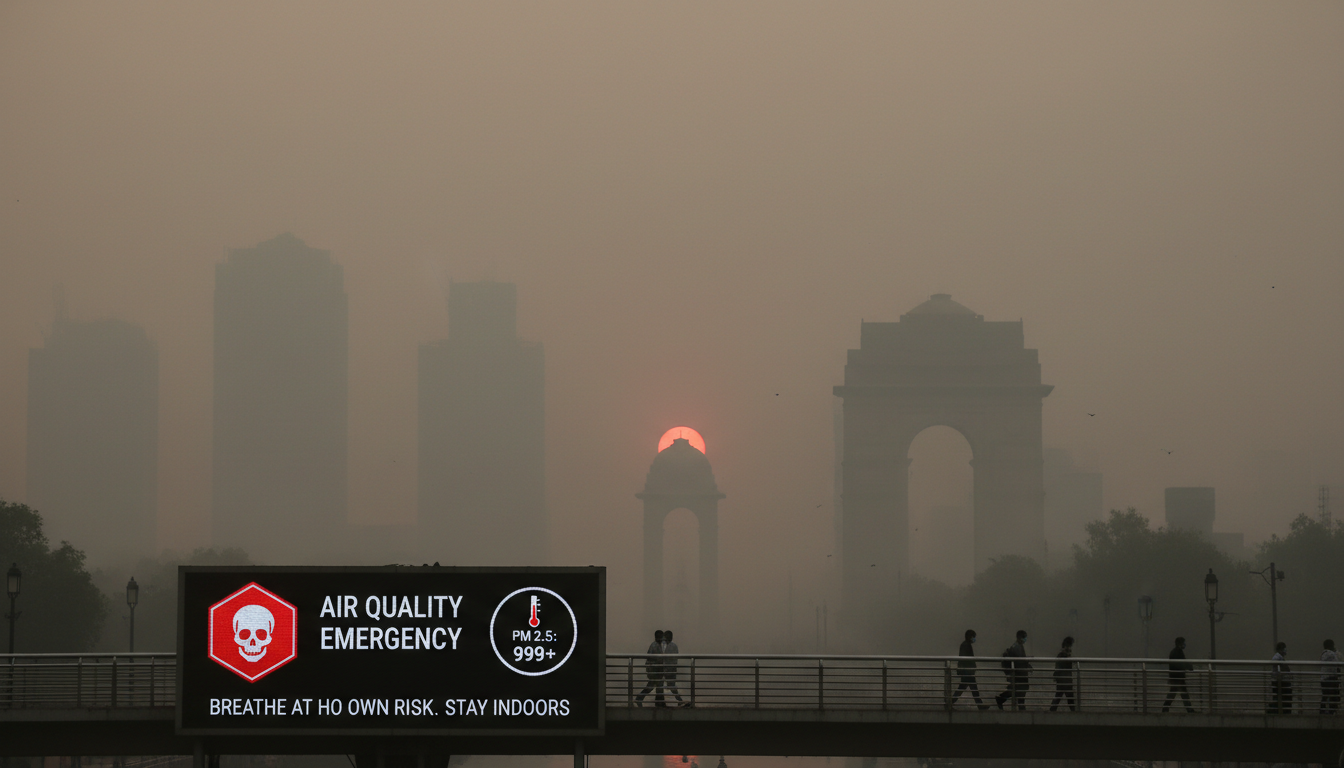
Delhi air quality severe has prompted the Commission for Air Quality Management (CAQM) to impose Stage 3 of the Graded Response Action Plan (GRAP) across Delhi and the National Capital Region. The action comes as air quality indices have worsened to dangerous levels, threatening public health and forcing authorities to take stricter measures against pollution sources.
The decision to activate Stage 3 reflects the gravity of the situation. Stage 3 restrictions go beyond advisory measures and require mandatory compliance from industries, construction sites, and transport operators. The move signals that conventional interventions have proven insufficient to check the deteriorating air quality in the region.
Air quality monitoring stations across the NCR have been recording readings in the severe category, a classification reserved for the most hazardous pollution levels. At these concentrations, even short-term exposure poses risks to the general population, not just vulnerable groups like children and the elderly.
Delhi air quality severe: What Stage 3 means
Stage 3 of GRAP introduces enforcement-backed restrictions. Construction and demolition activities face suspension. Schools may shift to online classes to reduce vehicular congestion. Government offices are asked to encourage work-from-home arrangements. Brick kilns and hot mix plants must halt operations. These are not suggestions—they are mandatory directives for institutions and businesses.
The Supreme Court has already flagged vehicular emissions as a major contributor to poor air quality in the region. Cars, buses, and trucks account for a significant portion of the nitrogen oxides and particulate matter choking Delhi’s air. According to recent reports, the concentration of pollutants has reached levels not seen in previous years at this time.
The Diwali factor and green cracker appeal
Timing has made the situation more urgent. Diwali celebrations are approaching, and the festival traditionally involves widespread firecracker use—a practice that has repeatedly sent air quality plummeting in past years. The Delhi government has already issued an appeal to citizens to use only green crackers and to adhere to restricted timings for their use.
The government’s appeal targets the window between 8 p.m. and 10 p.m. on Diwali night as the permitted time slot for crackers. Green crackers produce fewer harmful emissions compared to traditional ones. They contain chemicals that reduce particulate matter and harmful gases released into the atmosphere.
Citizens have been asked to exercise restraint. The message is clear: celebrations matter, but so does breathing safely. Compliance with firecracker restrictions remains voluntary, however, unlike the mandatory closures of industries under Stage 3.
Previous Diwali seasons have shown how rapidly air quality can deteriorate after firecracker bursting. Within hours of the festival, air quality indices have shot into the “hazardous” range. This year, with the region already at severe levels before the festival, the potential for further degradation is high.
Vehicular emissions remain central to the crisis
The Supreme Court’s identification of vehicular emissions as a major pollution driver has shaped the Stage 3 response. Odd-even schemes—restricting cars based on registration numbers—could be triggered if air quality continues to worsen. Public transport has been pushed as an alternative.
Construction sites across the region have already begun winding down operations in compliance with the restrictions. Dust from demolition and new building work is a significant contributor to particulate pollution. The suspension of these activities aims to reduce this source sharply.
Industries using coal or biomass have been asked to switch to cleaner fuels. Thermal power plants operating on coal are facing scrutiny. The restrictions acknowledge that pollution is not a single-source problem but a combination of vehicular, industrial, and environmental factors.
The broader pattern
This is not the first time Delhi has faced such crises. Every winter, the region experiences a seasonal spike in pollution. Factors like stubble burning in neighbouring states, cooler temperatures that trap pollutants near the ground, and increased heating fuel use all contribute. This year appears to be following the familiar pattern, but with earlier onset and possibly sharper severity.
The NCR encompasses not just Delhi but also parts of Haryana, Uttar Pradesh, and Punjab. Coordinating pollution control across state boundaries has proven challenging in the past. Stage 3 implementation requires synchronised action from multiple agencies across these states.
FAQ
What is Stage 3 GRAP?
Stage 3 is the third level of the Graded Response Action Plan. It mandates strict restrictions including suspension of construction work, closure of polluting industries, and possible work-from-home orders. It is activated when air quality reaches severe levels.
Can I burst crackers on Diwali?
The Delhi government has appealed to use only green crackers during the 8 p.m. to 10 p.m. window on Diwali night. Firecracker use outside this window or with traditional crackers may invite action, though enforcement varies.
Why are vehicular emissions a focus?
The Supreme Court has identified vehicular emissions as a major pollution contributor in Delhi-NCR. Cars, buses, and trucks release nitrogen oxides and particulate matter that degrade air quality. Reducing traffic is therefore a key Stage 3 measure.
How long will Stage 3 last?
Duration depends on air quality readings. If severe levels persist or worsen, Stage 3 remains active. If air quality improves to the “very poor” category, restrictions may be relaxed to Stage 2 or lifted entirely.
Are there health risks at severe air quality levels?
Yes. Severe air quality poses risks to the general population, not just vulnerable groups. Respiratory and cardiovascular problems can affect healthy individuals. Outdoor activities should be minimised, and masks should be worn when venturing out.
The implementation of Stage 3 GRAP marks a formal acknowledgment that Delhi-NCR faces an air quality crisis requiring immediate, coordinated action. Whether these measures, combined with public cooperation on firecracker use, can arrest the deterioration remains to be seen.
