
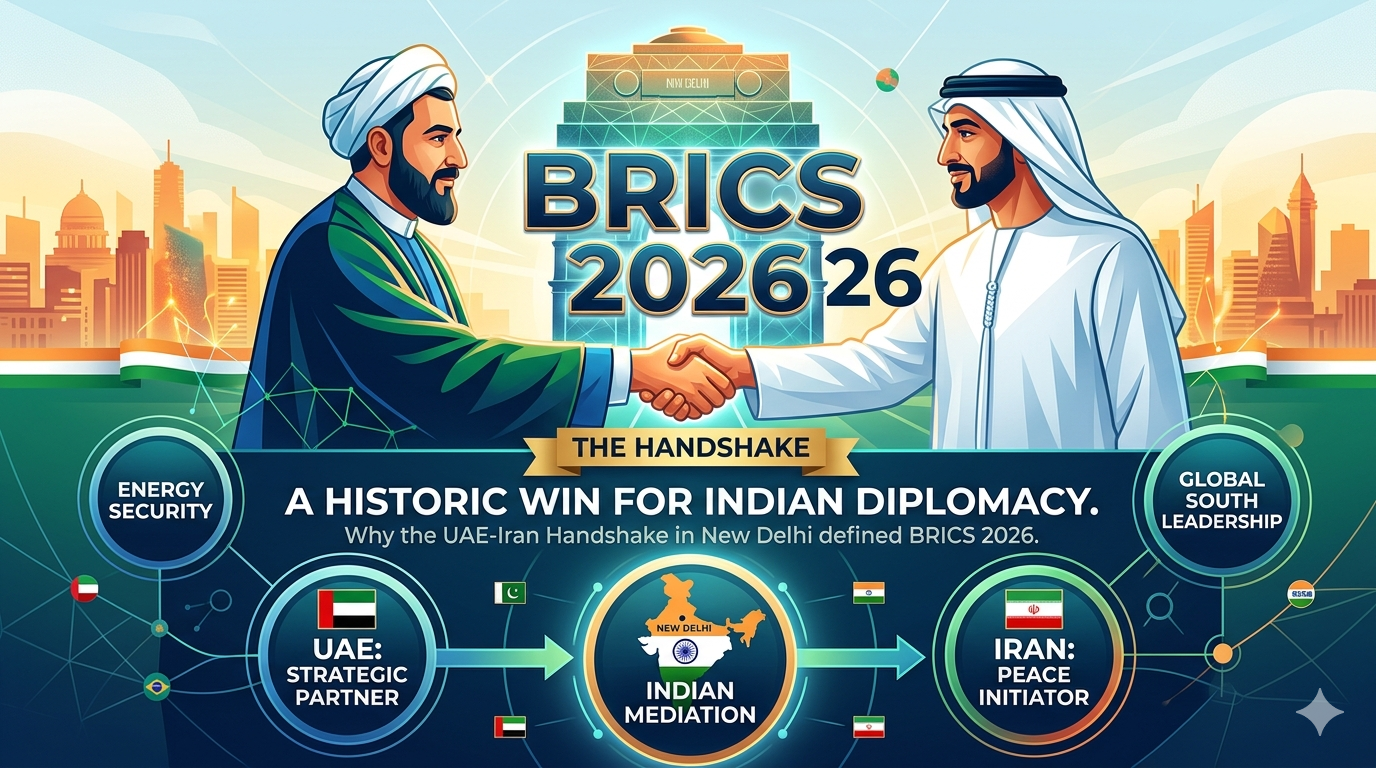
The world’s diplomatic eyes are currently fixed on New Delhi as it hosts the BRICS Foreign Ministers’ Meeting (May 14–15, 2026). While the agenda is packed with discussions on global governance and economic reform, the defining image of the summit has already emerged: a symbolic and strategic “handshake” between the Foreign Ministers of the United Arab Emirates (UAE) and Iran.
For India, acting as the host and mediator, this moment is far more than a photo op. It represents a masterclass in “strategic autonomy” and a pivotal victory for Indian diplomacy in the Middle East.
1. De-escalation Under the Indian Roof
The timing of this encounter is critical. Just a week prior to the summit, regional tensions flared after an attack on the Fujairah oil facility. As the current BRICS chair, India did not just issue a standard condemnation; it leveraged its “impartial” status to bring both sides to the table in New Delhi.
Iranian Deputy Foreign Minister Kazem Gharibabadi explicitly praised India’s role as “impartial” and “credible.” By facilitating dialogue between two rival powers who have historically struggled to find common ground within the BRICS framework, India has proved that it can manage the internal “West Asia divisions” that threatened to stall the grouping’s progress.
2. Securing the “Energy Lifeline”
India’s stakes in this reconciliation are deeply practical. The UAE is India’s fourth-largest crude source, while Iran holds the keys to the Strait of Hormuz—a narrow passage responsible for 20% of the world’s oil and LNG flow.
- Self-Charging Stability: By brokering peace, India ensures that its energy supply remains uninterrupted by regional skirmishes.
- The OPEC+ Context: With the UAE recently exiting the OPEC+ framework to pursue direct bilateral partnerships, India’s role as a bridge between the UAE and other regional powers like Iran becomes an irreplaceable strategic asset.
3. A Blow to Unilateralism
One of the most significant takeaways from this meeting is the unified stance against “unilateral mechanisms.” Iran and the UAE, despite their differences, found common language in New Delhi regarding the need for independent trade and financial banking ties that are not dependent on Western-dominated systems.
India has successfully positioned itself as the leader of the Global South, creating a space where countries can settle regional disputes without Western intervention. This “New Delhi Consensus” is a direct challenge to the idea that Middle Eastern peace can only be brokered in Washington or London.
4. The “Jaishankar Doctrine” in Action
External Affairs Minister S. Jaishankar’s vision for 2026 is clear: Multipolar Cooperation. By managing the “Vijay Factor” (the rising influence of domestic and regional actors), India has shown that its chairship is about more than just hosting; it’s about active conflict resolution.
The fact that Iran is now looking to India to leverage its “independent role” to halt wider regional hostilities (such as the US-Israel conflict) signifies a massive upgrade in India’s global standing. New Delhi is no longer just a participant in West Asian geopolitics—it is the arbiter.
Final Verdict
The UAE-Iran handshake in New Delhi is the ultimate validation of India’s foreign policy. It proves that India can maintain a Comprehensive Strategic Partnership with the UAE while simultaneously being a trusted “peace initiator” for Iran. As the summit concludes, the message to the world is clear: in 2026, the road to Middle Eastern stability runs through New Delhi.
Frequently Asked Questions: BRICS 2026 & The UAE-Iran Handshake
Q1: What is the significance of the UAE-Iran handshake at BRICS 2026? A: The handshake, mediated by India in New Delhi, symbolizes a major de-escalation of regional tensions in West Asia. It proves that BRICS can serve as a platform for conflict resolution among its members and highlights India’s growing influence as a neutral, “credible” global mediator.
Q2: How does this diplomatic win benefit the average Indian citizen? A: By fostering stability between the UAE and Iran, India secures its energy lifeline. Since 20% of the world’s oil passes through the Strait of Hormuz (controlled by Iran) and the UAE is a top supplier, this diplomacy helps prevent sudden spikes in petrol and diesel prices at home.
Q3: What role did S. Jaishankar play in this meeting? A: External Affairs Minister S. Jaishankar utilized what experts call the “Jaishankar Doctrine” of strategic autonomy. He successfully positioned India as the bridge between rival powers, ensuring that the BRICS 2026 agenda focused on collective economic growth rather than regional disputes.
Q4: Is BRICS 2026 different from previous summits? A: Yes. The 2026 summit is the first major meeting where the expanded “BRICS+” members (including UAE and Iran) have shown a unified front on creating independent trade mechanisms, reducing reliance on Western financial systems.
Q5: Why was New Delhi chosen as the venue for this historic dialogue? A: As the 2026 BRICS Chair, India hosted the Foreign Ministers’ Meeting. New Delhi was the logical “neutral ground” where both Middle Eastern nations felt comfortable engaging in high-level talks without the direct influence of Western or other regional blocs.
Based on the current 2026 landscape and your previous content focus on InstantNews.in, here are 8 high-engagement FAQ questions designed to keep readers on your page and improve your SEO ranking:
6. Why is the 2026 BRICS Summit in New Delhi being called a “pivot point” for the Global South?
- Answer: Unlike previous years, the 2026 summit focuses on “Agentic Diplomacy,” where India is leading the charge to create a BRICS-specific digital payment gateway to bypass traditional Western banking systems, specifically benefiting trade with the UAE and Iran.
7. How does the UAE-Iran de-escalation impact India’s internal fuel prices?
- Answer: Stability in the Strait of Hormuz reduces the “risk premium” on oil insurance. For Indian consumers, this means more stable petrol and diesel prices despite the peak summer demand across the country.
8. What is the “Jaishankar Doctrine” mentioned in the 2026 reports?
- Answer: It refers to India’s policy of “Multi-alignment,” where New Delhi maintains a Comprehensive Strategic Partnership with the US (via the Quad) while simultaneously acting as the primary mediator for Middle Eastern rivals within the BRICS framework.
9. Will the 2026 Assembly Election results impact India’s foreign policy?
- Answer: While local mandates in West Bengal and Tamil Nadu focus on internal development, the “Vijay Factor” and strong regional mandates give the central government a stable domestic platform to negotiate from a position of strength on the global stage.
10. Why are Hybrid SUVs trending more than EVs during the May 2026 heatwave?
- Answer: With temperatures hitting 48°C, many EV owners are facing “thermal throttling” issues and charging delays. Strong Hybrids are seen as more reliable because they use the engine to assist with heavy AC loads without draining the main drive battery.
11. Can India’s mediation help solve the ongoing maritime disputes in the Indian Ocean?
- Answer: During the BRICS 2026 meet, India proposed a “Blue Economy Security Protocol,” which aims to use satellite data sharing to prevent skirmishes, positioning Delhi as the “Net Security Provider” for the region.
12. How is AI being used in Indian diplomacy in 2026?
- Answer: The Ministry of External Affairs has launched a real-time “Vernacular Diplomatic Feed,” allowing BRICS delegates to communicate in their native languages (including Persian and Arabic) with instant, nuance-accurate translations.
13. Is India planning to introduce a “Summer Energy Tariff” for businesses?
- Answer: Rumors from the Ministry of Power suggest a new “Peak-Load Credit” system where businesses using energy-efficient tech (like solar or hybrid systems) will receive tax rebates to combat the record-breaking 2026 energy costs.
