
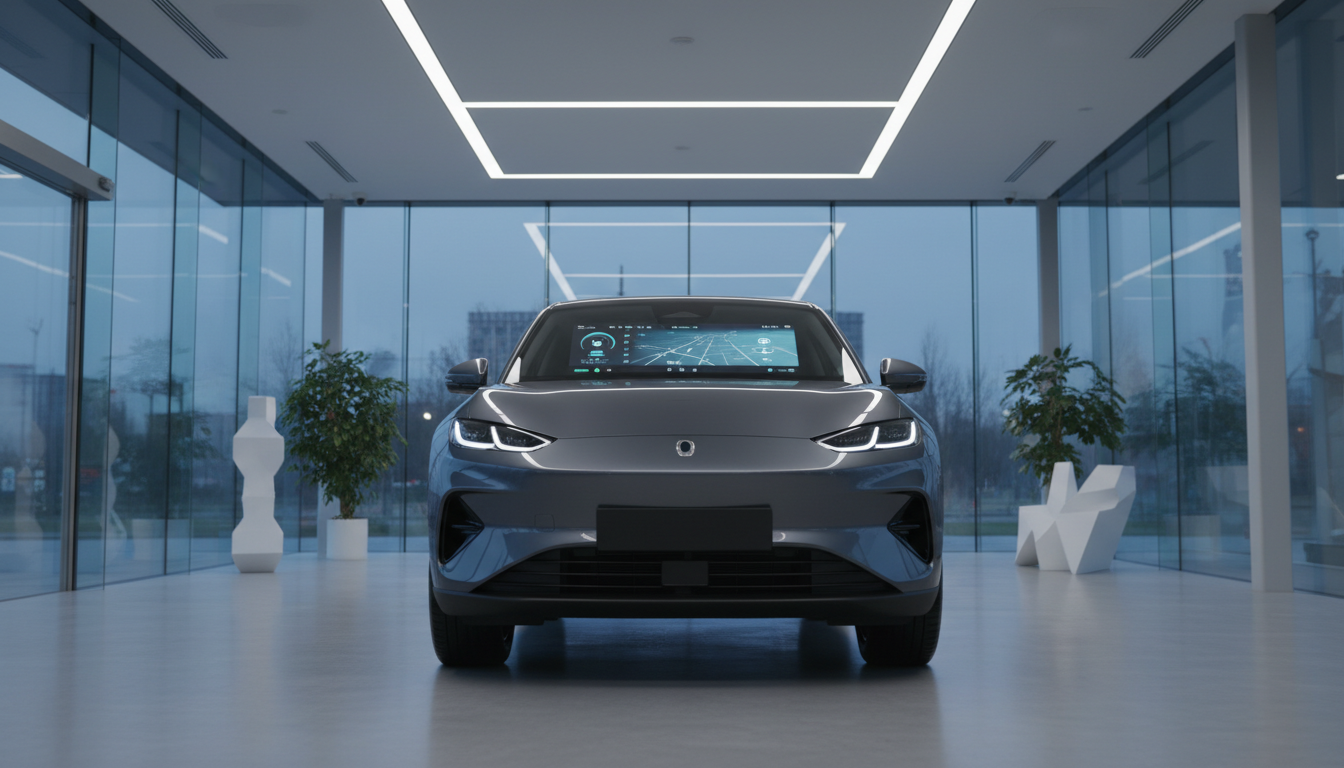
Chinese EV maker Xpeng has launched the Mona L05, an affordable electric SUV that undercuts rivals on price while delivering range and tech features that may force global automakers to reconsider their cost structures.
The Mona L05 starts at around $20,800 USD in China, making it one of the cheapest electric SUVs with a substantial driving range. According to Digital Trends, this pricing positions the vehicle squarely in the mass-market segment—territory where Western EV makers have struggled to compete profitably.
The entry-level model delivers up to 635 km of range on a full charge. That translates to roughly 395 miles, which exceeds what many similarly priced rivals offer in their home markets. For context, a Tesla Model Y or comparable mass-market EV at this price point typically offers 250 to 300 miles of range.
Spec sheet: What the Mona L05 offers
The Mona L05 isn’t bare-bones. The cabin centres on a 17.3-inch touchscreen—larger than the screens in most rivals at this price tier. A 26.8-inch head-up display spans the driver’s field of vision. Both elements suggest Xpeng is betting that tech-savvy buyers in China will value immersive digital interfaces over traditional chrome trim and leather seats.
The head-up display is particularly noteworthy. At this size, it’s more akin to what Audi and BMW charge €5,000–€8,000 to install on luxury models. Xpeng includes it standard on a vehicle that costs less than a base-model Honda Civic.
The vehicle is offered as a fully electric model, though Xpeng’s broader portfolio also includes plug-in hybrid options. The electric-only version is the headline act here.
Affordable electric SUV pricing shakes up the market
The sub-$21,000 entry price matters enormously. In China, where competition is fierce and margins razor-thin, Xpeng has found a way to deliver a compelling package at a figure that most Indian buyers would find accessible, albeit still beyond the reach of the broadest mass market here.
General Motors, Ford, and Volkswagen have all struggled to make profitable electric SUVs below $30,000. Xpeng’s achievement—whether it ultimately proves sustainable for the company is a separate question—suggests that Chinese supply chains, labour costs, and battery manufacturing scale have created a gap between East and West.
For American and European carmakers, the Mona L05 serves as a wake-up call. US automakers should be paying attention, as Digital Trends noted. If Xpeng can sustain this pricing while maintaining quality and profitability, it may reset customer expectations globally.
Indian automakers are watching too. Tata and MG have made inroads into the affordable EV segment here, but both struggle to offer range above 400 km at prices under ₹15 lakh. If Chinese competitors begin exporting vehicles like the Mona L05 to markets adjacent to India, or if Indian OEMs source batteries and platforms from Chinese suppliers, pricing pressure will intensify.
Technology at the centre
Xpeng has positioned itself as a tech-first EV maker. The Mona L05 reflects that philosophy. The 17.3-inch central screen is not just large; it’s likely running a proprietary OS optimised for over-the-air updates, infotainment, and vehicle controls. This is standard practise among Chinese EV makers now, but still relatively uncommon at this price point globally.
The 26.8-inch head-up display is almost theatrical. It projects navigation, speed, alerts, and entertainment across the windscreen in a band that occupies most of the driver’s sightline. Whether this enhances safety or distracts is debatable, but it certainly signals that Xpeng thinks Chinese buyers want innovation over understatement.
Climate control, driver-assist features, and smartphone integration are expected rather than exceptional. What stands out is the sheer density of tech per dollar spent.
Range claims and real-world expectations
The claimed 635 km range requires context. Chinese manufacturers typically test range using the CLTC standard, which is more generous than the WLTP standard used in Europe or the EPA standard in the US. Real-world range is likely lower—perhaps 500–550 km under mixed conditions.
Even accounting for that variance, 400+ miles of real-world range at under $21,000 is difficult to dismiss. It’s competitive with vehicles that cost $10,000–$15,000 more in North America.
Where the Mona L05 fits in Xpeng’s lineup
Xpeng already offers the G9, a larger SUV, and the P7, a sedan aimed at premium buyers. The Mona L05 occupies the entry-level rung. This tiered approach allows Xpeng to serve buyers across income brackets while maintaining brand presence and dealer network utilisation.
For buyers in China who need a practical electric vehicle without spending ₹18–₹25 lakh (rough equivalent), the Mona L05 fills a clear gap.
FAQ
Q: Is the Xpeng Mona L05 available outside China?
A: Not yet. Xpeng sells primarily in China, with some presence in select Southeast Asian markets. Export to India, Europe, or North America remains unconfirmed.
Q: What is the real-world range of the Mona L05?
A: The claimed 635 km range uses Chinese CLTC testing. Real-world range in mixed driving is likely 450–550 km, depending on weather, driving style, and terrain.
Q: How does the Mona L05’s price compare to competitors in China?
A: At $20,800, it undercuts most rival electric SUVs in its size and range class. Comparable vehicles from Li Auto, BYD, or NIO typically start $2,000–$8,000 higher.
Q: Does the Mona L05 come with a warranty?
A: Xpeng typically offers standard automotive warranties in China, though specifics vary by region and battery type.
Q: Can the battery be upgraded for more range?
A: Many Chinese EVs offer multiple battery pack options at purchase. Details on the Mona L05’s battery configurability remain limited in English-language sources.
