
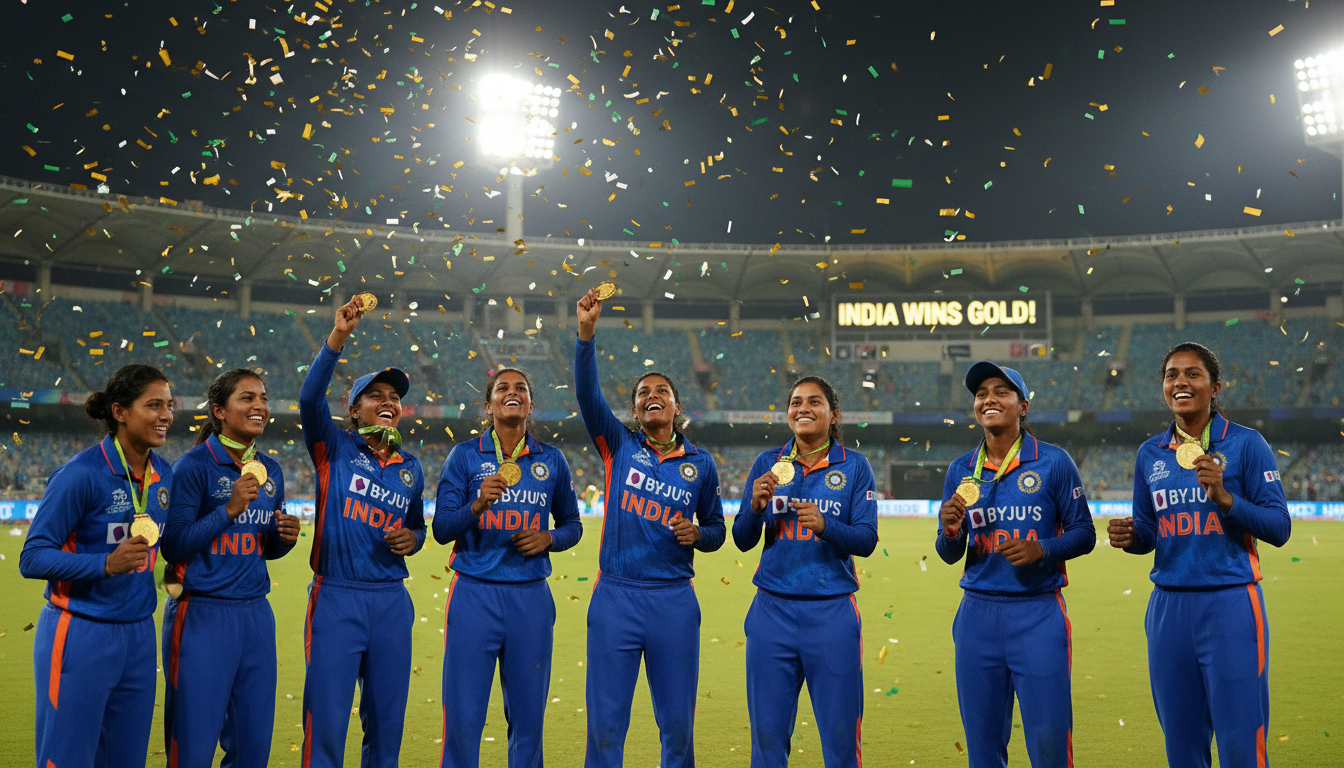
India’s Women’s T20 Asian Games gold triumph came with a scoreline so dominant it rewrote the record books. The team crushed Sri Lanka by 147 runs in the final, posting their highest margin of victory in Women’s T20 Internationals. This wasn’t a close contest. This was a statement.
The scale of the victory underscores how far Indian women’s cricket has come. A 147-run margin in a T20 format is extraordinary. The format itself—with its compressed timescales and explosive batting—rarely produces such runaway wins. Yet India didn’t just win. They overwhelmed.
How India Built the Winning Total
The foundation of India’s dominance was laid by their batting unit. Smriti Mandhana top-scored with 79 runs, combining aggression with the kind of controlled batting that wins finals. She set the tone early. Her runs created pressure that Sri Lanka could never quite relieve.
Shafali Verma added 48. The young opener brought her usual intent to the crease. These weren’t soft runs—they came in an environment where Sri Lanka was already on the back foot.
Then came Richa Ghosh. Playing an unbeaten 49, she accelerated in the final overs when boundaries mattered most. Her finishing ability pushed India’s total into a territory that looked insurmountable before Sri Lanka even batted.
Together, these three batters shaped a total that would become Sri Lanka’s mountainside.
The Bowling Masterclass
India’s bowling was equally clinical. Deepti Sharma took 3 wickets. She didn’t just pick up dismissals—she controlled the middle overs, that crucial phase where T20 matches are won or lost. With Sharma strangling Sri Lanka’s scoring rate and claiming scalps, the home side simply ran out of options.
The combination of strong batting followed by disciplined bowling created a gap too wide to bridge.
Women’s T20 Internationals Records Rewritten
India’s 147-run victory is now the largest margin in Women’s T20 Internationals history. That’s not hyperbole. That’s a record that will sit in the annals of the format. When you consider all Women’s T20 International cricket played across decades, India’s performance at the Asian Games 2026 stands at the peak.
The significance goes beyond numbers. Records in cricket mark turning points. They become reference moments. When future Indian women cricketers take the field in T20 formats, they’ll know what’s possible. They’ll know the standard.
Harmanpreet Kaur’s Team Delivers on the Biggest Stage
Under Harmanpreet Kaur’s captaincy, India has consistently delivered at major tournaments. The Asian Games gold represents another jewel in that crown. This isn’t a tournament where India scraped through on luck or narrow margins. They played the cricket expected of a top team: aggressive batting, smart bowling, and clinical execution.
The final itself demonstrated what Indian women’s cricket looks like when everything clicks. There was no hesitation, no tentative approach. Just sustained pressure and relentless execution.
The Broader Picture for Indian Women’s Cricket
This gold medal matters beyond the immediate satisfaction of victory. It reinforces India’s position as a powerhouse in women’s T20 cricket. The Asian Games gold attracts eyeballs, sponsorships, and—more importantly—young talent to the sport.
When 12-year-olds across India see Smriti Mandhana bat like she did in that final, or watch Deepti Sharma bowl with such control, they dream of doing the same. That dream pipeline is crucial to the sport’s future.
India’s women’s cricket ecosystem has matured substantially. State associations invest more. Media coverage is better. The BCCI has steadily increased its backing of the women’s game. Gold medals at Asian Games validate that investment.
What Comes Next
Asian Games gold is a landmark achievement. But Indian women’s cricket lives between World Cups now. The next major target is the ICC Women’s T20 World Cup. Gold at an Asian Games translates into confidence heading into world championships. It proves the team can handle pressure on the biggest stages.
The performances of Mandhana, Verma, Ghosh, and Sharma in this final are the kind that build momentum. Teams that carry such form into World Cup cycles don’t just participate—they contend for titles.
For now, though, India savours a record-breaking triumph. 147 runs. History made.
FAQ
Q: What was India’s margin of victory in the Women’s T20 Asian Games gold final?
A: India defeated Sri Lanka by 147 runs—the highest margin of victory in Women’s T20 International cricket history.
Q: Who scored the most runs for India in the final?
A: Smriti Mandhana top-scored with 79 runs. Richa Ghosh added an unbeaten 49, and Shafali Verma contributed 48.
Q: How many wickets did India’s bowlers take?
A: Deepti Sharma took 3 wickets for India in the final, playing a key role in the dominant victory.
Q: Is this India’s first Women’s T20 Asian Games gold medal?
A: Based on the record-breaking nature of this victory and the historic significance emphasised, this represents a major milestone in Indian women’s T20 cricket at the Asian Games level.
Q: Who captained India in this final?
A: Harmanpreet Kaur led India to the gold medal victory.
