
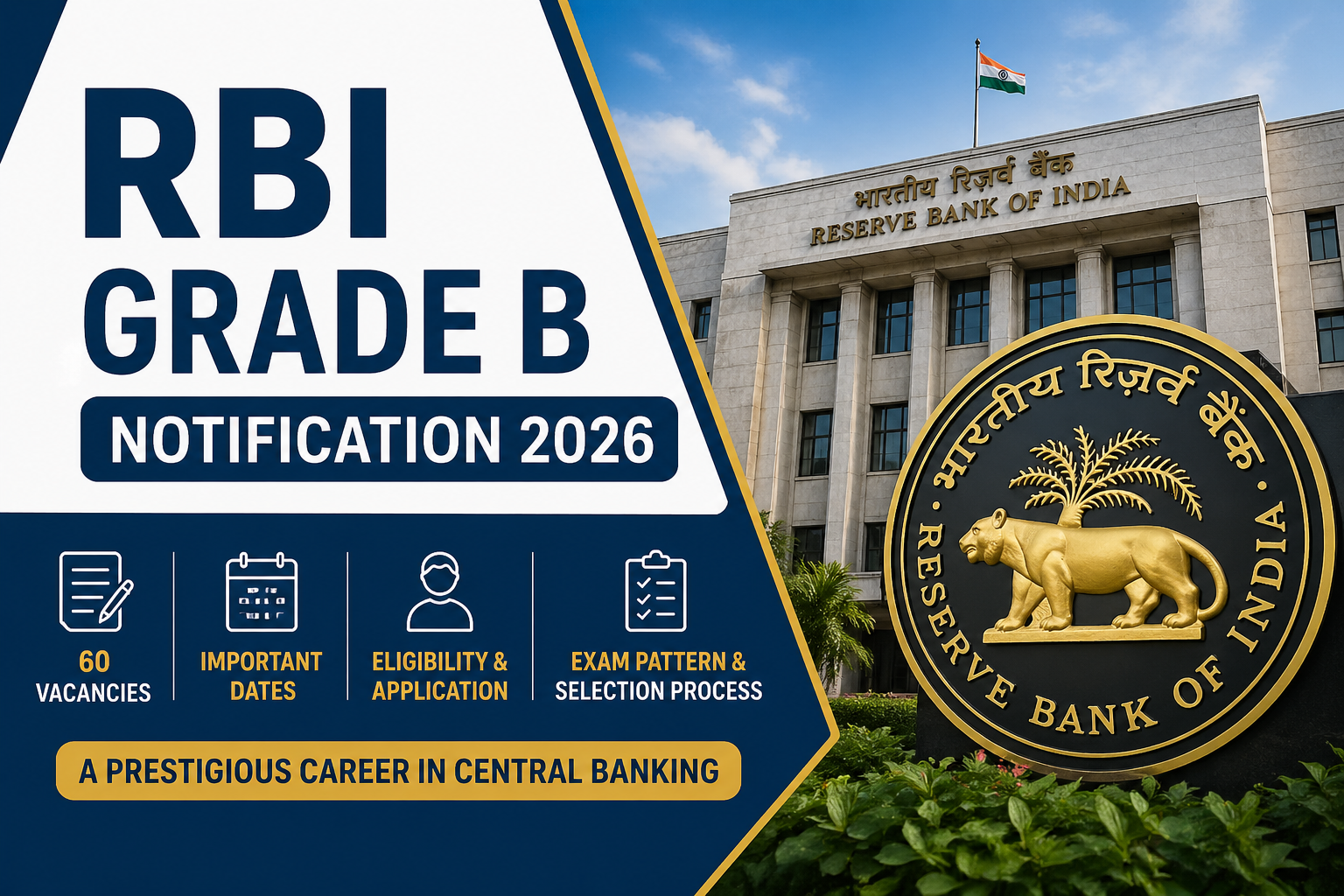
The Reserve Bank of India has officially announced the RBI Grade B Recruitment 2026, opening doors for candidates aspiring to build a career in the country’s central banking institution. This recruitment drive is aimed at filling officer-level positions in different streams, making it one of the most sought-after opportunities in the banking sector.
Key Highlights of RBI Grade B 2026
The notification for the 2026 cycle was released on 28 April 2026, with a total of 60 vacancies announced across multiple streams. Candidates will be able to submit their applications online starting from 29 April 2026, and the registration window will remain open until 20 May 2026. (adda247)
The recruitment includes positions in:
- General stream
- Department of Economic and Policy Research (DEPR)
- Department of Statistics and Information Management (DSIM)
Among these, the General stream carries the highest number of openings.
Vacancy Details
A total of 60 posts have been announced, distributed as follows:
- General: 40 posts
- DEPR: 10 posts
- DSIM: 10 posts
Compared to previous years, the number of vacancies is relatively lower, which indicates a likely increase in competition.
Important Dates
Candidates planning to apply should keep track of the following schedule:
- Application start date: 29 April 2026
- Last date to apply: 20 May 2026
- Phase I (Prelims): 13–14 June 2026
- Phase II (Mains): 25–26 July 2026
Applicants are advised to regularly check official updates for any changes in the schedule.
Eligibility Criteria
To be eligible for the RBI Grade B exam, candidates must meet certain conditions:
- Age Limit: 21 to 30 years (general category)
- Educational Qualification: A bachelor’s degree with at least 60% marks is required for the General stream, while specialized qualifications are needed for DEPR and DSIM roles
Additional relaxations apply to reserved categories as per government norms.
Application Fee
The application fee varies by category:
- General/OBC/EWS: ₹850 + GST
- SC/ST/PwBD: ₹100 + GST (adda247)
Payment must be completed online, and the fee is non-refundable.
Selection Process
The recruitment process is conducted in three stages:
- Phase I (Preliminary Exam): Objective-type screening test
- Phase II (Main Exam): Includes both objective and descriptive sections
- Interview: Final stage for shortlisted candidates
Final selection is based on performance in Phase II and the interview.
Salary and Benefits
The RBI Grade B officer position offers an attractive pay structure. The basic salary starts at ₹78,450 per month, and the overall monthly earnings can reach approximately ₹1.5 lakh when allowances are included.
Apart from salary, employees also receive benefits such as housing, medical facilities, and other perks, making it a highly rewarding career option.
Exam Pattern Overview
The preliminary examination tests candidates across four major areas:
- General Awareness
- Quantitative Aptitude
- English Language
- Reasoning Ability
The mains examination is more comprehensive and focuses on economic and financial concepts along with analytical writing skills.
Conclusion
The RBI Grade B 2026 recruitment presents a valuable opportunity for candidates aiming for a prestigious role in India’s central banking system. With limited vacancies and a rigorous selection process, serious preparation and a clear strategy will be essential for success. Candidates should carefully review the detailed notification and ensure they meet all eligibility requirements before applying.
Frequently Asked Questions (FAQs) – RBI Grade B 2026
1. What is RBI Grade B Recruitment 2026?
RBI Grade B Recruitment 2026 is a national-level exam conducted by the Reserve Bank of India to select officers for various departments like General, DEPR, and DSIM.
2. How many vacancies are announced for RBI Grade B 2026?
A total of 60 vacancies have been announced across different streams, with the majority in the General category.
3. What is the last date to apply for RBI Grade B 2026?
The last date to submit the online application is expected to be 20 May 2026. Candidates should apply well before the deadline to avoid last-minute issues.
4. What is the age limit for RBI Grade B exam?
Candidates must be between 21 and 30 years of age. Age relaxation is applicable for reserved categories as per government rules.
5. What educational qualification is required?
For the General stream, candidates need a bachelor’s degree with at least 60% marks (50% for reserved categories). Specialized qualifications are required for DEPR and DSIM posts.
6. What is the selection process for RBI Grade B?
The selection process consists of three stages:
- Phase I (Preliminary Exam)
- Phase II (Main Exam)
- Interview
Final selection depends on Phase II and interview performance.
7. Is RBI Grade B exam difficult?
Yes, it is considered one of the toughest banking exams in India due to limited vacancies and high competition. Strong preparation and consistency are essential.
8. What is the salary of an RBI Grade B officer?
The starting basic salary is ₹78,450 per month, and the gross monthly salary can go up to around ₹1.5 lakh including allowances.
9. How many attempts are allowed for RBI Grade B?
There is no fixed limit on attempts, but candidates must fall within the prescribed age limit to be eligible.
10. Can final-year students apply for RBI Grade B?
No, candidates must have completed their graduation and possess the required marks at the time of application.
11. Is there negative marking in the exam?
Yes, there is negative marking in Phase I. Typically, 0.25 marks are deducted for each incorrect answer.
12. What subjects are asked in Phase I exam?
Phase I includes:
- General Awareness
- Quantitative Aptitude
- English Language
- Reasoning Ability
13. Is RBI Grade B better than bank PO jobs?
RBI Grade B is generally considered more prestigious due to higher salary, better work-life balance, and policy-level exposure compared to typical bank PO roles.
14. How can I prepare for RBI Grade B 2026?
A focused strategy including current affairs, economic concepts, mock tests, and answer writing practice for Phase II is essential for success.
15. Is work experience required for RBI Grade B?
No, prior work experience is not mandatory. Fresh graduates can apply if they meet the eligibility criteria.
16. What is the exam mode for RBI Grade B?
Both Phase I and Phase II exams are conducted online. However, the interview is conducted in person.
17. How many papers are there in Phase II?
Phase II consists of three papers:
- Economic and Social Issues (ESI)
- English (Writing Skills)
- Finance and Management (FM)
18. Is the RBI Grade B interview tough?
The interview is designed to assess your personality, knowledge of current affairs, and understanding of economic concepts. With proper preparation, it is manageable.
19. What is the duration of the Phase I exam?
The Phase I exam is usually conducted for 120 minutes, with separate timing for each section.
20. Are there sectional cut-offs in RBI Grade B?
Yes, candidates must clear both sectional and overall cut-offs to qualify for the next stage.
21. Can candidates from any stream apply?
Yes, candidates from any academic background can apply for the General stream, provided they meet the minimum marks requirement.
22. Is coaching necessary for RBI Grade B preparation?
Coaching is not compulsory. Many candidates clear the exam through self-study with the help of standard books, online resources, and mock tests.
23. What is the language of the exam?
The exam is conducted in both English and Hindi, except for the English paper which is only in English.
24. How important are current affairs for RBI Grade B?
Current affairs, especially related to the economy, banking, and finance, play a crucial role in both Phase I and Phase II.
25. Can I choose the interview language?
Yes, candidates can choose either Hindi or English for the interview.
26. Is there any bond after selection?
Yes, selected candidates are required to sign a service bond, usually for a minimum period as specified in the official notification.
27. What is the job role of an RBI Grade B officer?
An RBI Grade B officer is involved in policy-making, financial regulation, currency management, and economic analysis.
28. Are transfers common in RBI Grade B jobs?
Yes, transfers can happen, but they are not very frequent compared to commercial banks.
29. What documents are required during the interview?
Candidates need to present educational certificates, identity proof, category certificates (if applicable), and other relevant documents.
30. Why is RBI Grade B considered a prestigious job?
It offers a high salary, strong job security, excellent work environment, and the opportunity to contribute to the country’s financial system through the Reserve Bank of India.
Here are FAQs 31 to 50 to complete your section:
31. Is there a descriptive paper in RBI Grade B?
Yes, Phase II includes a descriptive English paper that tests writing skills like essays, precis, and comprehension.
32. What type of questions are asked in the English paper?
The English paper focuses on essay writing, reading comprehension, and precis writing to evaluate clarity and expression.
33. How much time is required to prepare for RBI Grade B?
Preparation time varies, but most serious aspirants spend 6 to 12 months covering concepts, current affairs, and practice tests.
34. What is the syllabus for Economic and Social Issues (ESI)?
The ESI syllabus includes topics like growth and development, poverty, globalization, Indian economy, and social structure.
35. What is included in Finance and Management (FM)?
FM covers financial systems, banking concepts, risk management, along with management topics like leadership and motivation.
36. Are calculators allowed in the exam?
No, calculators are not allowed. Candidates must rely on their mental calculation skills.
37. What is the marking scheme in Phase II?
Phase II includes both objective and descriptive questions, with marks varying for each paper. There is negative marking in objective sections.
38. Can I change my exam center after applying?
No, once the application form is submitted, exam center changes are generally not allowed.
39. How is the final merit list prepared?
The final merit list is based on marks obtained in Phase II and the interview.
40. What is the probation period for RBI Grade B officers?
Selected candidates usually undergo a probation period of 2 years.
41. Are RBI Grade B officers eligible for promotions?
Yes, officers get regular promotions based on performance and experience within the Reserve Bank of India.
42. Is there a dress code for the interview?
There is no strict dress code, but formal attire is recommended to create a professional impression.
43. Can I apply for multiple streams at once?
No, candidates can apply for only one stream at a time based on their eligibility.
44. What is the role of DEPR officers?
DEPR officers mainly work on economic research, policy formulation, and analysis within the RBI.
45. What is the role of DSIM officers?
DSIM officers focus on statistical analysis, data management, and research related to financial systems.
46. Is there any training after selection?
Yes, selected candidates undergo training programs to understand RBI functions, policies, and operations.
47. What are the working hours for RBI Grade B officers?
Typically, the working hours are fixed and balanced, offering a better work-life balance compared to many other banking jobs.
48. Do RBI Grade B officers get accommodation?
Yes, officers may receive housing facilities or a housing allowance depending on availability.
49. What are the career growth opportunities?
RBI offers excellent career growth, allowing officers to rise to senior positions like Deputy Governor over time.
50. Where can I find the official notification and updates?
Candidates should regularly check the official website of the Reserve Bank of India for accurate and updated information.
RBI Grade B 2026 – 50 Most Expected MCQs
General Awareness (1–15)
1. Who is the current Governor of the Reserve Bank of India?
A. Shaktikanta Das
B. Urjit Patel
C. Raghuram Rajan
D. Duvvuri Subbarao
Answer: A
2. Repo Rate is decided by which body?
A. Finance Ministry
B. Monetary Policy Committee
C. SEBI
D. NITI Aayog
Answer: B
3. What does CRR stand for?
A. Cash Reserve Ratio
B. Credit Risk Ratio
C. Current Reserve Rate
D. Capital Risk Ratio
Answer: A
4. Which institution regulates the securities market in India?
A. RBI
B. SEBI
C. NABARD
D. SIDBI
Answer: B
5. What is the full form of IMF?
A. International Monetary Fund
B. Indian Monetary Forum
C. International Market Federation
D. Indian Market Fund
Answer: A
6. Which bank issues currency notes in India?
A. SBI
B. Finance Ministry
C. RBI
D. NABARD
Answer: C
7. What is Inflation?
A. Increase in production
B. Decrease in money supply
C. Rise in general price level
D. Increase in employment
Answer: C
8. What does GDP measure?
A. Population growth
B. Total goods and services produced
C. Inflation rate
D. Export value
Answer: B
9. Which organization releases the World Economic Outlook?
A. World Bank
B. IMF
C. WTO
D. UNDP
Answer: B
10. What is the full form of NEFT?
A. National Electronic Funds Transfer
B. New Economic Fund Transfer
C. National Exchange Fund Transfer
D. Net Electronic Finance Tool
Answer: A
11. What is the purpose of SLR?
A. Control inflation
B. Maintain liquidity
C. Increase loans
D. Reduce taxes
Answer: B
12. Which sector contributes the most to India’s GDP?
A. Agriculture
B. Manufacturing
C. Services
D. Mining
Answer: C
13. What is Fiscal Deficit?
A. Total revenue
B. Total expenditure minus revenue
C. Tax collection
D. Government savings
Answer: B
14. Which ministry prepares the Union Budget?
A. RBI
B. Finance Ministry
C. Commerce Ministry
D. NITI Aayog
Answer: B
15. What is the base year for GDP calculation in India?
A. 2004-05
B. 2011-12
C. 2015-16
D. 2020-21
Answer: B
Quantitative Aptitude (16–25)
16. What is 25% of 480?
A. 100
B. 110
C. 120
D. 140
Answer: C
17. If x + 5 = 12, find x.
A. 5
B. 6
C. 7
D. 8
Answer: C
18. Average of 10, 20, 30 is?
A. 15
B. 20
C. 25
D. 30
Answer: B
19. Simple Interest on ₹1000 at 10% for 2 years?
A. 100
B. 150
C. 200
D. 250
Answer: C
20. What is √144?
A. 10
B. 11
C. 12
D. 13
Answer: C
21. 15 × 12 = ?
A. 160
B. 170
C. 180
D. 190
Answer: C
22. If a train travels 60 km in 1 hour, distance in 5 hours?
A. 200 km
B. 250 km
C. 300 km
D. 350 km
Answer: C
23. Ratio of 20:40 is?
A. 1:2
B. 2:1
C. 3:2
D. 4:1
Answer: A
24. 5² = ?
A. 10
B. 20
C. 25
D. 30
Answer: C
25. What is 10% of 200?
A. 10
B. 20
C. 30
D. 40
Answer: B
Reasoning Ability (26–35)
26. Find the odd one out: Apple, Banana, Carrot, Mango
A. Apple
B. Banana
C. Carrot
D. Mango
Answer: C
27. If CAT = DBU, then DOG = ?
A. EPH
B. EOG
C. DPH
D. EPG
Answer: A
28. What comes next: 2, 4, 8, 16, ?
A. 18
B. 24
C. 32
D. 64
Answer: C
29. Mirror image of LEFT is?
A. TFEL
B. LEFT
C. TFEI
D. FELT
Answer: A
30. Blood relation: Father’s brother is?
A. Uncle
B. Cousin
C. Grandfather
D. Nephew
Answer: A
31. If A = 1, B = 2, then C = ?
A. 2
B. 3
C. 4
D. 5
Answer: B
32. Find missing number: 3, 6, 9, ?
A. 10
B. 11
C. 12
D. 13
Answer: C
33. Direction: East → South → West → ?
A. North
B. East
C. South
D. West
Answer: A
34. Odd one: Dog, Cat, Cow, Tiger
A. Dog
B. Cat
C. Cow
D. Tiger
Answer: C
35. Coding: 123 → 234, 456 → ?
A. 567
B. 568
C. 5678
D. 4567
Answer: A
English Language (36–50)
36. Choose correct spelling:
A. Recieve
B. Receive
C. Receeve
D. Recive
Answer: B
37. Synonym of “Big”
A. Small
B. Large
C. Tiny
D. Short
Answer: B
38. Antonym of “Happy”
A. Sad
B. Joyful
C. Glad
D. Cheerful
Answer: A
39. Fill in the blank: She ___ going to school.
A. is
B. are
C. am
D. be
Answer: A
40. Choose correct sentence:
A. He go to school
B. He goes to school
C. He going school
D. He gone school
Answer: B
41. One word substitution for “one who writes poems”
A. Poet
B. Writer
C. Author
D. Editor
Answer: A
42. Idiom: “Break the ice” means?
A. Start conversation
B. Destroy something
C. Freeze
D. Fight
Answer: A
43. Fill in: I have ___ apple.
A. a
B. an
C. the
D. no article
Answer: B
44. Synonym of “Quick”
A. Slow
B. Fast
C. Late
D. Weak
Answer: B
45. Antonym of “Strong”
A. Weak
B. Powerful
C. Solid
D. Tough
Answer: A
46. Choose correct tense: He ___ eaten food.
A. has
B. have
C. had
D. is
Answer: A
47. Fill in: They ___ playing cricket.
A. is
B. are
C. am
D. be
Answer: B
48. One word for “fear of heights”
A. Claustrophobia
B. Acrophobia
C. Hydrophobia
D. Xenophobia
Answer: B
49. Idiom: “Hit the nail on the head” means?
A. Be exact
B. Miss target
C. Hurt someone
D. Build something
Answer: A
50. Choose correct article: ___ sun rises in the east.
A. A
B. An
C. The
D. No article
Answer: C
RBI Grade B 2026 – Full Mock Test (100 Questions)
Section 1: General Awareness (1–25)
1. Repo Rate is decided by:
A. Finance Ministry
B. Monetary Policy Committee
C. SEBI
D. SBI
Answer: B
2. Reverse Repo Rate means:
A. RBI lends to banks
B. Banks lend to RBI
C. Government borrows
D. Public borrows
Answer: B
3. CRR is maintained with:
A. RBI
B. SBI
C. Government
D. SEBI
Answer: A
4. Full form of NBFC:
A. Non-Banking Financial Company
B. National Banking Finance Corporation
C. New Banking Finance Company
D. Non-Budget Finance Company
Answer: A
5. Who regulates stock market in India?
A. RBI
B. SEBI
C. NABARD
D. SIDBI
Answer: B
6. Inflation is measured by:
A. CPI/WPI
B. GDP
C. NPA
D. Repo Rate
Answer: A
7. Fiscal deficit means:
A. Income > Expense
B. Expense > Income
C. Savings
D. Loans
Answer: B
8. IMF headquarters is in:
A. London
B. Washington D.C.
C. Geneva
D. Paris
Answer: B
9. GDP full form:
A. Gross Domestic Product
B. General Domestic Product
C. Gross Development Product
D. Global Domestic Product
Answer: A
10. Bank Rate is:
A. Lending rate
B. Borrowing rate
C. Long-term rate
D. Short-term rate
Answer: C
11. SLR is maintained in form of:
A. Cash only
B. Gold & securities
C. Loans
D. Bonds only
Answer: B
12. NPA stands for:
A. Non-Performing Asset
B. Net Profit Asset
C. National Public Asset
D. Non-Profit Asset
Answer: A
13. Which sector contributes most to India GDP?
A. Agriculture
B. Industry
C. Services
D. Mining
Answer: C
14. What is Budget?
A. Income statement
B. Govt financial plan
C. Tax plan
D. Savings
Answer: B
15. RBI established in:
A. 1935
B. 1947
C. 1950
D. 1969
Answer: A
16. Demonetization happened in:
A. 2014
B. 2015
C. 2016
D. 2017
Answer: C
17. Which body sets inflation target?
A. RBI alone
B. Govt alone
C. MPC
D. SEBI
Answer: C
18. Forex reserves are held by:
A. RBI
B. SBI
C. Govt
D. IMF
Answer: A
19. Digital payments include:
A. UPI
B. NEFT
C. RTGS
D. All
Answer: D
20. What is repo rate used for?
A. Control inflation
B. Increase exports
C. Reduce GDP
D. Increase tax
Answer: A
21. Which bank is central bank?
A. SBI
B. RBI
C. ICICI
D. HDFC
Answer: B
22. Monetary policy controls:
A. Taxes
B. Money supply
C. Govt spending
D. Trade
Answer: B
23. Current account deficit relates to:
A. Trade
B. Budget
C. Loans
D. Savings
Answer: A
24. Blue economy relates to:
A. Agriculture
B. Ocean resources
C. Industry
D. Banking
Answer: B
25. G20 is:
A. Military group
B. Economic group
C. Sports group
D. Cultural group
Answer: B
Section 2: Quantitative Aptitude (26–50)
26. 20% of 500 =
A. 80
B. 90
C. 100
D. 120
Answer: C
27. 15 × 8 =
A. 100
B. 110
C. 120
D. 130
Answer: C
28. √169 =
A. 11
B. 12
C. 13
D. 14
Answer: C
29. SI on 1000 at 10% for 3 years =
A. 200
B. 250
C. 300
D. 350
Answer: C
30. Average of 5,10,15 =
A. 10
B. 12
C. 15
D. 20
Answer: A
31. Ratio 10:20 =
A. 1:2
B. 2:1
C. 3:2
D. 4:1
Answer: A
32. 25² =
A. 525
B. 625
C. 725
D. 825
Answer: B
33. 100 ÷ 4 =
A. 20
B. 25
C. 30
D. 40
Answer: B
34. 60 km/hr × 2 hr =
A. 100
B. 110
C. 120
D. 140
Answer: C
35. 10% of 300 =
A. 20
B. 30
C. 40
D. 50
Answer: B
36. 5³ =
A. 100
B. 110
C. 125
D. 150
Answer: C
37. Profit = SP – ?
A. CP
B. Loss
C. Discount
D. Tax
Answer: A
38. 40% of 200 =
A. 60
B. 70
C. 80
D. 90
Answer: C
39. 18 × 5 =
A. 80
B. 85
C. 90
D. 95
Answer: C
40. 144 ÷ 12 =
A. 10
B. 11
C. 12
D. 13
Answer: C
41. 7² =
A. 42
B. 45
C. 49
D. 56
Answer: C
42. 1/2 of 50 =
A. 20
B. 25
C. 30
D. 35
Answer: B
43. Time = Distance / ?
A. Speed
B. Work
C. Rate
D. Force
Answer: A
44. 90 ÷ 3 =
A. 20
B. 25
C. 30
D. 35
Answer: C
45. 12 × 12 =
A. 124
B. 134
C. 144
D. 154
Answer: C
46. 3/4 of 100 =
A. 70
B. 75
C. 80
D. 85
Answer: B
47. 16² =
A. 246
B. 256
C. 266
D. 276
Answer: B
48. 45 + 55 =
A. 90
B. 95
C. 100
D. 105
Answer: C
49. 81 ÷ 9 =
A. 8
B. 9
C. 10
D. 11
Answer: B
50. 200 – 50 =
A. 120
B. 130
C. 140
D. 150
Answer: D
Section 3: Reasoning Ability (51–75)
51. Odd: Apple, Mango, Carrot, Banana
Ans: Carrot
52. Series: 2,4,6,?
Ans: 8
53. Coding CAT→DBU, DOG→?
Ans: EPH
54. Opposite North → ?
Ans: South
55. A is father of B → relation?
Ans: Parent
56. Missing: 5,10,15,?
Ans: 20
57. Alphabet next after Z?
Ans: A
58. Odd: Cow, Dog, Tiger, Car
Ans: Car
59. Mirror LEFT →
Ans: TFEL
60. 1,3,5,7,?
Ans: 9
61. Blood relation brother’s son →
Ans: Nephew
62. Series: 10,20,30 →
Ans: 40
63. Coding 123→234 → 456→
Ans: 567
64. Odd: Circle, Square, Triangle, Table
Ans: Table
65. Direction: East→West opposite →
Ans: West
66. 3,9,27 →
Ans: 81
67. Father’s sister →
Ans: Aunt
68. Even number: 3,5,8,9
Ans: 8
69. Missing: A,C,E →
Ans: G
70. Mirror TOP →
Ans: POT
71. 4,16,64 →
Ans: 256
72. Opposite Hot →
Ans: Cold
73. Odd: Rose, Lily, Chair, Lotus
Ans: Chair
74. Series: 100,90,80 →
Ans: 70
75. Coding ABC→BCD → XYZ→
Ans: YZA
Section 4: English Language (76–100)
76. Correct spelling: Receive
77. Synonym Big → Large
78. Antonym Happy → Sad
79. She ___ going → is
80. He ___ school → goes
81. Poet → writes poems
82. Break ice → start conversation
83. ___ apple → an
84. Quick → Fast
85. Strong → Weak
86. He ___ eaten → has
87. They ___ playing → are
88. Fear heights → Acrophobia
89. Hit nail → exact
90. ___ sun → the
91. Past of go → went
92. Synonym Rich → Wealthy
93. Antonym Old → New
94. Fill: I ___ happy → am
95. Correct: She has done work
96. Plural child → children
97. Opposite Day → Night
98. Synonym Smart → Intelligent
99. Antonym Early → Late
100. Correct article: The Earth
Final Tip
This mock reflects the pattern used by the Reserve Bank of India exam, but the real exam will include more analytical and current-affairs-based questions. Treat this as a baseline test, then move to higher difficulty mocks.
