
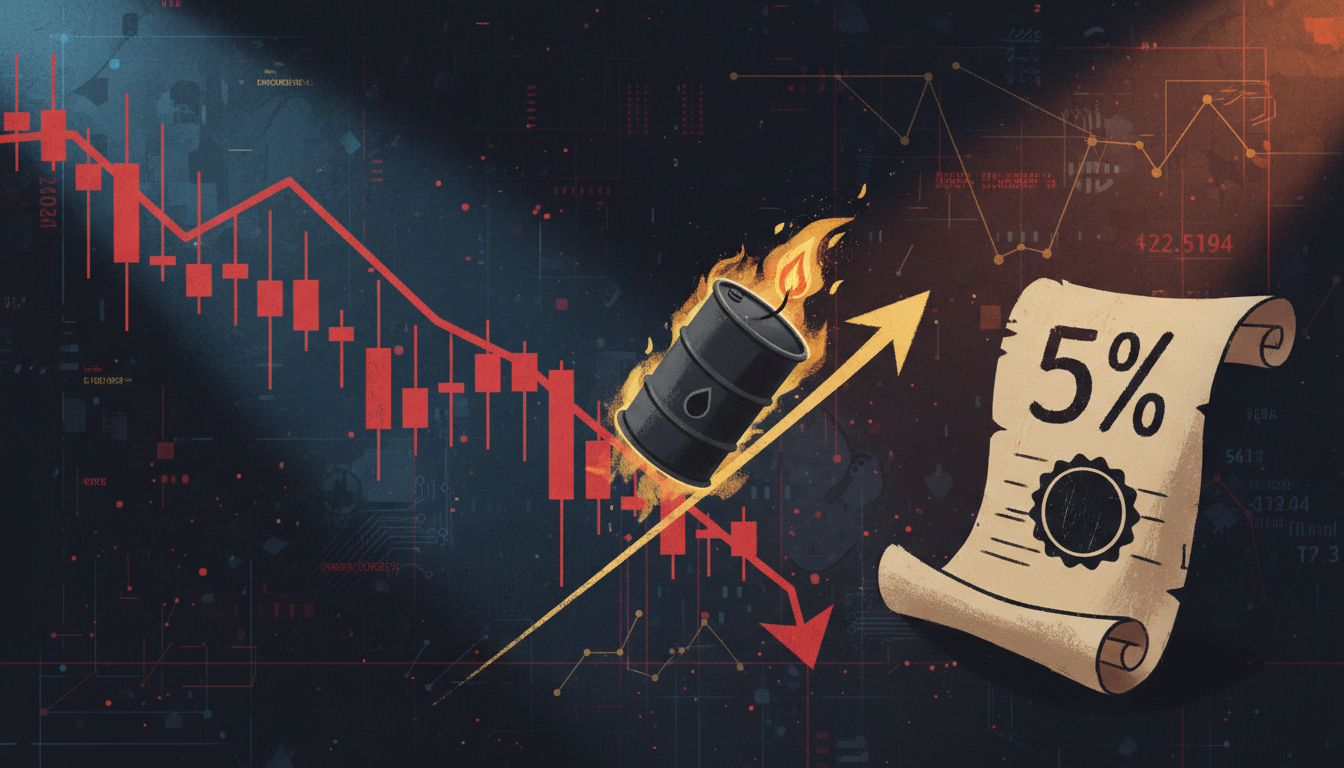
Rising interest rates have pushed global financial markets into precarious territory, with US Treasury yields breaching the 5% mark for the first time since 2023 and oil prices rocketing past $100 a barrel on Middle East tensions. The combination is strangling corporate earnings while stoking fears of an imminent stock market correction.
The Federal Reserve’s continued interest rate hikes reflect a stubborn inflation problem that refuses to yield to monetary policy. Sticky inflation—the kind that clings to the economy despite rate hikes—has forced policymakers into a corner. They cannot ease up without risking a fresh price spiral, yet tightening further risks triggering the very crash many fear.
American companies find themselves caught in a triple squeeze. Borrowing costs have surged with higher rates. Fuel expenses remain punishing as global crude stays elevated. Trade tariffs add another layer of pressure to already-compressed margins.
The 5% Treasury Yield Threshold
When the 10-year Treasury yield crossed 5%, it marked a watershed moment. Investors use this benchmark rate as a baseline for all other borrowing costs. Higher rates mean companies must pay more to finance operations, expansions, or even routine refinancing of existing debt.
The last time yields hit this level was over a year ago. Back then, markets spiraled on recession fears. This time, the ascent feels different—faster, more driven by geopolitical upheaval than by domestic economic overheating.
According to reporting on bond yields and stock market risks, higher yields don’t just affect borrowers. They also make bonds themselves more attractive to investors, pulling capital away from equities. When a Treasury pays 5%, why take the risk of the stock market? That rotation out of stocks has already begun.
Oil, Geopolitics, and Corporate Costs
Oil prices topping $100 a barrel represent the most visible cost shock for most companies. Airlines, logistics firms, and manufacturers all face soaring fuel surcharges that eat directly into profits.
Middle East tensions show no signs of easing. Each fresh headline from the region sends crude higher. For Indian companies with dollar-denominated oil costs, the rupee depreciation compounds the pain—a dollar buys more rupees, making imported oil even costlier in local terms.
According to CNBC’s analysis of tariffs and fuel impacts, US firms are now contending with three simultaneous headwinds: tariffs raising input costs, fuel expenses at multiyear highs, and the need to refinance debt at punishing rates. Few sectors have the pricing power to pass all these costs to consumers without demand destruction.
Rising Interest Rates and Earnings Pressure
When companies borrow at 7% or 8% instead of 3%, that’s millions in additional annual interest expense. For highly leveraged firms, the difference between profitability and a loss isn’t revenue growth anymore—it’s interest payments.
Earnings projections for 2026 and beyond are being quietly revised downward. Sell-side analysts have no choice. The math is simple: higher interest costs reduce net income, period.
The stock market has historically traded on earnings multiples. If rates stay high and earnings fall, stocks face a double blow. The multiple compresses because bonds are now competitive, and the earnings per share shrink because interest costs rise.
The AI IPO Exception
Curiously, amidst this gloom, Nscale announced a $30 billion IPO with AI sector investment still flowing. The artificial intelligence sector remains a bright spot in investor portfolios.
Venture capital and institutional buyers continue backing AI firms even as traditional sectors struggle. This divergence underscores a two-tier market: AI players with growth narratives and deep-pocketed backers can still raise capital at hefty valuations, while mature industries face a funding squeeze.
The Nscale filing also signals that some founders and investors believe this downturn will pass. They’re betting on AI upside trumping near-term market turbulence. Whether that bet pays off depends largely on whether the Fed can engineer a soft landing.
Rising Interest Rates: The Soft Landing Question
The Fed walks a razor’s edge. Rates must stay elevated long enough to wrestle inflation to the ground. Yet if they stay up too long, a recession becomes unavoidable—and recessions typically trigger stock market crashes far steeper than anything a 5% Treasury yield alone would produce.
Most economists now assign a higher probability to a hard landing than they did six months ago. If that occurs, stock valuations could compress by 25% to 40% from current levels before stabilising.
Corporate debt levels remain historically high. Companies that borrowed cheaply during the pandemic now face refinancing nightmares. Even solvent firms can stumble if they can’t roll over maturing debt at acceptable rates.
Global Implications
Emerging markets watch US rates closely. When Treasury yields rise, hot money flees to the safety of US bonds, weakening currencies in Asia, Africa, and Latin America. The rupee faces fresh selling pressure whenever rates tick higher.
For Indian exporters, a weaker rupee sounds good. But if US companies are slashing spending due to margin pressure, demand for Indian goods and services softens anyway. The benefit of currency weakness evaporates.
FAQ
Q: Why are 5% Treasury yields bad for stocks?
Higher yields make bonds attractive alternatives to equities. Investors rotate capital into safe bonds, pulling money out of stocks. Additionally, companies pay more to borrow, cutting into earnings.
Q: Will the stock market crash soon?
No one can predict timing precisely. According to Guardian analysis of yield and crash risks, the probability of a 20%+ correction has risen materially if rates remain elevated and earnings estimates continue falling. A recession would trigger a sharper drop.
Q: How do rising interest rates affect Indian investors?
Indian stock valuations tend to compress when global rates rise, as foreign investors repatriate funds. A weakening rupee also affects India’s import-dependent sectors. However, IT and software companies often benefit if they’re earning in dollars.
Q: Can the Fed cut rates soon to ease pressure?
Unlikely in the near term. Sticky inflation means the Fed must keep rates restrictive. Cutting too early risks reigniting price growth. Most economists expect rates to stay elevated through 2026.
Q: Is the AI sector immune to rising interest rates?
Partially. AI companies with strong growth trajectories and deep backers can still access capital. But if a recession hits and corporate spending collapses, even AI demand could weaken. Current valuations assume optimistic adoption curves.
