
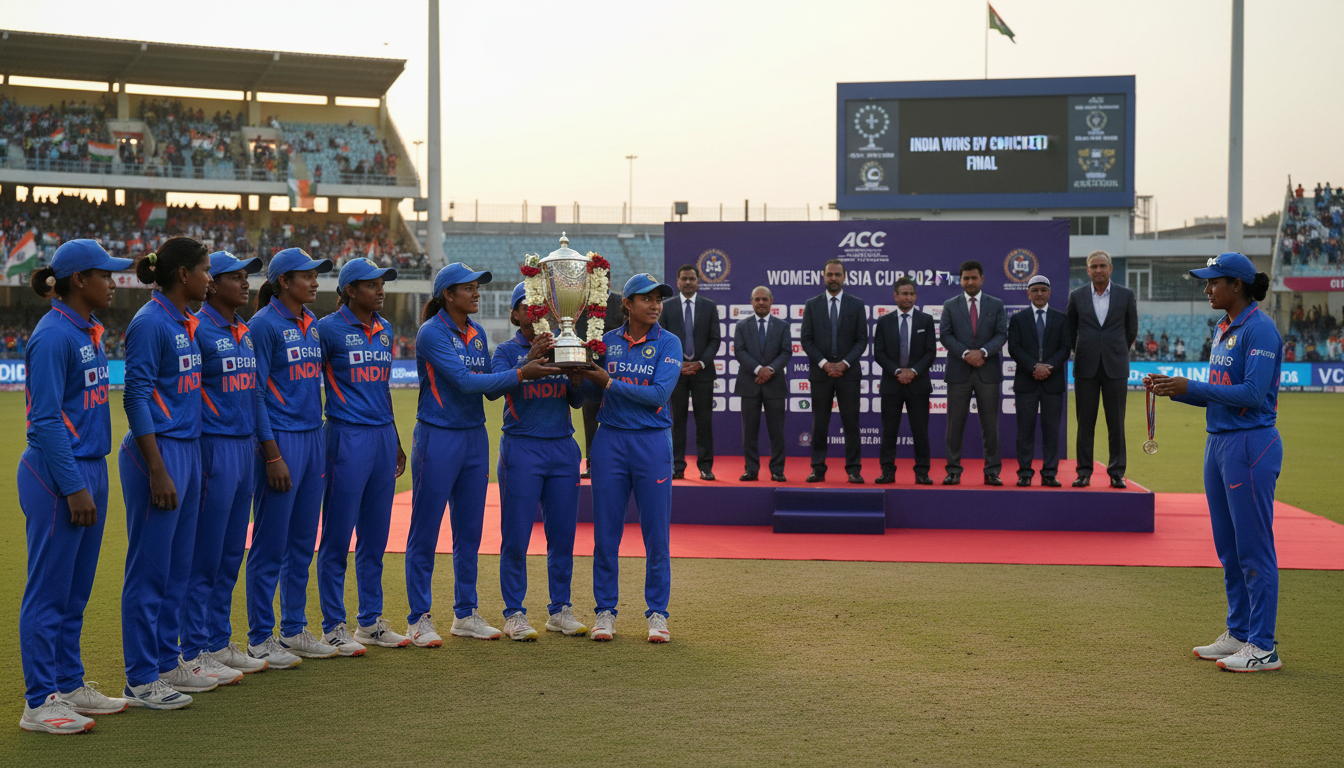
India’s women’s cricket team has refused to accept the Asia Cup trophy from Pakistan Cricket Board chairman Mohsin Naqvi, marking another flashpoint in India-Pakistan cricket diplomacy and reflecting deepening political tensions between the two nations.
The Indian women’s squad defeated Sri Lanka to claim the Asia Cup title. However, when Naqvi, who also serves as ACC (Asian Cricket Council) chairman, was set to present the trophy, the team declined to receive it from him. According to the BCCI, Naqvi did not lodge any formal objection to the refusal.
The move signals solidarity with India’s men’s cricket team, which adopted a similar stance during an earlier tournament. Both teams’ decisions have sent a clear message about the state of relations between Indian and Pakistani cricket authorities amid broader geopolitical tensions.
The Context Behind India-Pakistan Cricket Diplomacy Tensions
Cricket has long served as a mirror for Indo-Pakistani relations. When political tensions spike, the sport often becomes a stage for symbolic gestures—both cooperative and confrontational.
The women’s team’s refusal did not happen in isolation. Men’s cricketers had already set this precedent at a previous tournament. By mirroring that stance, the women’s squad underscored that the diplomatic rift extends across Indian cricket, not limited to one gender or one event.
The PCB chairman’s role made him the focal point. Naqvi is not merely an administrator; he represents both Pakistani cricket governance and the ACC, a multilateral body meant to unite Asian cricket. His position made him a natural target for a symbolic gesture.
How the Trophy Presentation Unfolded
The exact mechanics of who ultimately presented the trophy remain unclear from available reports. What is definitive: the Indian women’s team chose not to accept it from Naqvi’s hands.
The BCCI’s statement that Naqvi raised no objection is noteworthy. It suggests the PCB chairman either anticipated the move or chose diplomacy over confrontation. Public protest would have inflamed tensions further.
Yet silence on his part did not defuse the symbolism. The refusal itself became the story. Media outlets across both countries highlighted the snub.
India-Pakistan Cricket Diplomacy: A Broader Pattern
This is not the first time cricket has reflected political friction between India and Pakistan. Over decades, the relationship between BCCI and PCB has tracked national relations closely.
When governments warm to each other, bilateral cricket series resume. When tensions spike, matches get cancelled or postponed. Players become inadvertent ambassadors—or, as in this case, symbols of protest.
The women’s team’s refusal adds a new dimension: unified Indian cricket making a joint statement. That both men and women took the same stance suggests coordination, whether explicit or implicit, at the BCCI level.
What BCCI Said
The BCCI framed Naqvi’s non-objection as significant. By highlighting that he did not raise concerns, the board may have been trying to portray the refusal as a measured, even agreed-upon gesture rather than a unilateral snub.
This framing matters for international cricket relations. If the PCB had objected strongly, it could have escalated into an ICC matter or broader diplomatic row. The apparent acceptance—however grudging—kept the incident from exploding.
Still, the absence of objection is not endorsement. Naqvi’s silence may reflect pragmatism: protesting would only deepen the rift and invite more scrutiny on India-Pakistan cricket diplomacy tensions.
The Timing and Asian Cricket Politics
The Asia Cup is a flagship ACC tournament. Naqvi’s dual role—PCB chairman and ACC chief—placed him at the intersection of Pakistani and pan-Asian cricket interests.
By refusing his presentation, India sent a message not just to Pakistan but to the broader Asian cricket community. The gesture signalled that political tensions override protocol, even at multilateral events.
For other Asian cricket boards, the moment was awkward. Thailand, Bangladesh, Sri Lanka, and Afghanistan all competes in the same tournament. Their silence suggests either sympathy with India’s position or a preference to stay out of Indo-Pakistani disputes.
The Women’s Team as Political Actor
India’s women’s cricketers have fought for recognition and resources for years. Their Asia Cup victory was hard-won. Yet instead of basking in triumph, they became actors in a geopolitical drama.
This is neither their burden nor their choice, strictly speaking. Teams competing at international tournaments should ideally focus on sport. But when nations are in conflict, athletes inevitably become symbolic figures.
The women’s refusal shows they are willing to take positions on political matters. Whether that empowers them or constrains their focus on cricket itself remains debatable.
What Happens Next
There is no indication that this incident will lead to formal diplomatic channels or ICC intervention. The lack of formal objection from Naqvi suggests both boards may let the matter settle.
India’s next cricket engagement with Pakistan—if any bilateral series are planned—will be watched closely. Will this refusal prompt PCB retaliation? Will BCCI and PCB seek to rebuild relations? Or will India-Pakistan cricket diplomacy remain frozen?
For now, the women’s Asia Cup victory is tinged with political messaging rather than pure sporting celebration. The trophy was won on the field. Its acceptance became a matter of state.
FAQ
Q: Why did India’s women’s cricket team refuse the Asia Cup trophy?
A: The team declined to accept the trophy from Pakistan Cricket Board chairman Mohsin Naqvi in solidarity with India’s men’s cricket team, which had taken a similar stance at a previous tournament. The refusal reflects ongoing political tensions between India and Pakistan.
Q: Did the PCB object to India’s refusal?
A: According to the BCCI, Mohsin Naqvi did not raise any formal objection to the team’s refusal to accept the trophy from him, though he did not publicly comment on the matter.
Q: Who presented the trophy to India’s women’s team instead?
A: Available reports do not specify who ultimately handed over the trophy. The key fact is that it was not Naqvi.
Q: Is this the first time Indian cricket teams have refused to accept trophies from Pakistani officials?
A: No. India’s men’s team had previously adopted the same stance at another tournament, which prompted the women’s team to follow suit.
Q: How does this affect India-Pakistan bilateral cricket series?
A: There is no immediate indication of scheduled bilateral series between India and Pakistan. This incident reflects the broader diplomatic freeze rather than triggering new cancellations, though future engagements will likely attract scrutiny.
