
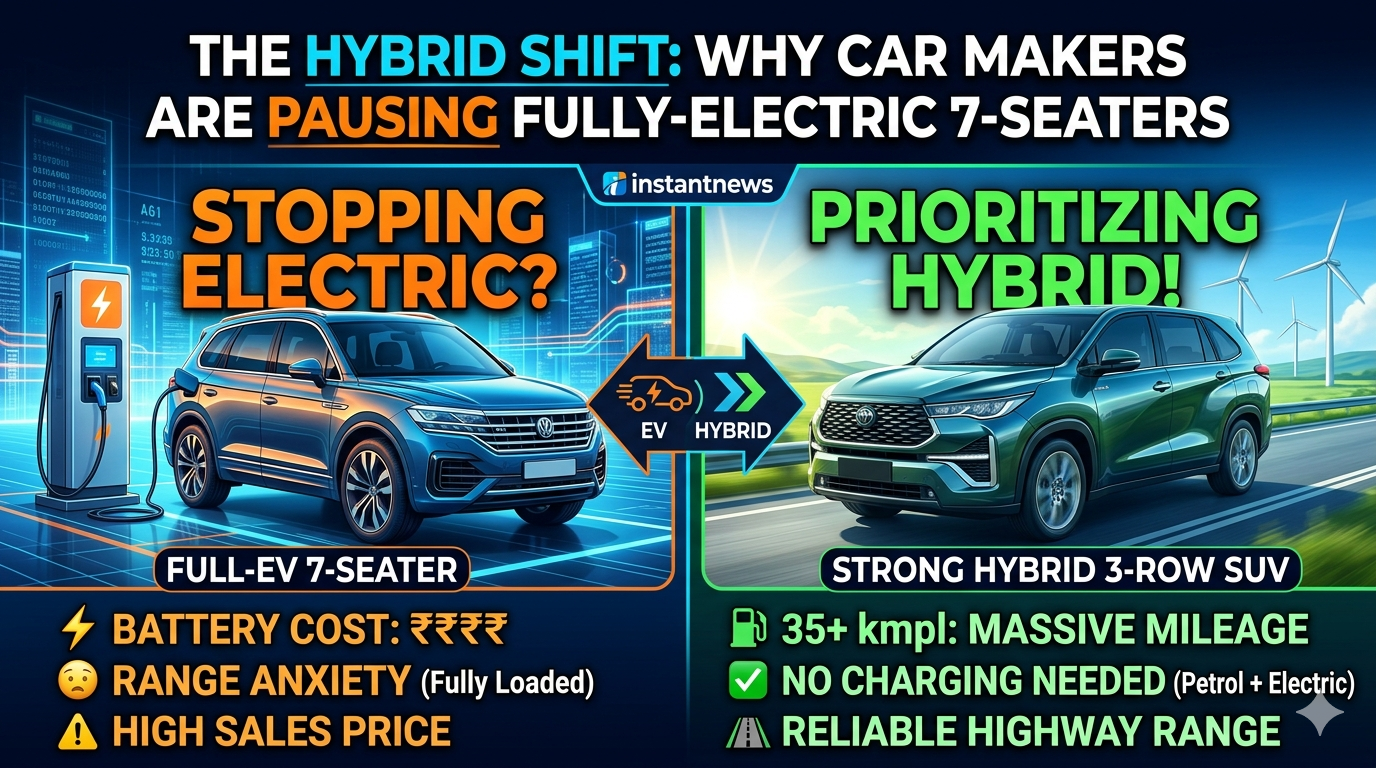
While the 5-seater compact SUV market continues its steady transition toward full electrification, a fascinating shift is happening in the larger, three-row family car segment. India’s 7-seater vehicle sales recorded a massive 15.2% year-on-year growth just this past month, proving that the demand for bigger family haulers is at an all-time high.
Yet, if you look closely at the upcoming pipelines of top carmakers like Maruti Suzuki, Toyota, Renault, and Kia, they aren’t rushing to drop fully electric 7-seaters into the mass market. Instead, billions of dollars are being funneled into Strong Hybrid technology.
Aside from luxury flagships and niche EV offerings, the primary mass-market strategy for 3-row SUVs has firmly shifted to hybrid powertrains. Here is a deep dive into why auto giants are hitting the pause button on mass-market electric 7-seaters—and why hybrids are winning the family race.
The Core Problem: The 7-Seater Range Anxiety Formula
Building an efficient 5-seater EV hatchback or crossover is relatively straightforward. However, scaling that technology up to a heavy, brick-shaped 7-seater SUV introduces a massive engineering hurdle: Weight vs. Range.
- The Weight Penalty: A 3-row vehicle carrying seven passengers and luggage requires a massive chassis. To give it a real-world range of over 450 km, manufacturers have to pack in heavy 70kWh to 80kWh battery packs.
- The Diminishing Returns: The heavier the battery pack, the heavier the vehicle becomes. This forces automakers to stiffen the suspension, utilize larger electric motors, and ultimately sacrifice the plush, comfortable ride quality that family buyers expect.
- The Price Shock: A massive battery pack pushes the ex-showroom cost of a mass-market 7-seater EV well past the ₹25–30 Lakh mark, placing it out of reach for middle-class Indian families upgrading from a smaller hatchback or sedan.
The Hybrid Counter-Attack: 35+ Kmpl and Absolute Peace of Mind
Rather than forcing consumers to pay a massive price premium for an EV that might run out of juice on a long highway family trip, carmakers are deploying advanced strong hybrid systems.
Upcoming heavyweights—like the highly anticipated Maruti Suzuki Grand Vitara 7-seater and the Toyota Urban Cruiser Hyryder 7-seater—are utilizing stretched versions of their highly efficient 1.5L strong-hybrid platforms. Meanwhile, global players like Kia are readying the Carnival Hybrid with a 1.6L turbo-petrol parallel hybrid system, and Renault is preparing the Boreal (a 7-seater Duster sibling) with a 1.8L strong hybrid powertrain.
These vehicles operate on pure electric mode during bumper-to-bumper city traffic—where large vehicles typically guzzle fuel—and seamlessly switch to the petrol engine on the highway. The result? Massive 3-row vehicles delivering an astounding 25 to 35 kmpl, effectively cutting a family’s monthly fuel bill in half without a single minute spent hooked to a charging station.
The Impending CAFE 3 Norms Trigger
The pivot toward strong hybrids is also heavily driven by policy. With the strict CAFE 3 (Corporate Average Fuel Efficiency) norms looming on the horizon for 2027, car manufacturers face steep penalties if their overall fleet carbon emissions are too high.
Because 7-seaters sell in massive volumes in India, manufacturers cannot risk relying purely on low-volume, high-cost EVs to balance their emission sheets. Strong hybrids offer a plug-and-play solution: they significantly lower the manufacturer’s overall fleet emissions while remaining affordable enough to sell in thousands every single month.
What Should Buyers Do?
If you are currently in the market for a 3-row family vehicle, the next 6 to 12 months will offer the most diverse lineup in Indian automotive history.
While pure EV 7-seaters will exist as premium tech showcases, the true value-for-money, high-mileage sweet spot will belong to the incoming wave of strong hybrids. For the average family that loves spontaneous weekend road trips and faces daily urban gridlock, the hybrid shift isn’t just a corporate strategy—it’s the most practical choice for the wallet.
Frequently Asked Questions (FAQs)
1. Which are the most anticipated upcoming 7-seater hybrid SUVs launching in India?
Several top automakers are gearing up to launch spacious 3-row hybrid vehicles over the next year to meet growing family demands.
| Manufacturer | Model (Expected) | Expected Launch Timeline | Core Feature |
| Maruti Suzuki | Grand Vitara 7-Seater (Codenamed Y17) | Late 2026 | 1.5L Strong Hybrid, Level 2 ADAS |
| Toyota | Urban Cruiser Hyryder 7-Seater | Late 2026 / Early 2027 | Stretched Wheelbase, Panoramic Sunroof |
| Kia | Sorento Hybrid / Carnival Hybrid | Mid to Late 2026 | 1.5L/1.6L Turbo Petrol Hybrid |
| Renault | Duster-based 7-Seater (Boreal) | Early 2027 | 1.8L Strong Hybrid System |
2. What is the expected real-world mileage of a 7-seater strong hybrid SUV?
While traditional petrol or diesel 7-seaters generally deliver around 11 to 15 kmpl in combined conditions, upcoming strong hybrid 3-row SUVs are expected to deliver an impressive 22 to 28 kmpl in the real world. In bumper-to-bumper city traffic, where the vehicle relies heavily on its electric battery pack, efficiency can spike even higher.
3. Why are car manufacturers launching hybrids instead of pure electric 7-seaters?
- Massive Price Disadvantage: Fitting a massive battery pack (70kWh+) to give a heavy 7-seater decent highway range pushes the final showroom price past ₹25–30 Lakhs, alienating the budget-conscious middle-class buyer.
- Range & Weight Anxiety: A heavier chassis compromises ride quality and leaves large families vulnerable to highway charging bottlenecks during long family road trips.
- The CAFE 3 Deadline: Strict corporate emission limits coming into effect mean manufacturers need high-volume, affordable low-emission cars (like hybrids) immediately to avoid steep penalties.
4. Are there any pure electric 7-seater cars coming to India?
Yes, but they are primarily targeted at premium segments or tech early-adopters. Tata Motors is currently testing the Tata Safari EV (expected around the late 2026 festive season) featuring 65kWh and 75kWh battery packs aiming for a 500+ km range. Maruti Suzuki is also developing an electric MPV (codenamed YMC) based on its eVitara platform, slated for a late 2026 or 2027 debut.
5. Hybrid vs. EV: Which is better for a large Indian family right now?
If your family uses the vehicle primarily for city commutes and has access to dedicated home charging, an EV is highly efficient. However, for families who take frequent, spontaneous cross-state road trips with heavy passenger loads and want to avoid looking for charging stations along highways, a strong hybrid offers the best balance of low running costs and absolute peace of mind.
