
The global energy landscape is undergoing a period of profound volatility. Against the backdrop of escalating geopolitical tensions in West Asia and threats to maritime chokepoints, securing a reliable supply of hydrocarbons has transitioned from a purely economic requirement to a vital national security priority.
In a decisive move to insulate its economy from sudden supply shocks, India has signed a series of landmark agreements with the United Arab Emirates (UAE). Finalized during Prime Minister Narendra Modi’s high-level bilateral visit to Abu Dhabi, the historic agreements feature a $5 billion investment pledge alongside a monumental expansion of the Strategic Petroleum Reserves (SPR) network.
Driven by a collaboration between Indian Strategic Petroleum Reserves Limited (ISPRL) and the Abu Dhabi National Oil Company (ADNOC), this pact significantly upgrades the Indo-UAE Comprehensive Strategic Partnership. It fundamentally alters how India manages its long-term energy risks.
The Anatomy of the Deal: Expanding the Buffers
At the heart of this bilateral breakthrough is a massive scale-up of crude oil stockpiling. The central pillar of the energy agreement allows ADNOC to significantly increase its storage presence in India, enhancing the country’s buffer capacity against sudden market disruptions.
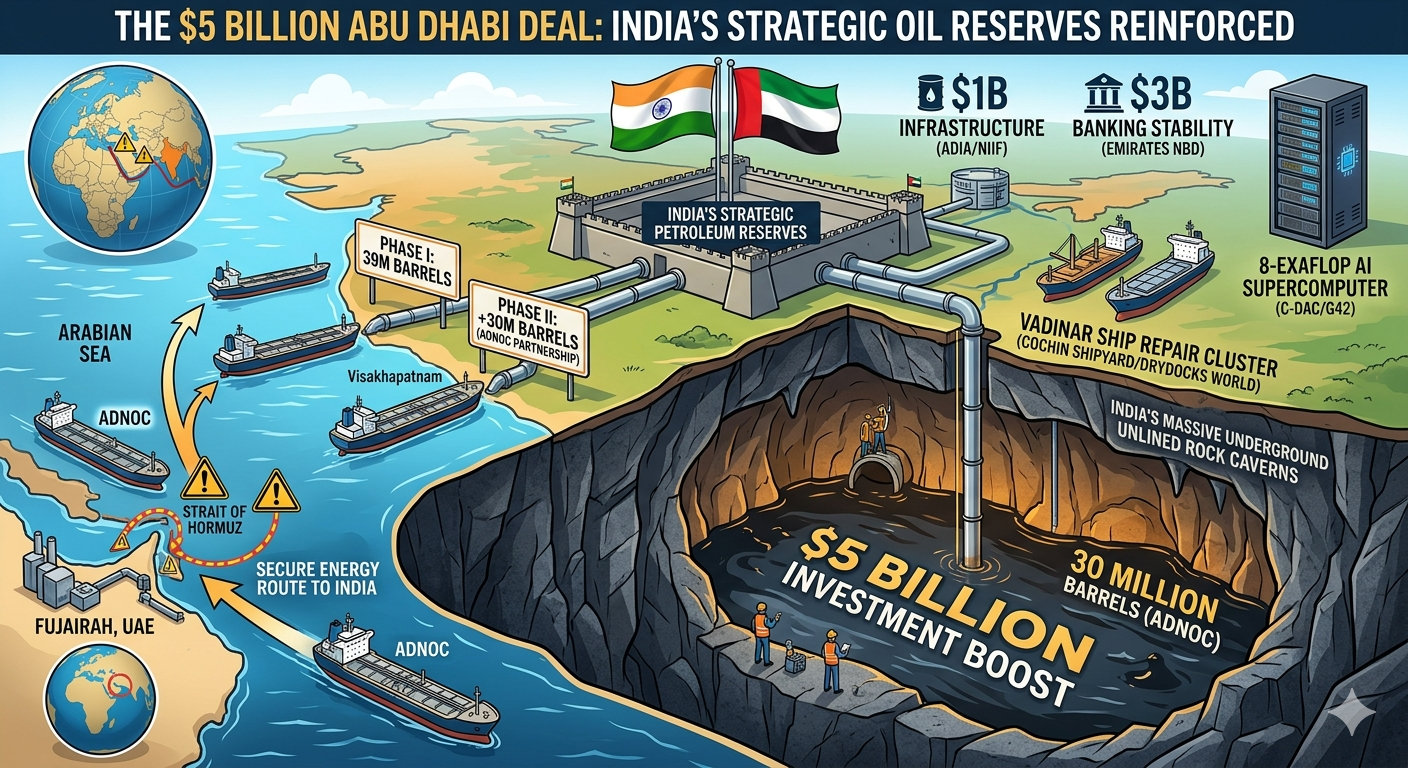
- 30 Million Barrel Stockpile: Under the new Strategic Collaboration Agreement, UAE’s participation in India’s SPR network will scale up to 30 million barrels. This is a dramatic escalation from previous commercial agreements and infuses India’s underground caverns with a massive reserve of emergency crude.
- Geographic Diversification: The agreement covers ADNOC’s operational participation at the existing storage site in Mangaluru (Karnataka), while exploring integration into the facility at Visakhapatnam (Andhra Pradesh) and the upcoming Phase II expansion at Chandikol (Odisha).
- The Fujairah Equation: Moving beyond domestic boundaries, the agreement explicitly details plans to explore storing Indian-bound crude directly in Fujairah, UAE. This overseas stockpile will officially form part of India’s strategic reserve ecosystem.
- Beyond Crude (LNG and LPG): Recognizing that energy security extends beyond crude oil, the framework includes strategic collaboration to build domestic storage infrastructure for Liquefied Natural Gas (LNG) and Liquefied Petroleum Gas (LPG). This includes a separate, long-term commercial supply contract between Indian Oil Corporation Limited (IOCL) and ADNOC.
Understanding India’s SPR Infrastructure
To appreciate the scale of this agreement, it is essential to look at the baseline architecture of India’s energy safety net. Managed by ISPRL (a special-purpose vehicle under the Ministry of Petroleum and Natural Gas), India’s Phase I SPR consists of massive underground unlined rock caverns designed to hold emergency stocks.
Current SPR Phase I Architecture
| Location | State | Capacity (Million Metric Tons) | Approximate Barrel Equivalent |
| Visakhapatnam | Andhra Pradesh | 1.33 MMT | ~9.77 Million Barrels |
| Mangaluru | Karnataka | 1.50 MMT | ~11.00 Million Barrels |
| Padur | Karnataka | 2.50 MMT | ~18.37 Million Barrels |
| Total Phase I | 5.33 MMT | ~39.14 Million Barrels |
While Phase I provides approximately 9.5 days of net oil import coverage for the country, it falls significantly short when compared to the 90-day emergency reserve buffers held by nations like the United States, Japan, or China. The integration of 30 million barrels from ADNOC—alongside the construction of Phase II sites like Chandikol—serves as an aggressive, fast-tracked expansion of this vital cushion.
The Geopolitical Imperative: Bypassing Maritime Chokepoints
The integration of the Fujairah storage facility into India’s strategic math is a masterstroke in maritime risk mitigation.
A substantial percentage of India’s crude oil imports historically travel through the Strait of Hormuz, a narrow waterway wedged between Oman and Iran. In periods of regional conflict, the Strait becomes highly vulnerable to blockades, missile attacks, and drone strikes. A disruption here can instantly trigger global price spikes and choke supply lines to Asian economies.
By storing a portion of its strategic reserves in Fujairah—which sits outside the Strait of Hormuz on the Gulf of Oman—India creates a crucial geographical workaround. In the event that the Strait is compromised, India can bypass the chokepoint entirely, loading crude directly from the UAE’s outer coast into tankers bound for India’s western ports. This creates a resilient, external supply loop that safeguards the country’s energy interests during times of regional crisis.
4. Dissecting the $5 Billion Financial Infusion
The energy agreements are reinforced by a massive financial commitment. The UAE has pledged $5 billion in fresh investments aimed directly at stabilizing and scaling India’s critical infrastructure and financial sectors. This funding is distributed across three strategic pillars:
- Infrastructure Funding ($1 Billion): A joint initiative between the Abu Dhabi Investment Authority (ADIA) and India’s National Investment and Infrastructure Fund (NIIF) to pour capital directly into domestic logistics, clean energy, and transport infrastructure.
- Financial Sector Re-capitalization ($3 Billion): A massive injection by the Emirates National Bank of Dubai (Emirates NBD) into India’s banking sector, specifically targeted toward strengthening financial institutions like RBL Bank to support industrial credit growth.
- Corporate and Capital Markets Support ($1 Billion): Strategic capital allocations directed to entities like Samman Capital to deepen liquidity and foster corporate expansion across essential manufacturing lines.
This layout ensures that while India gains direct access to hydrocarbon reserves, its domestic industrial ecosystem simultaneously receives the liquidity needed to sustain high economic growth.
Strategic Side-Gains: Defence, Shipping, and Supercomputing
The bilateral summit in Abu Dhabi made it clear that energy security and national security are inextricably linked. Alongside the petroleum reserve framework, several complementary pacts were signed to solidify the broader bilateral alliance:
- Strategic Defence Framework: Moving beyond a buyer-seller relationship, India and the UAE established a framework for defence industrial collaboration. This includes joint production of military hardware, secure communication exchanges, and enhanced maritime security coordination to police the Indian Ocean sea lanes.
- Vadinar Ship Repair Cluster: Cochin Shipyard Limited signed an agreement with Drydocks World to set up a dedicated Ship Repair Cluster at Vadinar, Gujarat. This local maritime hub will be critical for maintaining the large tanker fleets required to ferry expanded crude reserves.
- The 8-Exaflop AI Supercomputer: In a forward-looking technological tie-up, India’s C-DAC partnered with the UAE’s G42 to deploy an 8-Exaflop supercomputing cluster. This massive computational engine will support India’s National AI Mission, providing the data processing power required to optimize complex industrial supply chains, including petroleum logistics.
The Long-Term Economic Impact
For India—the world’s third-largest energy consumer, which relies on imports for over 85% of its crude needs—the implications of this deal are monumental.
“Larger and more collaborative reserve arrangements reduce our exposure to short-term volatility, providing policymakers with vital breathing room during global crises. It marks a transition from reactive procurement to proactive risk management.”
By utilizing a commercial co-sharing model with ADNOC, India effectively expands its emergency stockpiles without bearing the entire, staggering financial burden of purchasing tens of millions of crude barrels upfront. This frees up fiscal space for the government while establishing a highly reliable buffer.
Ultimately, the $5 Billion Abu Dhabi deal goes far beyond a simple trade transaction. It represents a highly calculated, multi-layered defensive shield that integrates finance, geography, and energy infrastructure to ensure that India’s economic engine remains fully fueled, regardless of how the geopolitical winds blow in West Asia.
Frequently Asked Questions (FAQ): How India Benefits from the $5 Billion Abu Dhabi Deal
1. What is the main benefit India gains from this deal?
The primary benefit is a massive upgrade to India’s energy security. By expanding the Abu Dhabi National Oil Company’s (ADNOC) participation to 30 million barrels of crude within India’s Strategic Petroleum Reserves (SPR), the country gains an immediate, massive safety cushion against sudden global oil supply shocks, price spikes, or conflicts in West Asia.
2. How does the deal protect India from maritime threats like a blockade of the Strait of Hormuz?
A massive chunk of India’s oil passes through the narrow Strait of Hormuz. The deal includes plans to store India-bound crude directly in Fujairah (UAE), which sits outside the Strait on the Gulf of Oman. If the Strait is ever blocked or compromised due to regional war, India can bypass the chokepoint entirely and load oil directly from Fujairah, keeping its domestic supply lines open.
3. Does India have to pay upfront for this 30-million-barrel oil stockpile?
No. This is one of the biggest economic wins for India. Under this co-sharing model, ADNOC bears the financial cost of supplying and storing the crude in India’s underground caverns. India gets immediate access to emergency oil stocks right on its own soil without having to shell out billions of dollars upfront from its fiscal budget to purchase the inventory.
4. How will the $5 billion investment component be used to benefit India’s economy?
The $5 billion cash infusion is split across three vital sectors to spur domestic growth and bolster financial stability:
- Infrastructure ($1 Billion): Channeled via the Abu Dhabi Investment Authority (ADIA) and India’s NIIF into green energy, logistics, and transport.
- Banking Stability ($3 Billion): Injected by Emirates NBD into the Indian banking sector (specifically supporting institutions like RBL Bank) to boost industrial credit and financial liquidity.
- Corporate Growth ($1 Billion): Routed into the financial/capital markets (like Sammaan Capital) to support local business expansions.
5. Is this deal only about crude oil, or are other energy sources included?
The deal goes beyond crude to secure India’s broader fuel requirements. It establishes a framework to set up strategic gas reserves (LNG and LPG) within India. Furthermore, Indian Oil Corporation Limited (IOCL) secured a long-term supply agreement for Liquefied Petroleum Gas (LPG), ensuring a stable, uninterrupted supply of cooking gas for millions of Indian households.
6. What are the non-energy benefits signed during this bilateral meet?
The deal functions as a comprehensive strategic package. Alongside oil and finance, India secured three massive secondary benefits:
- Strategic Defence Framework: Shifts India-UAE relations from a basic buyer-seller dynamic to deeper military collaboration, featuring joint defence manufacturing, cyber defence, and coordinated maritime security in the Indian Ocean.
- Domestic Maritime Boost: An agreement between Cochin Shipyard and Dubai’s Drydocks World to build a dedicated Ship Repair Cluster at Vadinar, Gujarat, driving the Make in India initiative in maritime logistics.
- Advanced Technology: A partnership between India’s C-DAC and UAE’s G42 to deploy an 8-Exaflop AI supercomputer, giving a major computational boost to India’s National AI Mission and supply chain analytics.
7. What exactly are “Strategic Petroleum Reserves,” and why are they located underground?
Strategic Petroleum Reserves (SPR) are massive stockpiles of crude oil maintained by governments to safeguard against severe supply disruptions. India stores its SPR in underground unlined rock caverns (predominantly in deep granite formations).
Storing oil underground is vastly superior to above-ground steel tanks because it provides natural protection against external security threats like drone attacks, sabotage, or airstrikes. Additionally, underground caverns are highly cost-effective to maintain, naturally vapor-proof, and offer much higher seismic resistance against earthquakes.
8. How many days of oil autonomy does India gain from this expanded arrangement?
Currently, India’s existing Phase I SPR infrastructure holds roughly 39.14 million barrels, which translates to about 9.5 days of the country’s net oil import requirements.
Adding ADNOC’s 30 million barrels nearly doubles India’s immediate emergency storage buffer, bumping its dedicated SPR autonomy by an additional 7 to 8 days. When combined with the commercial storage maintained by domestic oil marketing companies (like IOCL, BPCL, and HPCL), which hold roughly 64 days of supply, India is steadily pushing closer toward international safety benchmarks.
9. What is the commercial incentive for the UAE (ADNOC) to store its oil inside India?
This is a win-win partnership. While India gets a reliable security buffer, ADNOC gets direct, friction-free access to the world’s fastest-growing energy market.
By keeping millions of barrels of its oil physically inside Indian territory, ADNOC can bypass weeks of shipping wait-times and sell its crude instantly to Indian refineries during periods of high demand. Essentially, India provides the infrastructure, and the UAE establishes a highly lucrative, localized distribution hub for the South Asian market.
10. How does the Vadinar Ship Repair Cluster support India’s broader maritime goals?
To move millions of barrels of strategic oil, India relies heavily on massive ocean tankers. Historically, many of these large vessels had to go to foreign shipyards in the Middle East or Singapore for complex drydock repairs, costing India significant foreign exchange.
The agreement to build a Ship Repair Cluster at Vadinar, Gujarat (partnering Cochin Shipyard with Dubai’s Drydocks World) means India can now service and repair massive oil tankers domestically. This strengthens India’s maritime self-reliance and ensures that the shipping fleets handling its strategic imports face minimal operational downtime.
11. What role does the 8-Exaflop AI supercomputer play in India’s energy and industrial future?
While a supercomputer might seem unrelated to oil, modern energy logistics rely heavily on massive data processing. The 8-Exaflop AI supercomputer (collaboratively deployed by C-DAC and UAE’s G42) provides the immense computing power needed to optimize India’s national grid and energy supply chains.
It can run real-time predictive simulations on global shipping lanes, model fluctuating weather patterns affecting oil tankers, analyze refinery efficiencies, and predict domestic fuel demand spikes with pinpoint accuracy, turning raw data into an active tool for national security.
12. What does “unlined rock cavern” technology mean, and why is it used for India’s oil reserves?
An unlined rock cavern is a highly specialized engineering structure carved deep into solid, impermeable granite rock. Unlike conventional above-ground steel tanks, these caverns do not use artificial linings like concrete or steel to hold the oil.
Instead, they rely on the hydrogeologic containment principle. The caverns are excavated well below the natural groundwater table. Because the pressure of the surrounding groundwater is naturally higher than the pressure of the stored crude oil, the water constantly pushes inward through the rock’s microscopic cracks. This creates a natural hydraulic seal that prevents the oil from ever leaking out into the surrounding environment.
13. Why is the UAE the only country allowed to store oil in India’s Strategic Petroleum Reserves?
Allowing a foreign nation to store massive quantities of oil inside domestic military-grade infrastructure requires immense diplomatic and geopolitical trust. The UAE holds this exclusive privilege because of the highly evolved India-UAE Comprehensive Strategic Partnership.
By allowing ADNOC to manage a portion of the SPR, India secures a trusted, politically stable partner in the Gulf region that is willing to invest heavily in local infrastructure. For India, it secures the physical oil on home soil; for the UAE, it secures an unshakeable commercial foothold in one of the world’s largest energy-consuming markets.
14. How does the long-term LPG supply contract directly impact the daily lives of Indian citizens?
While crude oil keeps industries and cars running, Liquefied Petroleum Gas (LPG) is the literal fuel of Indian kitchens. Under the new agreements, Indian Oil Corporation Limited (IOCL) and ADNOC have locked in a major long-term LPG supply and trading framework.
This contract ensures a steady, predictable flow of cooking gas into India, bypassing sudden price spikes in the spot market. For the average citizen, this structural stability helps the government insulate retail cooking gas prices from extreme international volatility, safeguarding household budgets and protecting rural fuel-security programs like the Pradhan Mantri Ujjwala Yojana.
15. Does this agreement help India transition to cleaner energy, or does it lock the country into fossil fuels?
The agreement actually acts as a financial and logistical bridge toward cleaner energy. The $5 billion investment package allocates a definitive $1 billion purely toward infrastructure and green energy initiatives through the Abu Dhabi Investment Authority (ADIA) and India’s NIIF.
Furthermore, by establishing a hyper-efficient energy buffer, India stabilizes its traditional economic engine. This gives the country the economic security and fiscal room required to heavily fund its long-term goals for green hydrogen, solar grids, and EV infrastructure without being derailed by sudden, expensive fossil-fuel crises.
16. How will India and the UAE monitor and secure the shipping lanes between Fujairah and India’s western coast?
The new Framework for the Strategic Defence Partnership signed during the summit addresses this exact logistical vulnerability. Because the oil stored in Fujairah must cross the Arabian Sea to reach India, the two nations are integrating their maritime security forces.
This includes regular joint naval exercises, real-time secure communication exchanges, and coordinated maritime patrolling. By pairing India’s dominant naval presence in the Indian Ocean Region with the UAE’s strategic ports, both countries can actively deter piracy, drone threats, and hostile state interventions, keeping the vital energy corridor completely free and open.
17. What is the specific “First-Right Access” clause, and how does it protect India during an emergency?
The “First-Right Access” (or right of first refusal) is the foundational legal mechanism that guarantees India’s sovereignty over the stored oil. Even though the UAE (ADNOC) owns the crude oil and can sell it commercially during normal market conditions, the agreement dictates that in the event of a national emergency or global supply disruption, the Government of India has the absolute right to requisition the entire stockpile.
During a crisis, India can block any external exports of this stored oil, buy it directly from ADNOC at prevailing market rates, and route it immediately into domestic refineries. This ensures that while the storage is managed through a commercial model, the operational control flips entirely to India when national security is threatened.
18. How will the newly added Phase II sites (Chandikol and Padur expansion) factor into this deal?
India’s Phase I SPR network is highly utilized, which left limited room for massive inventory scaling. The landmark agreement directly incorporates Phase II expansion plans, under which the Union Cabinet has approved an additional 6.5 Million Metric Tons (MMT) of capacity—consisting of a brand new 4 MMT cavern at Chandikol (Odisha) and a 2.5 MMT expansion at Padur (Karnataka).
By explicitly naming Chandikol and Visakhapatnam in the new framework, the deal gives ADNOC the opportunity to help develop and fill these newer facilities. This transforms India’s Phase II expansion from a slow, capital-heavy government project into a fast-tracked, public-private partnership backed by Emirati capital and crude oil.
19. Why did the UAE invest $3 billion specifically into RBL Bank as part of this deal?
The massive $3 billion investment by Emirates NBD into India’s RBL Bank is a calculated economic move designed to deepen bilateral financial integration. Large-scale infrastructure projects—like setting up oil caverns, pipelines, ship repair clusters, and AI supercomputers—require immense local banking liquidity and specialized corporate credit.
By injecting this capital directly into a prominent Indian private-sector bank, the UAE is creating a localized, highly liquid financial engine inside India. This capital will be used to issue corporate loans, fund mid-to-large cap industrial expansion, and provide the credit lines necessary to execute the very infrastructure and maritime projects outlined in the broader bilateral agreement.
20. How does the Local Currency Settlement (LCS) system impact these multi-billion-dollar energy deals?
Historically, global oil trading has been completely dependent on the US Dollar (USD), making transactions vulnerable to currency fluctuations and international banking bottlenecks. India and the UAE have actively operationalized a Local Currency Settlement (LCS) system, allowing transactions to be settled directly in Indian Rupees (INR) and UAE Dirhams (AED).
By integrating the LCS framework into long-term energy contracts, India can pay for a portion of its massive oil and LPG imports using its own currency. This significantly reduces transaction costs, minimizes foreign exchange volatility, decreases the country’s reliance on the USD, and prevents India’s foreign exchange reserves from draining during global energy shocks.
21. What is the broader geopolitical message this deal sends to the rest of West Asia?
Amid ongoing volatility and shifting alliances in West Asia, this deal sends a powerful diplomatic signal: India and the UAE have institutionalized their security and economic architectures. By moving from a simple commodity trade dynamic to co-managing sovereign defense, AI supercomputing, and emergency petroleum reserves, the UAE has firmly positioned India as its primary strategic anchor in South Asia.
Concurrently, it shows that despite complex regional conflicts, India can successfully leverage bilateral diplomacy to secure concrete, long-term national security assets—safeguarding its economic growth engine while keeping major maritime trade routes free, open, and legally protected.
22. What happens to the stored crude oil if it sits underground for years? Does it spoil or degrade?
Crude oil stored deep underground in unlined rock caverns does not spoil, degrade, or evaporate. Because these caverns are carved out of solid, impermeable granite hundreds of feet beneath the surface, they create a perfectly dark, pressurized, and oxygen-free environment.
Without oxygen, sunlight, or extreme temperature fluctuations, the chemical composition of the oil remains completely stable for decades. Furthermore, since the natural pressure of the surrounding groundwater acts as a tight seal, there is zero risk of volatile gases escaping, ensuring the oil retains its full refining quality until the day it is pumped out.
23. Why did International Holding Company (IHC) invest $1 billion into Sammaan Capital as part of this deal?
International Holding Company (IHC), a massive Abu Dhabi-based conglomerate, directed its $1 billion investment into Sammaan Capital to tap into India’s rapidly growing retail finance, housing, and MSME (Micro, Small, and Medium Enterprises) sectors.
For the broader economic deal to succeed, India needs robust liquidity not just at the heavy industrial level, but at the consumer and small-business level. This investment ensures that as India’s energy and infrastructure projects expand, local supply chains, contractors, and specialized service providers have access to affordable, domestic non-banking financial capital to scale up their operations.
24. How does the “Maritime Development Fund Scheme” tie into the new Vadinar Ship Repair Cluster?
The agreement between Cochin Shipyard and Dubai’s Drydocks World to build a ship repair hub at Vadinar, Gujarat, is explicitly tied to India’s Maritime Development Fund Scheme. This scheme is a government initiative designed to provide low-cost, long-term financial assistance to boost domestic shipbuilding, repair facilities, and cruise terminal infrastructure.
By utilizing Emirati expertise alongside Indian public sector execution, the Vadinar cluster leverages this fund to quickly construct world-class offshore fabrication and drydock facilities, positioning India as a global, cost-competitive destination for mega-tanker servicing.
25. How do the new strategic gas reserves differ from the existing crude oil reserves?
While crude oil reserves are designed primarily to protect India’s transport sector and heavy industries, the newly planned strategic gas reserves (for LNG and LPG) target domestic energy, power generation, and chemical manufacturing.
Gas requires vastly different, highly specialized infrastructure—either deeply chilled cryogenic tanks for Liquefied Natural Gas (LNG) or pressurized storage systems for Liquefied Petroleum Gas (LPG). By setting up these gas buffers under the new agreement, India ensures that its power grid and millions of households reliant on piped or bottled gas will remain insulated from international gas market disruptions, which frequently trigger blackouts or hyperinflation in other developing nations.
26. What are the environmental safety protocols used to prevent groundwater contamination around these oil caverns?
Preventing oil from seeping into the surrounding water table is a critical engineering priority. To achieve this, ISPRL relies entirely on the water curtain system. During construction, a network of horizontal and vertical boreholes is drilled into the rock directly above and around the storage caverns.
Water is pumped into these boreholes under high pressure, maintaining a constant, artificial water blanket over the caverns. Because this water curtain keeps the surrounding hydrostatic pressure significantly higher than the pressure inside the oil cavern, groundwater is constantly forced inward toward the cavern. This physical pressure barrier makes it mathematically impossible for any crude oil to migrate outward or contaminate the external environment and natural water tables.
27. How does the presence of foreign-owned oil affect India’s regulatory sovereignty?
It does not infringe on it at all. While ADNOC retains legal and commercial ownership of the crude oil under normal market operations, the entire inventory must comply with Indian federal laws, environmental mandates, and maritime safety regulations.
The physical oil sits firmly within Indian jurisdiction, and ISPRL retains administrative control over the facilities. Furthermore, because of the strict “First-Right Access” protocols built into the treaty, the arrangement ensures that foreign ownership never supersedes India’s national interests or statutory powers during an emergency.
28. What happens if the oil sits unused for a long time? Is there an expiration or rotation process?
To ensure the oil remains optimal for refining over long periods, ADNOC and Indian oil marketing companies practice a system known as inventory rolling or stock rotation.
During normal commercial periods, parts of the stored crude are systematically pumped out and sold to domestic refineries before the oil undergoes any long-term settling or stratification. This extracted oil is immediately replaced with fresh, newly imported crude. This constant, phased cycle keeps the stockpile dynamically rotated, ensuring that the reserve always contains high-quality, ready-to-process crude.
29. How does the 30-million-barrel deal impact India’s fiscal deficit and the value of the Rupee?
This structure provides a major macroeconomic shield. Typically, when global oil prices spike, India has to spend massive amounts of foreign exchange (primarily US Dollars) to buy expensive spot-market crude, which widens its fiscal deficit and depreciates the Indian Rupee.
By having 30 million barrels already physically present on domestic soil—and accessible via local currency settlement frameworks—India reduces its exposure to sudden, volatile dollar outflows. This saves precious foreign exchange reserves, helps stabilize the rupee, and prevents sudden shocks to the country’s balance of payments.
30. How does the “Ship Repair Cluster at Vadinar” reduce operational costs for India’s oil fleet?
Before this agreement, large Indian crude tankers often had to sail to international maritime hubs in Colombo, Singapore, or Dubai for mandatory hull inspections, drydock repairs, and safety certifications. This cost valuable transit time, high fuel burn, and expensive foreign currency service fees.
Establishing a world-class, localized ship repair cluster at Vadinar, Gujarat, means Indian tankers can undergo major overhauls directly along their domestic transit routes. This significantly drops operational downtime, keeps maintenance revenues within the Indian maritime economy, and ensures high fleet readiness for strategic oil transport.
31. What is the significance of the timing of this deal relative to global geopolitics?
The timing is highly strategic. Finalized amidst escalating conflicts in West Asia and evolving trade tensions elsewhere, this deal shows that India is proactively securing its economic perimeter before external disruptions hit its supply lines.
Instead of waiting for an energy crisis to unfold, the multi-layered alliance wraps energy security, physical defense, advanced data processing, and large-scale industrial funding into a single protective shield. It cements India’s position as a stabilized, highly resilient global economic power capable of steering its own sovereign interests through turbulent times.
32. How exactly is the oil pumped out of these deep underground caverns during an emergency?
Extracting crude oil from deep granite caverns involves a highly specialized system of high-capacity submersible pumps. These pumps are lowered into dedicated shafts that reach the lowest points of the cavern floor, known as the “sumps.”
Because crude oil is lighter than water, it naturally floats on top of the water bed used to maintain the hydraulic seal. When India triggers an emergency drawdown, the pumps push the oil upward through heavy-duty vertical pipelines directly into above-ground manifold stations. From there, the crude is seamlessly routed into cross-country pipeline networks connected to nearby refineries, completing the transfer from subterranean storage to active production in just a few hours.
33. Does the deal give ADNOC permission to sell this strategic oil to other countries from Indian soil?
Under normal, non-emergency market conditions, the agreement does allow ADNOC a level of commercial flexibility to trade its stored inventory. However, any potential re-export of this oil to third-party nations is strictly regulated by the Indian government and subject to rigorous clearing protocols.
ADNOC’s primary commercial goal is to supply the rapidly growing domestic Indian market, minimizing the financial viability of shipping it back out. More importantly, during any period of regional crisis or global supply tightening, India’s “First-Right Access” completely overrides commercial trading, locking the entire 30-million-barrel stockpile within domestic borders.
34. What kind of physical security measures protect these massive underground oil repositories?
Because the Strategic Petroleum Reserves are classified as critical national infrastructure, they are protected by multi-layered, military-grade security architectures. The above-ground entry points, pumping stations, and pipeline networks are heavily guarded by specialized paramilitary forces, such as the Central Industrial Security Force (CISF).
The facilities are monitored 24/7 using advanced perimeter intrusion detection systems, thermal imaging, and restricted airspace zones to prevent drone threats. The actual oil storage chambers, being hundreds of feet beneath solid rock, are naturally immune to sabotage, earthquakes, and conventional aerial bombardments, making them virtually indestructible.
35. How does the 8-Exaflop AI supercomputer help prevent oil theft and pipeline leakages?
The computational power of the C-DAC and G42 AI supercomputer is a massive asset for infrastructure monitoring. By running advanced machine learning algorithms, the supercomputer can process real-time telemetry data from thousands of kilometers of pipelines and storage networks simultaneously.
It monitors minute drops in pressure, acoustic anomalies, and temperature fluctuations along the routes. If a criminal attempts to tap into a pipeline, or if a structural defect causes a micro-leak, the AI instantly pinpoints the exact coordinates of the anomaly and alerts security teams, preventing environmental hazards and protecting valuable national resources.
36. Will this partnership influence India’s position within OPEC (Organization of the Petroleum Exporting Countries)?
While India is a major consumer and not an OPEC member, this deal significantly strengthens its diplomatic leverage with the cartel. The UAE is a core, highly influential OPEC member.
By locking in long-term, multi-billion-dollar sovereign investments and co-managing emergency stockpiles, India moves away from being just a transactional buyer vulnerable to OPEC’s production cuts. This deep institutional integration creates a mutual dependency, ensuring that India’s economic voice and energy security concerns are directly represented at the highest levels of global oil policy formulation.
37. How does storing oil deep underground protect it from lightning strikes or static electricity?
Above-ground steel storage tanks are highly vulnerable to lightning strikes, which can ignite volatile hydrocarbon vapors and cause catastrophic industrial disasters. Underground rock caverns completely eliminate this danger.
Because the crude oil is sealed hundreds of feet beneath the earth inside solid, grounded granite formations, there is a total absence of atmospheric exposure. Furthermore, during the construction process, strict engineering protocols ensure that all piping, pumping infrastructure, and instruments are thoroughly grounded. With zero oxygen inside the sealed cavern chambers and an environment entirely shielded from lightning or static accumulation, the risk of a spark-induced fire is effectively non-existent.
38. What is the role of the Indian Strategic Petroleum Reserves Limited (ISPRL), and who controls it?
Indian Strategic Petroleum Reserves Limited (ISPRL) is a Special Purpose Vehicle (SPV) that acts as the technical and operational custodian of India’s emergency oil buffers. It is a wholly-owned subsidiary of the Oil Industry Development Board (OIDB), operating directly under the jurisdiction of the Ministry of Petroleum and Natural Gas, Government of India.
While companies like ADNOC provide the crude inventory and co-manage the commercial flow, ISPRL retains absolute sovereign control over the physical sites, manages the engineering operations, enforces safety protocols, and executes the formal emergency drawdown commands issued by the Union Cabinet.
39. How does the deal help Indian refineries optimize their production costs?
Refineries operate most efficiently when they have a steady, predictable blend of crude oil arriving on a strict schedule. When global supply lines are disrupted, refineries often have to scramble to buy alternative crude blends on the expensive spot market, forcing them to re-calibrate their processing units at a high operational cost.
Having 30 million barrels of ADNOC’s high-quality crude physically sitting within India’s domestic reserve network means local refineries have a massive, localized marketplace next door. They can access the exact grades of oil they need with zero transit delay, optimizing their refining runs, minimizing operational downtime, and keeping production costs lower for domestic petroleum products.
40. What is the environmental impact of digging these massive underground caverns?
Compared to constructing sprawling above-ground tank farms, underground caverns have an incredibly low environmental and surface footprint. Developing a conventional tank farm to hold 30 million barrels would require clearing thousands of acres of land, disrupting local ecosystems, and creating a permanent risk of surface soil and water contamination.
Underground caverns are excavated deep into the bedrock, meaning the surface land above them can often be replanted, reforested, or safely utilized for other light infrastructure. All excavated granite rock is typically repurposed for local highway construction, harbor breakwaters, or concrete aggregates, turning the primary waste byproduct of the project into a valuable asset for regional infrastructure development.
41. Does this deal mean India will buy less oil from other regions, like Russia or Iraq?
Not necessarily. This deal is focused on building an emergency infrastructure buffer, rather than shifting India’s day-to-day commercial oil imports. India will continue to purchase oil dynamically from various international markets—including Russia, Iraq, and Saudi Arabia—depending on pricing, discount margins, and refining needs.
The Abu Dhabi deal serves as a foundational safety valve. While India buys its daily commercial oil from the most cost-effective global vendors on any given day, the 30 million barrels from the UAE remain securely locked underground, serving as a permanent national insurance policy to be deployed only when those external commercial markets face a severe geopolitical crisis.
42. What is the METRI Virtual Trade Corridor, and how does it benefit India’s energy shipping logistics?
The METRI corridor is a newly operationalized virtual trade corridor designed to digitally link Indian and UAE ports. In massive logistics operations like transferring millions of barrels of crude oil or LNG, traditional shipping involves immense paperwork, custom clearance lag times, and bureaucratic bottlenecks.
By integrating port operations digitally under the METRI framework, both nations can share secure, real-time customs data, automate manifest clearances, and seamlessly track cargo ships. For India, this significantly slashes transit turnaround times, lowers the cost of maritime commerce, and ensures that energy shipments moving between Fujairah and India’s western coast are handled with peak operational efficiency.
43. Does the UAE’s shifting position regarding OPEC production quotas impact this deal?
Yes, and favorably for India. The UAE has consistently pushed for higher production limits to monetize its vast capacity expansions, occasionally causing friction within the OPEC/OPEC+ framework.
Because the UAE is heavily investing in expanding its domestic oil extraction capabilities, it requires guaranteed, long-term buyers. By tying up with India through a massive 30-million-barrel storage and commercial framework, the UAE secures an unshakeable consumer base. For India, this means that even if OPEC mandates broad production cuts elsewhere, the country’s unique bilateral framework with Abu Dhabi guarantees a steady, prioritized baseline of crude.
44. How does the deal ensure that the construction of Phase II caverns won’t face standard bureaucratic delays?
India’s Phase II SPR expansion—specifically the 4-million-metric-ton cavern at Chandikol, Odisha—has moved away from a solely state-funded model. The agreement explicitly integrates ADNOC’s participation into the development of Phase II facilities.
By converting these mega-projects into public-private partnerships (PPP) fueled by Emirati capital, the construction is bound by strict corporate milestones and commercial delivery timelines. ADNOC’s financial backing and deep international expertise in massive cavern engineering help bypass the budget re-allocations and fiscal constraints that typically stall large-scale domestic public infrastructure projects.
45. Why is the long-term LPG agreement between IOCL and ADNOC considered a major win for rural India?
The UAE is India’s largest source of Liquefied Petroleum Gas (LPG), fulfilling nearly 40% of the country’s total cooking fuel demand. Rural energy security programs like the Pradhan Mantri Ujjwala Yojana have successfully shifted millions of households away from hazardous biomass cooking to clean LPG cylinders.
However, keeping this massive social program affordable requires protecting it from international price shocks. The long-term sale-and-purchase agreement signed between Indian Oil Corporation (IOCL) and ADNOC ensures a locked-in, steady supply matrix. This helps the Indian government avoid sudden spot-market premiums, guaranteeing a stable flow of affordable cylinders to rural households without draining the state’s subsidy budget.
46. How does India’s political stance on “dialogue and diplomacy” in West Asia secure these economic deals?
Energy security cannot exist without geopolitical stability. During the high-level bilateral talks, Prime Minister Modi explicitly backed the UAE’s efforts to maintain regional peace amid escalating West Asian conflicts, directly condemning recent drone and missile strikes against the Gulf nation.
By standing “shoulder-to-shoulder” with the UAE and advocating for the legally protected, unimpeded navigation of the Strait of Hormuz, India has cemented itself as a highly reliable, non-interfering security partner in the region. This deep diplomatic trust is exactly what paves the way for the UAE to commit $5 billion in investments and hand over operational access to its sovereign energy assets.
47. What is the newly operationalized MAITRI / METRI virtual trade corridor, and how does it speed up shipping?
The virtual trade corridor, referred to under the bilateral framework, is a state-of-the-art digital bridge that directly connects the port and customs authorities of India and the UAE. Traditionally, moving massive oil shipments or container cargo involves heavy paperwork, customs clearing delays, and administrative bottlenecks at both ends.
By integrating customs data into a single virtual ecosystem, the two nations can execute automated manifest clearances, share real-time secure cargo data, and pre-clear ships while they are still in transit. This significantly cuts port turnaround times, drops maritime transaction costs, and ensures maximum logistics efficiency for energy corridors running across the Arabian Sea.
48. If India exercises its “First-Right Access” to the oil during a war, how is the price determined?
The specific pricing mechanisms during an emergency drawdown are pre-negotiated within the Strategic Collaboration Agreement to prevent price gouging. If India activates its sovereign right to seize the stored crude oil, the transaction is settled based on predetermined, transparent global market benchmarks (such as Platts or Argus averages) for that specific grade of oil over a baseline period.
Crucially, because India can settle a portion of these transactions using the Local Currency Settlement (LCS) framework, it avoids having to scramble for immense amounts of US Dollars during a crisis, keeping the acquisition fast and financially predictable.
49. What is the history of Sammaan Capital, and why is IHC’s investment in it significant for this deal?
Sammaan Capital Limited was formerly known as Indiabulls Housing Finance Limited before rebranding. West Asia’s massive International Holding Company (IHC), a multi-billion-dollar Abu Dhabi investment giant, stepped in as a promoter by executing a massive capital injection into the company.
This investment is vital to the wider economic package because Sammaan Capital focuses heavily on retail housing, micro-finance, and MSME (Micro, Small, and Medium Enterprises) lending. For India’s massive energy and maritime infrastructure projects to succeed on the ground, the local sub-contractors, supply chain vendors, and auxiliary workers must have smooth access to domestic credit. IHC’s entry provides the exact non-banking financial liquidity needed to fuel these grass-roots economic operations.
50. How does the underground storage structure prevent oil from leaking out if an earthquake strikes?
Underground rock caverns are naturally among the most seismic-resistant structures ever engineered. When an earthquake occurs, seismic waves travel rapidly through the earth, causing violent shaking primarily at the surface where loose soil and buildings are located.
Deep underground—where these caverns are carved into dense, uniform granite bedrock—the entire rock mass moves completely in sync with the seismic wave. Because there are no contrasting surface structures to resist the movement, structural stress is extremely minimal. Coupled with the constant inward pressure of the surrounding water curtain system, the physical integrity of the cavern remains entirely intact, guaranteeing zero structural leakage even during significant seismic events.
51. What is the next major milestone India must achieve to fully capitalize on this Abu Dhabi alliance?
The next critical milestone is the rapid physical execution and completion of the Phase II Strategic Petroleum Reserve sites, specifically at Chandikol (Odisha). While Phase I facilities are successfully active and co-shared, India’s ultimate goal is to push its strategic storage buffer to meet international benchmarks.
With the engineering blueprints, public-private partnership models, and Emirati investment frameworks now legally locked in place through this historic summit, the focus shifts to fast-tracking the excavation of these newer subterranean caverns, cementing an unbreakable energy shield for the decades ahead.
