
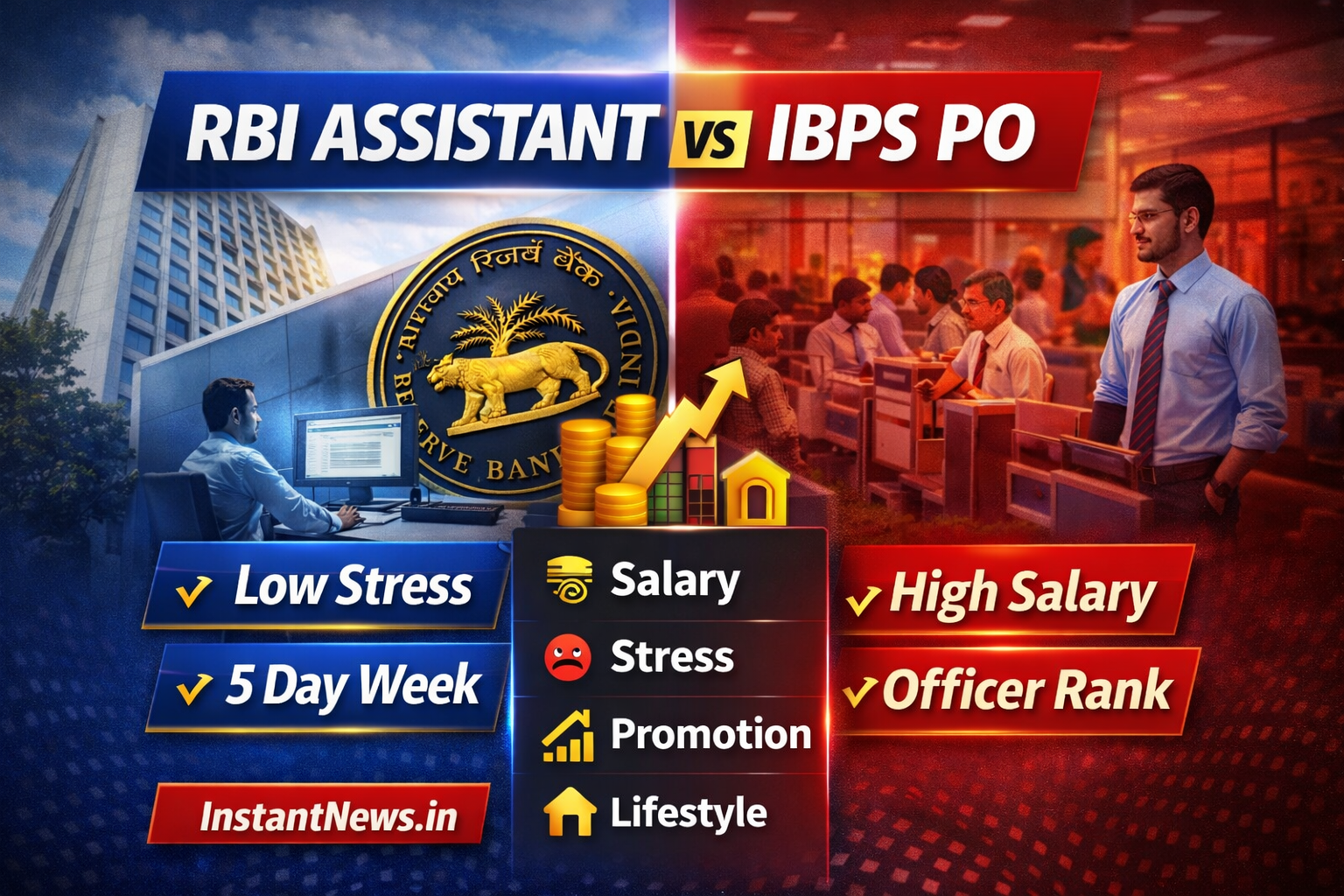
Choosing between RBI Assistant and IBPS PO is not just about salary. It is about lifestyle, stress tolerance, ambition level, long-term financial growth, family stability, authority, and career vision.
This is the most detailed comparison available, covering more than 100 comparison metrics across salary, work culture, authority, transfers, growth, psychological impact, lifestyle factors, retirement security and beyond.
Section 1: Basic Identity & Designation (1–10)
- Recruiting Body
RBI Assistant – Recruited directly by Reserve Bank of India.
IBPS PO – Recruited via IBPS for multiple Public Sector Banks. - Organization Type
RBI – Central Bank.
IBPS PO – Commercial Public Sector Banks. - Post Level
RBI Assistant – Clerical Grade.
IBPS PO – Officer Scale I. - Cadre Entry Rank
RBI Assistant – Entry clerical.
IBPS PO – Entry managerial. - Officer Tag
RBI Assistant – No officer tag.
IBPS PO – Officer designation. - Authority Position
RBI Assistant – Support role.
IBPS PO – Decision-making role. - Organizational Prestige
RBI Assistant – Prestige of RBI.
IBPS PO – Prestige of officer rank. - Public Recognition
RBI Assistant – Known as RBI employee.
IBPS PO – Known as Bank Officer. - Organizational Structure Size
RBI Assistant – Smaller structured departments.
IBPS PO – Large branch network system. - Selection Stages
RBI Assistant – Prelims + Mains + LPT.
IBPS PO – Prelims + Mains + Interview.
Section 2: Salary & Financial Growth (11–25)
- Starting Basic Pay
RBI Assistant – Lower.
IBPS PO – Higher. - In-Hand Salary
RBI Assistant – ₹38–42K approx.
IBPS PO – ₹48–52K approx. - Gross Salary
RBI Assistant – ₹45–48K.
IBPS PO – ₹52–57K. - Annual Increment Rate
RBI Assistant – Stable but moderate.
IBPS PO – Faster after promotion. - Promotion Jump in Salary
RBI Assistant – Slower jump.
IBPS PO – Significant jumps. - Long-Term Salary (10 Years)
RBI Assistant – Moderate growth.
IBPS PO – Can reach managerial scale. - Long-Term Salary (20 Years)
RBI Assistant – Officer level possible.
IBPS PO – AGM/DGM level possible. - Allowances
RBI Assistant – DA, HRA, CCA.
IBPS PO – DA, HRA, Special Allowances. - Housing Allowance Value
RBI Assistant – Competitive.
IBPS PO – Competitive. - Medical Benefits
RBI Assistant – Strong institutional coverage.
IBPS PO – Good coverage. - Leave Encashment
Both available. - Pension System
Both under NPS. - Overtime Compensation
RBI Assistant – Rare overtime.
IBPS PO – Overtime without extra pay common. - Bonus Structure
RBI Assistant – Structured benefits.
IBPS PO – Performance influence possible. - Financial Risk Exposure
RBI Assistant – Minimal.
IBPS PO – Higher accountability.
Section 3: Work Nature & Pressure (26–45)
- Work Type
RBI Assistant – Administrative.
IBPS PO – Operational + managerial. - Customer Interaction
RBI Assistant – Limited.
IBPS PO – Daily interaction. - Business Targets
RBI Assistant – None.
IBPS PO – Strong targets. - Sales Pressure
RBI Assistant – No.
IBPS PO – Yes. - Loan Responsibility
RBI Assistant – None.
IBPS PO – Yes. - Credit Risk Handling
RBI Assistant – No.
IBPS PO – Yes. - Documentation Load
RBI Assistant – Moderate.
IBPS PO – Heavy. - End-of-Year Pressure
RBI Assistant – Moderate.
IBPS PO – High. - Audit Pressure
RBI Assistant – Limited.
IBPS PO – Frequent. - Public Complaints
RBI Assistant – Rare.
IBPS PO – Common. - Work Speed Demand
RBI Assistant – Structured.
IBPS PO – Fast-paced. - Responsibility for Cash
RBI Assistant – Limited.
IBPS PO – High in branch. - Mistake Consequences
RBI Assistant – Minor disciplinary action.
IBPS PO – Can face vigilance issues. - Stress Level
RBI Assistant – Low to moderate.
IBPS PO – Moderate to high. - Burnout Probability
RBI Assistant – Low.
IBPS PO – High. - Work Predictability
RBI Assistant – Predictable schedule.
IBPS PO – Dynamic schedule. - Crisis Handling
RBI Assistant – Rare.
IBPS PO – Frequent. - Performance Pressure
RBI Assistant – Low.
IBPS PO – High KPI pressure. - Work Complexity
RBI Assistant – Limited technical expansion.
IBPS PO – Wide banking exposure. - Psychological Pressure
RBI Assistant – Controlled.
IBPS PO – Competitive environment.
Section 4: Work-Life Balance & Lifestyle (46–65)
- Working Days
RBI Assistant – 5 days.
IBPS PO – Often 6 days. - Office Timing
RBI Assistant – Fixed hours.
IBPS PO – Extended hours common. - Weekend Availability
RBI Assistant – Off mostly.
IBPS PO – Alternate Saturday work. - Family Time
RBI Assistant – More.
IBPS PO – Less during peak cycles. - Transfer Frequency
RBI Assistant – Low.
IBPS PO – High. - Inter-State Transfer
RBI Assistant – Rare.
IBPS PO – Common. - Urban Posting Probability
RBI Assistant – High.
IBPS PO – Mixed rural + urban. - Rural Posting Risk
RBI Assistant – Minimal.
IBPS PO – High initially. - Location Stability
RBI Assistant – Stable.
IBPS PO – Mobile. - Family Relocation Impact
RBI Assistant – Minimal.
IBPS PO – Significant. - Social Life Balance
RBI Assistant – Balanced.
IBPS PO – Work-centric. - Health Impact
RBI Assistant – Lower stress lifestyle.
IBPS PO – Higher stress potential. - Sleep Pattern Stability
RBI Assistant – Stable.
IBPS PO – Can be irregular. - Holiday Policy
RBI Assistant – Structured.
IBPS PO – Operational dependency. - Leave Approval Ease
RBI Assistant – Easier.
IBPS PO – Branch dependent. - Women-Friendly Environment
RBI Assistant – Safer predictable hours.
IBPS PO – Depends on branch. - Night Work
RBI Assistant – Rare.
IBPS PO – Possible during closing. - Commuting Stability
RBI Assistant – Urban locations.
IBPS PO – Variable. - Relocation Stress
RBI Assistant – Low.
IBPS PO – High. - Long-Term Life Stability
RBI Assistant – High.
IBPS PO – Moderate.
Section 5: Career Growth & Authority (66–90)
- Promotion Speed
RBI Assistant – Slower.
IBPS PO – Faster. - Promotion Exams
RBI Assistant – Required.
IBPS PO – Performance + exam. - Leadership Roles
RBI Assistant – Limited.
IBPS PO – Strong path. - Branch Manager Role
RBI Assistant – No.
IBPS PO – Yes. - Executive Level Reach
RBI Assistant – Limited.
IBPS PO – Can reach GM level. - Decision-Making Power
RBI Assistant – Limited.
IBPS PO – Significant. - Strategic Role Exposure
RBI Assistant – Moderate.
IBPS PO – Strong. - Department Switching
RBI Assistant – Limited internal mobility.
IBPS PO – Wider exposure. - Cross Functional Learning
RBI Assistant – Restricted.
IBPS PO – Extensive. - Risk Management Exposure
RBI Assistant – Limited.
IBPS PO – Strong. - Banking Product Knowledge
RBI Assistant – Limited retail exposure.
IBPS PO – Deep exposure. - Networking Scope
RBI Assistant – Internal network.
IBPS PO – Business network. - Industry Mobility
RBI Assistant – Moderate.
IBPS PO – Better exit options. - International Exposure
RBI Assistant – Rare.
IBPS PO – Rare but possible at senior level. - Leadership Grooming
RBI Assistant – Limited.
IBPS PO – Structured growth. - Accountability Level
RBI Assistant – Low.
IBPS PO – High. - Promotion Ceiling
RBI Assistant – Officer level.
IBPS PO – Executive level. - Career Diversification
RBI Assistant – Restricted.
IBPS PO – Broad. - Department Head Possibility
RBI Assistant – Rare.
IBPS PO – Possible. - Organizational Impact
RBI Assistant – Supportive role.
IBPS PO – Operational impact. - Public Influence
RBI Assistant – Minimal.
IBPS PO – Strong local influence. - Loan Sanction Authority
RBI Assistant – None.
IBPS PO – Yes. - Business Development Role
RBI Assistant – No.
IBPS PO – Yes. - Revenue Impact
RBI Assistant – Indirect.
IBPS PO – Direct. - Performance-Based Rewards
RBI Assistant – Limited.
IBPS PO – Strong link.
Section 6: Exam & Entry Difficulty (91–100)
- Vacancy Count
RBI Assistant – Limited.
IBPS PO – Larger. - Cut-Off Level
RBI Assistant – Very high cut-off.
IBPS PO – Moderate but interview stage. - Interview Stage
RBI Assistant – No interview.
IBPS PO – Yes. - Competition Intensity
RBI Assistant – High due to limited seats.
IBPS PO – High but distributed. - Exam Pattern Complexity
RBI Assistant – Moderate.
IBPS PO – Tougher with interview. - Preparation Time
Both require serious preparation. - Selection Transparency
Both structured. - Selection Duration
RBI Assistant – Faster cycle.
IBPS PO – Longer cycle. - Reattempt Strategy
RBI Assistant – Cut-off sensitive.
IBPS PO – Balanced approach needed. - Entry Barrier Level
RBI Assistant – Cut-off barrier.
IBPS PO – Multi-stage barrier.
Final Decision Framework
Choose RBI Assistant if you prioritize:
- Low stress
- Fixed working hours
- 5-day work week
- Urban stability
- Peaceful long-term life
Choose IBPS PO if you prioritize:
- Officer authority
- Faster promotions
- Higher long-term salary
- Leadership roles
- Dynamic and challenging career
Final Verdict
RBI Assistant is a stability-driven career.
IBPS PO is a growth-driven career.
Neither is universally better. The right choice depends on whether you value peace or power, stability or scale, predictable routine or professional ambition. But if you are an aspirant, you should try for both and join whereever selected as the compitition today is super high.
