For most people, a bank account feels like the safest place to store hard-earned money. Salaries are credited directly, savings are parked in fixed deposits, and monthly expenses are managed digitally.
But an important question remains:
What happens if a bank fails? Is your money truly safe?
Understanding the safeguards in the Indian banking system can remove fear and replace it with clarity.
How the Banking System Is Regulated

All scheduled banks in India are regulated by the Reserve Bank of India (RBI). The RBI continuously monitors:
- Capital adequacy ratios
- Non-Performing Assets (NPAs)
- Liquidity levels
- Risk exposure
- Governance standards
If a bank shows early signs of financial stress, the RBI can intervene immediately. This may include restricting withdrawals, replacing management, arranging a merger, or providing temporary liquidity support.
Because of this supervision, sudden bank collapses are rare.
What Is Deposit Insurance?

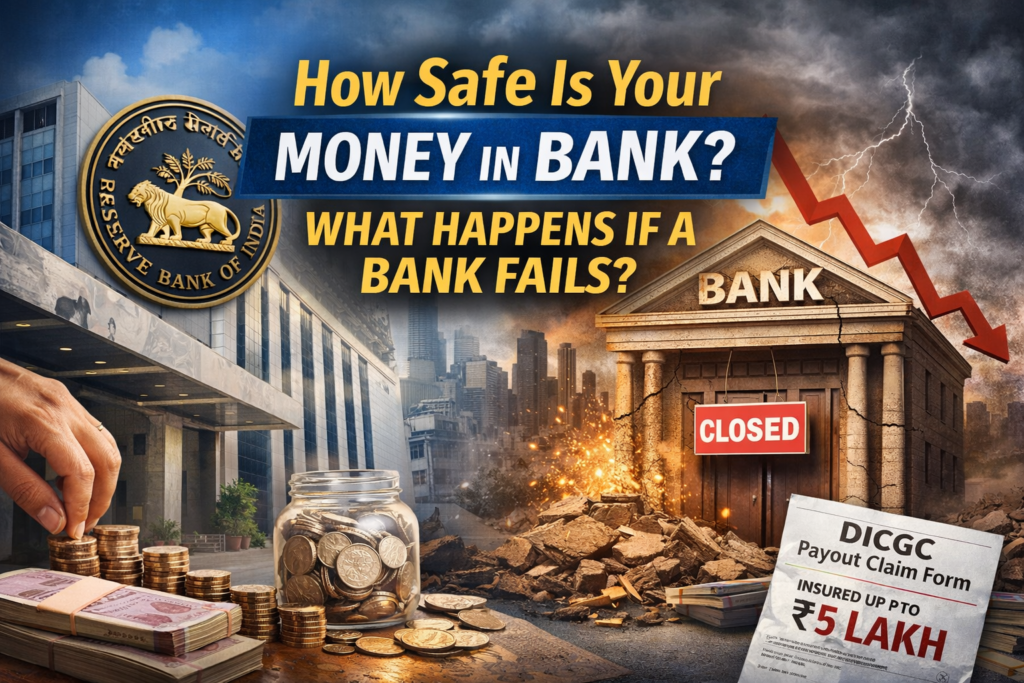
Deposits in Indian banks are insured by the Deposit Insurance and Credit Guarantee Corporation (DICGC), a subsidiary of the RBI.
Insurance Coverage Limit
Each depositor is insured up to:
₹5 lakh per bank (principal + interest combined).
This includes:
- Savings accounts
- Current accounts
- Fixed deposits
- Recurring deposits
If you hold multiple accounts in the same bank, the total coverage is capped at ₹5 lakh.
However, if you have deposits in different banks, each bank is covered separately up to ₹5 lakh.
Insurance coverage is automatic. No registration is required.
What Happens If a Bank Faces Trouble?

When a bank becomes financially unstable, the RBI usually acts in stages.
1. Withdrawal Restrictions
The RBI may temporarily cap withdrawals to prevent panic and protect the remaining funds.
2. Resolution Process
There are generally three possible outcomes:
A. Merger With Another Bank
A financially stronger bank may take over the weaker one. In such cases, depositors typically regain access to funds under new management.
B. Reconstruction
Fresh capital is infused and management is replaced to revive operations.
C. Liquidation
In rare cases, the bank is closed and assets are sold. DICGC then pays insured deposit amounts up to ₹5 lakh.
How and When Do Depositors Get Their Money?
If liquidation happens:
- The DICGC processes insured payments.
- Depositors receive up to ₹5 lakh.
- The process follows regulatory timelines.
Depositors do not need to file separate insurance claims; the bank handles documentation during resolution.
Can You Lose All Your Money?
Complete loss is highly unlikely because of:
- RBI supervision
- Deposit insurance
- Structured resolution mechanisms
- Government intervention in systemic cases
However, temporary access restrictions may occur during crisis management.
Is ₹5 Lakh Enough Protection?
For many individuals, ₹5 lakh covers most of their savings. Those with higher balances can reduce risk by:
- Distributing funds across multiple banks
- Avoiding very large idle balances in one account
- Monitoring financial news and annual reports
- Choosing well-capitalized and regulated institutions
Are Public Sector Banks Safer?
Both public and private banks are regulated by the RBI and covered by DICGC insurance. Public sector banks have government ownership, which adds confidence, but regulatory protection applies to all insured banks.
Key Takeaways
- Deposits are insured up to ₹5 lakh per bank.
- Insurance applies automatically.
- RBI closely supervises banks.
- Bank failures are rare and usually resolved through mergers or restructuring.
- Diversifying deposits reduces concentration risk.
Conclusion
The Indian banking system is structured to protect depositors. While no financial system is entirely risk-free, multiple safeguards exist to ensure that ordinary customers are shielded from catastrophic loss.
Understanding deposit insurance and regulatory oversight helps depositors make informed decisions instead of reacting to fear.
Your money in the bank is not left unprotected. It is supported by regulation, insurance coverage, and structured crisis management designed to maintain financial stability. But you will have to be cautious with your money, better never put all the eggs in a single basket.