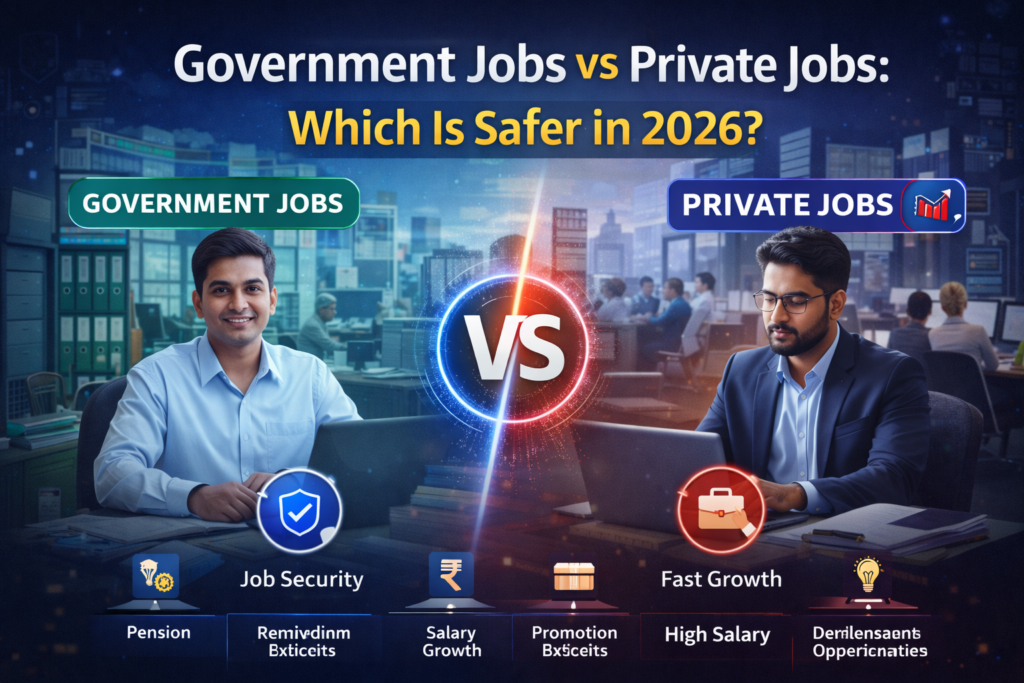
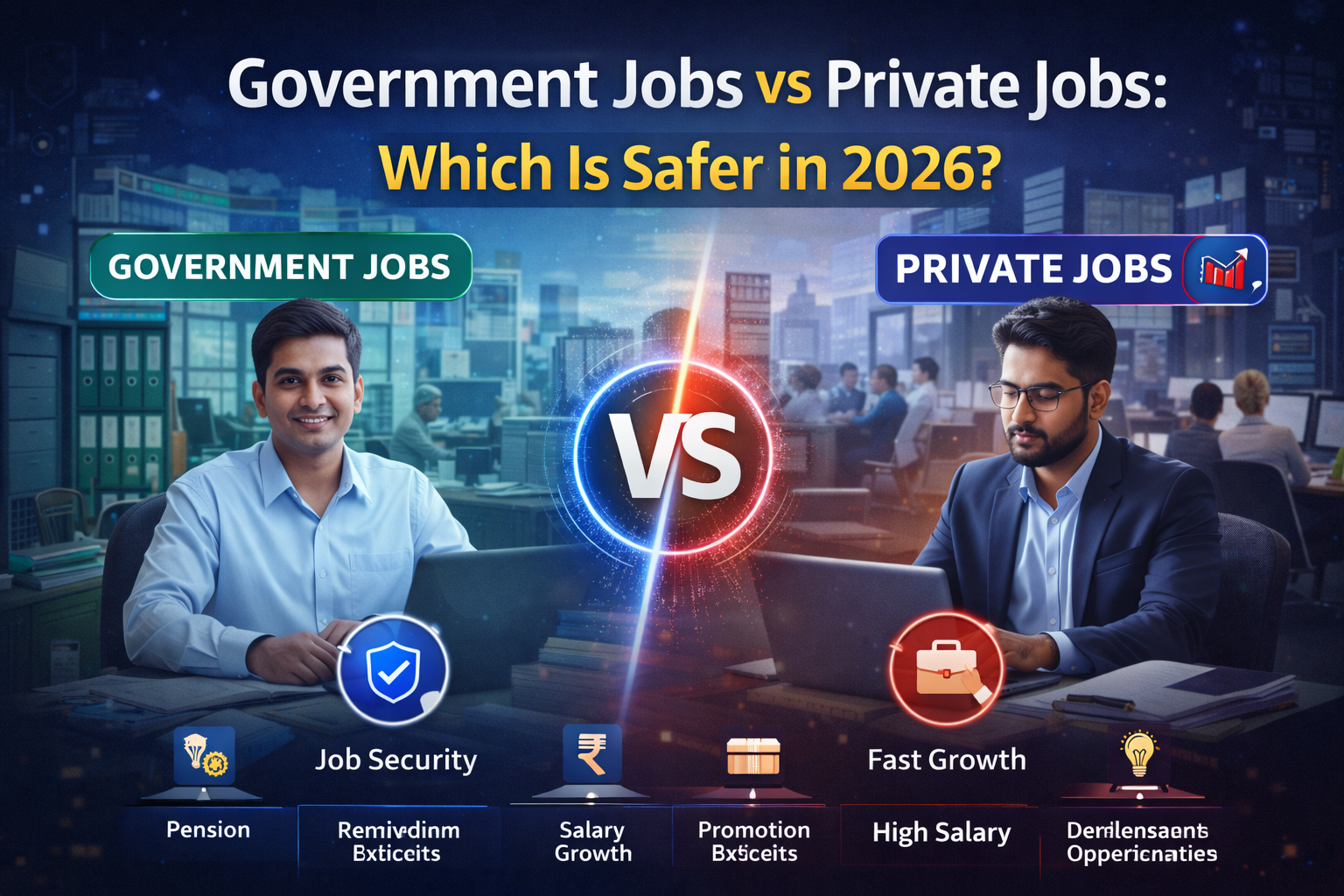
Government Jobs vs Private Jobs: Which Is Safer Today?The debate between government and private jobs has existed for decades. But in 2026, the conversation has become more intense than ever. Rapid technological change, layoffs in the corporate sector and evolving government reforms have changed how professionals evaluate job security.
Today, “safety” means more than just permanent employment. It includes income stability, career growth, work pressure, job satisfaction and long-term financial security.
Let’s compare both sectors based on real factors that matter today.
The Changing Meaning of Job Security



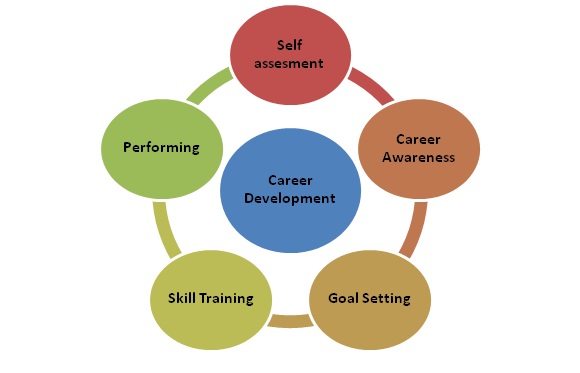
Earlier, job security meant lifetime employment. Now it includes:
Income stability
Skill relevance
Career growth
Work life balance
Future demand
Automation and digital transformation have reshaped both sectors.
Government Jobs: The Traditional Safety Choice
Why Government Jobs Still Feel Safer



Government jobs have long been considered the safest career path in India.
Key advantages:
Permanent employment
Strong job protection
Predictable salary growth
Pension and retirement benefits
Fixed working hours
Layoffs in government jobs are extremely rare compared to the private sector.
This stability remains the biggest attraction.
Government Job Salary and Benefits
Typical benefits include:
Dearness allowance
House rent allowance
Medical benefits
Paid leave and holidays
Pension schemes
The total compensation package becomes attractive over long careers.
Limitations of Government Jobs Today
Despite stability, challenges exist:
Slower salary growth
Limited performance based incentives
Slow promotions
Less exposure to new technologies
Young professionals increasingly value growth and learning along with stability.
Private Jobs: The Growth and Opportunity Choice
Why Private Jobs Attract Young Professionals




The private sector offers faster growth and higher earning potential.
Advantages:
Higher starting salaries
Faster promotions
Performance bonuses
Skill development opportunities
Global career exposure
The private sector rewards performance and innovation strongly.
Income Growth Comparison
Private sector salaries often grow faster due to:
Annual increments
Bonuses
Stock options
Job switching opportunities
Professionals can significantly increase income within a few years.
Risks in Private Jobs
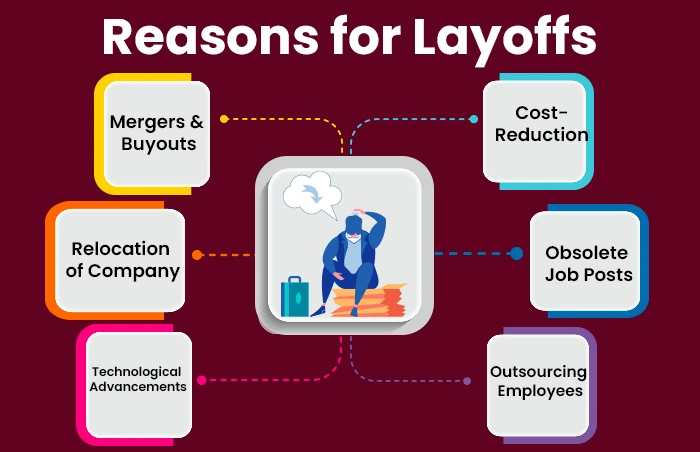



The biggest concern is job uncertainty.
Common risks:
Layoffs during economic slowdown
High work pressure
Long working hours
Constant need to upgrade skills
Job security depends heavily on performance and market conditions.
Job Security Comparison Table
| Factor | Government Jobs | Private Jobs |
|---|---|---|
| Job Stability | Very High | Moderate |
| Salary Growth | Slow and steady | Fast and variable |
| Promotions | Slow | Fast |
| Work Pressure | Lower | Higher |
| Benefits | Strong | Company dependent |
| Skill Growth | Moderate | High |
| Layoff Risk | Very Low | Moderate to High |
Which Sector Is Safer in 2026?
The answer depends on how you define safety.
Government jobs are safer if safety means:
Stable income
Low risk of job loss
Long term retirement security
Private jobs are safer if safety means:
High earning potential
Skill relevance
Career flexibility
Global opportunities
The Rise of the Hybrid Career
A new trend is emerging. Many professionals now combine:
Private job + side income
Government job + investments
Freelancing + corporate work
Multiple income streams are becoming the new job security.
Final Verdict
Government jobs remain the most stable career choice.
Private jobs offer faster financial growth and opportunities.
True career safety today comes from skills, adaptability and multiple income sources rather than a single job.
Both paths can be secure when planned wisely and both can become unsafe if taken as a joke.