
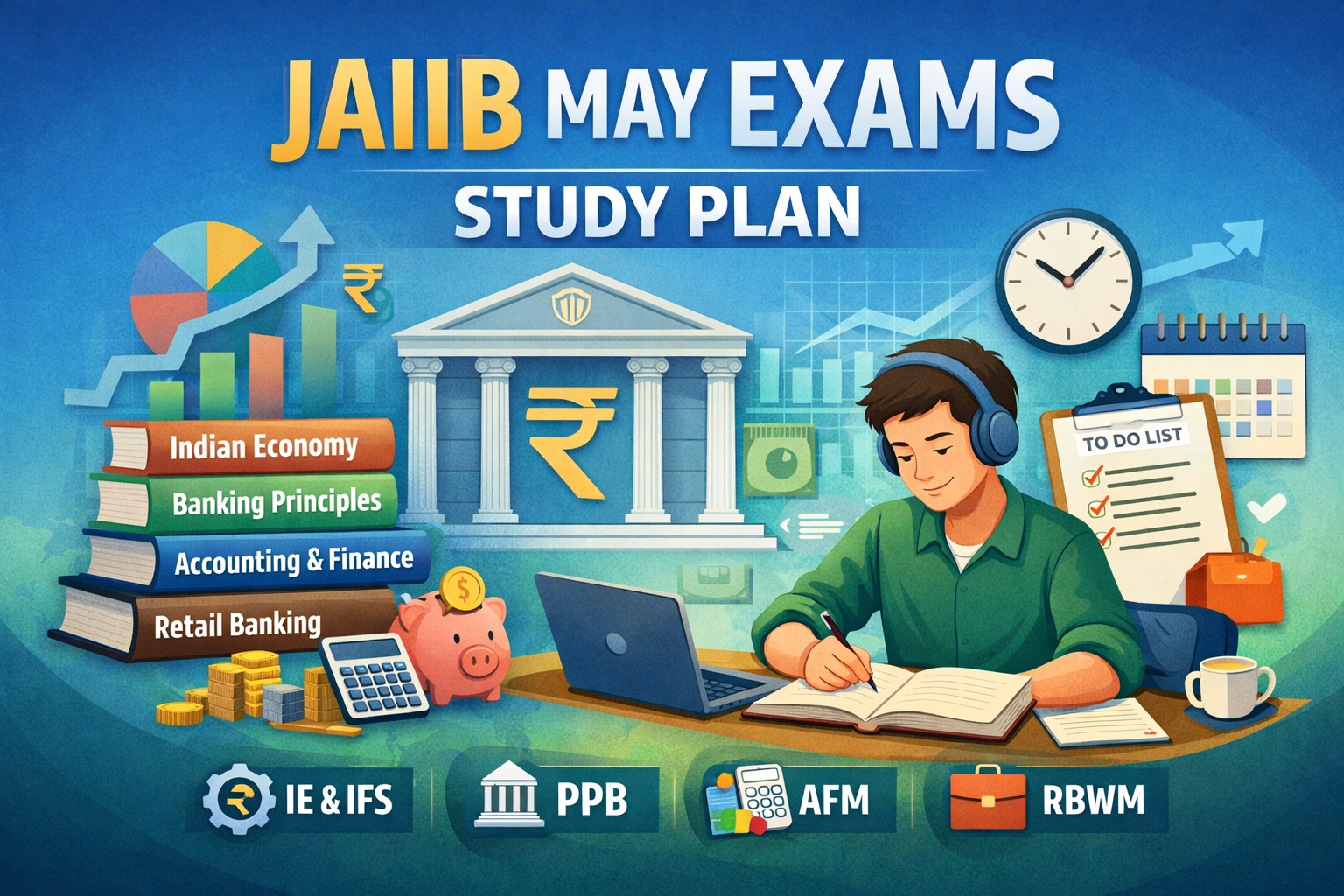
The Junior Associate of the Indian Institute of Bankers (JAIIB) examination is one of the most important professional certifications for employees working in the banking and financial sector. Conducted by the Indian Institute of Banking and Finance (IIBF), this exam is designed to strengthen the conceptual clarity, practical knowledge, and decision-making abilities of banking professionals.
The JAIIB exam is conducted twice a year, typically in May and November. The May cycle is particularly popular among candidates aiming for early career advancement within the same financial year. The examination is conducted in online mode and consists of four compulsory papers, each focusing on a specific domain of banking knowledge. (Testbook)
Structure and Pattern of JAIIB Exam
The JAIIB exam is structured to test both theoretical understanding and practical application. Each paper carries 100 marks with multiple-choice questions, and candidates are required to secure at least 50 marks to pass. Importantly, there is no negative marking, which allows candidates to attempt all questions confidently. (Testbook)
Each subject is divided into four modules (A, B, C, and D), ensuring a systematic coverage of topics. The duration for each paper is two hours, making time management a crucial aspect of preparation.
Paper 1: Indian Economy and Indian Financial System (IE & IFS)
This paper forms the foundation of the entire JAIIB syllabus. It introduces candidates to the broader economic environment in which banks operate.
The syllabus begins with an understanding of India’s economic structure, including economic policies, growth indicators, and the role of various sectors. It then moves towards financial systems, covering institutions such as banks, non-banking financial companies, and regulatory bodies.
A significant portion of this paper is devoted to financial products and services, which helps candidates understand how banking products are designed and delivered in real-world scenarios. (EduTap)
This paper is largely conceptual but requires regular reading of financial news and updates to grasp current economic developments effectively.
Paper 2: Principles and Practices of Banking (PPB)
The second paper focuses on the operational and functional aspects of banking. It is considered one of the most practical subjects in the JAIIB syllabus.
It covers topics such as types of banks, banking operations, customer service, and the functions performed by banks in daily activities. Candidates also learn about banking technology, which has become increasingly important in the era of digital banking.
Another critical component of this paper is ethics in banking. It emphasizes integrity, transparency, and professional conduct, which are essential qualities for banking professionals. (EduTap)
This subject directly relates to the day-to-day responsibilities of bankers, making it both relevant and scoring.
Paper 3: Accounting and Financial Management for Bankers (AFM)
This paper introduces candidates to the financial and accounting side of banking. It is often perceived as the most technical paper among the four.
The syllabus begins with basic accounting principles and gradually moves towards financial statements, balance sheets, and profit analysis. Candidates are also introduced to financial management concepts such as capital budgeting, cost analysis, and risk management.
Additionally, the paper includes taxation and costing fundamentals, which are essential for understanding the financial health of banking operations. (EduTap)
A strong grasp of numerical concepts and consistent practice are key to performing well in this paper.
Paper 4: Retail Banking and Wealth Management (RBWM)
The fourth paper focuses on customer-centric banking and financial advisory services. It reflects the evolving nature of banking, where personalized services and wealth management play a crucial role.
The syllabus includes retail banking products such as loans, deposits, and credit facilities. It also covers marketing strategies, customer behavior, and sales techniques used in banking services.
A unique feature of this paper is wealth management, where candidates learn about investment products, financial planning, and portfolio management. This section is particularly useful for those involved in advisory roles. (Testbook)
This paper is relatively easier for candidates who have practical exposure to customer handling and retail banking operations.
Importance of JAIIB for Banking Professionals
Clearing the JAIIB examination is not just about acquiring a certification; it significantly enhances professional competence. It helps bankers understand their roles more effectively and improves their ability to handle complex financial situations.
Moreover, JAIIB-qualified candidates often receive benefits such as increments, promotions, and recognition within their organizations. It also builds a strong foundation for advanced certifications like CAIIB.
Preparation Strategy for May Attempt
Preparing for the May cycle requires a disciplined approach due to limited time. Candidates should start with a clear understanding of the syllabus and focus on one subject at a time.
Conceptual clarity should be prioritized over rote learning, especially for papers like AFM and IE & IFS. Regular practice of mock tests helps in improving speed and accuracy. Since there is no negative marking, attempting all questions is advisable.
Revision plays a crucial role, particularly for theoretical subjects like PPB and RBWM. Short notes and summaries can be extremely helpful during the final days of preparation.
Conclusion
The JAIIB May examination is a well-structured assessment that equips banking professionals with essential knowledge across multiple domains. Each of the four papers contributes uniquely to building a comprehensive understanding of banking, from economic fundamentals to customer-oriented services.
With the right preparation strategy and consistent effort, clearing all four papers in a single attempt is achievable. More importantly, the knowledge gained during this process proves valuable throughout one’s banking career, making JAIIB a worthwhile investment in professional growth.
Here’s a practical, structured, and realistic study plan for the JAIIB May exam, designed to help you cover all four papers efficiently without burnout. This plan assumes you have around 10–12 weeks before the exam. If your time is shorter, I can compress it.
JAIIB May Study Plan
Overall Strategy
Instead of studying all four subjects randomly, the key is to:
- Build conceptual base first
- Move to practice and revision
- Keep daily consistency rather than long irregular sessions
Ideal daily time:
- Working professionals: 2–3 hours on weekdays, 4–5 hours on weekends
- Non-working: 5–6 hours daily
Phase 1: Foundation (Weeks 1–6)
Focus: Understanding concepts + completing syllabus once
Week 1–2
Indian Economy & Financial System (IE & IFS)
- Study 2 modules per week
- Focus areas:
- Economic concepts (GDP, inflation, policy)
- Financial institutions
- Daily:
- 1–1.5 hr theory
- 30 min MCQs
👉 Goal: Build strong base (this paper is theory-heavy but scoring)
Week 3–4
Principles & Practices of Banking (PPB)
- Cover:
- Banking operations
- Banker-customer relationship
- Ethics & compliance
- Daily:
- 1.5 hr study
- 30–45 min practice
👉 This is the most practical and scoring paper
Week 5
Accounting & Financial Management (AFM)
- Focus:
- Basics of accounting
- Ratio analysis
- Numerical problems
- Daily:
- 1 hr concept
- 1 hr numerical practice
👉 Do not skip practice — this paper requires repetition
Week 6
Retail Banking & Wealth Management (RBWM)
- Focus:
- Loans, deposits
- Wealth products
- Customer handling
- Daily:
- 1–1.5 hr study
- 30 min MCQs
👉 Easiest paper if understood properly
Phase 2: Strengthening + Practice (Weeks 7–9)
Focus: Practice + weak areas
Weekly Plan:
- Study 2 subjects per week
- Solve topic-wise MCQs daily
- Start mock tests (2–3 per week)
Example:
- Week 7: IE & IFS + PPB
- Week 8: AFM + RBWM
- Week 9: All 4 mixed revision
Daily Routine (Phase 2)
- 1 hr revision
- 1 hr MCQs
- 1 mock test every 2–3 days
👉 Analyze mistakes — this is where improvement happens
Phase 3: Final Revision (Weeks 10–12)
Focus: Revision + full mocks + speed
What to Do:
- Revise short notes only
- Attempt full-length mocks regularly
- Focus on:
- Frequently asked questions
- Weak topics
Final 10 Days Strategy
- Daily:
- 1 full mock
- 2–3 hr revision
- Revise:
- Formulas (AFM)
- Definitions (PPB, IE & IFS)
- Products (RBWM)
👉 Do not start new topics now
Subject-Wise Priority Strategy
1. IE & IFS
- Concept + current understanding
- Revise repeatedly
2. PPB
- Must score high
- Focus on conceptual clarity
3. AFM
- Practice daily
- Don’t ignore numericals
4. RBWM
- Quick scoring
- Focus on memory + concepts
Weekly Study Template
Weekday (2–3 hrs):
- 1 hr concept
- 1 hr MCQs
- 30 min revision
Weekend (4–5 hrs):
- 2 hr study
- 2 mocks
- 1 hr analysis
Important Tips
- No negative marking → attempt all questions
- Focus on concept + MCQs combination
- Make short notes for revision
- Don’t leave AFM for last
- Consistency > long study hours
Realistic Target
- First attempt goal: 50+ in each subject
- Strong attempt goal: 60–70+ for safety
📘 Paper 1: IE & IFS (Indian Economy & Indian Financial System)
🔥 High Priority Topics
- Monetary Policy (Repo, Reverse Repo, CRR, SLR)
- Inflation (CPI, WPI – concepts & differences)
- Role of RBI (functions, tools, regulations)
- Financial Markets:
- Money Market
- Capital Market
- Banking System Structure in India
⭐ Medium Priority
- Economic Development & Growth
- Financial Inclusion
- Digital Payments (UPI, NEFT, RTGS)
- NBFCs and their role
- Basel Norms
⚡ Quick Revision Topics
- GDP, GNP basics
- Types of inflation
- Government schemes (basic idea)
👉 Tip: Focus on concept clarity + current awareness
📗 Paper 2: PPB (Principles & Practices of Banking)
🔥 High Priority Topics
- Banker-Customer Relationship
- Types of Accounts (SB, CA, FD, RD)
- KYC & AML Guidelines
- Negotiable Instruments (Cheque, Endorsement)
- Loans & Advances (priority sector lending)
⭐ Medium Priority
- Payment Systems (UPI, Cards, Digital Banking)
- Banking Ombudsman Scheme
- Risk Management basics
- Ethics in Banking
⚡ Quick Revision Topics
- Types of banks
- Functions of banks
- Customer service basics
👉 Tip: This is most scoring paper → aim 60+
📙 Paper 3: AFM (Accounting & Financial Management)
🔥 High Priority Topics
- Final Accounts (Balance Sheet, P&L)
- Ratio Analysis (very important)
- Time Value of Money
- Capital Budgeting (NPV, IRR basics)
- Costing basics
⭐ Medium Priority
- Depreciation methods
- Cash Flow Statement
- Working Capital Management
- Budgeting
⚡ Quick Revision Topics
- Basic accounting principles
- Simple journal entries
👉 Tip: Practice numericals daily — this paper is scoring only if practiced
📕 Paper 4: RBWM (Retail Banking & Wealth Management)
🔥 High Priority Topics
- Retail Loan Products:
- Home loan
- Personal loan
- Vehicle loan
- Credit Scoring & Risk
- Investment Products:
- Mutual Funds
- Insurance
- Wealth Management basics
⭐ Medium Priority
- Marketing of Banking Services
- Customer Relationship Management
- Priority sector lending in retail
⚡ Quick Revision Topics
- Types of deposits
- Basic financial planning concepts
👉 Tip: Mostly theory + common sense based
🎯 Most Important Cross-Subject Topics
These areas often overlap and are frequently asked:
- Digital Banking & Payment Systems
- RBI Regulations
- Risk & Compliance
- Financial Products
📊 Smart Study Priority (If Time is Less)
- PPB → Highest scoring
- RBWM → Easy + quick
- IE & IFS → Conceptual
- AFM → Practice-heavy
🧠 Final Advice
- Don’t try to cover everything — focus on high-yield topics
- Solve previous year questions
- Revise the same topics multiple times
- Attempt all questions in exam (no negative marking)
Here are 50 most expected questions with answers for JAIIB Paper 1 (IE & IFS). These are framed based on repeated exam patterns, core concepts, and high-weightage areas.
📘 JAIIB IE & IFS – Top 50 Expected Questions (With Answers)
🔹 Economy Basics (1–10)
1. What does GDP measure?
👉 Total value of goods and services produced within a country.
2. What is GNP?
👉 GDP + income earned by residents from abroad.
3. What is inflation?
👉 Sustained increase in general price level.
4. What is deflation?
👉 Continuous fall in price levels.
5. What is stagflation?
👉 High inflation + low growth + high unemployment.
6. What is fiscal deficit?
👉 Excess of government expenditure over revenue.
7. What is primary deficit?
👉 Fiscal deficit minus interest payments.
8. What is monetary policy?
👉 Policy by RBI to control money supply.
9. What is repo rate?
👉 Rate at which RBI lends to banks.
10. What is reverse repo rate?
👉 Rate at which RBI borrows from banks.
🔹 Banking & Financial System (11–20)
11. Who regulates banks in India?
👉 RBI
12. What is CRR?
👉 Cash Reserve Ratio – cash banks keep with RBI.
13. What is SLR?
👉 Statutory Liquidity Ratio – liquid assets banks maintain.
14. What is a scheduled bank?
👉 Bank listed in RBI Act Second Schedule.
15. What is NBFC?
👉 Non-Banking Financial Company.
16. Difference between NBFC and bank?
👉 NBFC cannot accept demand deposits.
17. What is financial inclusion?
👉 Access to financial services for all.
18. What is payment bank?
👉 Bank that accepts deposits but cannot lend.
19. What is small finance bank?
👉 Focuses on small borrowers and MSMEs.
20. What is money market?
👉 Market for short-term funds.
🔹 Financial Markets (21–30)
21. What is capital market?
👉 Market for long-term funds.
22. What is primary market?
👉 Market for new securities.
23. What is secondary market?
👉 Market for trading existing securities.
24. What is SEBI?
👉 Regulator of capital markets.
25. What is a bond?
👉 Debt instrument.
26. What is equity share?
👉 Ownership share in a company.
27. What is mutual fund?
👉 Pool of funds invested in securities.
28. What is NAV?
👉 Net Asset Value of mutual fund.
29. What is IPO?
👉 Initial Public Offering.
30. What is derivative?
👉 Financial instrument based on underlying asset.
🔹 RBI & Monetary Tools (31–40)
31. What is bank rate?
👉 Long-term lending rate by RBI.
32. What is open market operation (OMO)?
👉 RBI buying/selling government securities.
33. What is liquidity adjustment facility (LAF)?
👉 Tool for short-term liquidity management.
34. What is marginal standing facility (MSF)?
👉 Emergency borrowing window for banks.
35. What is inflation targeting?
👉 Keeping inflation within a target range.
36. Who sets monetary policy in India?
👉 Monetary Policy Committee (MPC)
37. What is base rate?
👉 Minimum lending rate of banks.
38. What is MCLR?
👉 Marginal Cost of Funds Based Lending Rate.
39. What is priority sector lending?
👉 Lending to specific sectors like agriculture, MSME.
40. What is Basel norm?
👉 International banking regulation standards.
🔹 Financial System & Misc (41–50)
41. What is NEFT?
👉 Electronic fund transfer system.
42. What is RTGS?
👉 Real-time gross settlement for large transactions.
43. What is UPI?
👉 Instant payment system.
44. What is financial stability?
👉 Stability of financial institutions.
45. What is shadow banking?
👉 NBFC-like activities outside traditional banking.
46. What is sovereign risk?
👉 Risk of government default.
47. What is credit rating?
👉 Assessment of borrower’s creditworthiness.
48. What is disinvestment?
👉 Government selling stake in PSUs.
49. What is forex reserve?
👉 Foreign currency assets held by RBI.
50. What is exchange rate?
👉 Value of one currency against another.
🎯 How to Use This List
- Revise these daily for 10–15 minutes
- Expect direct or slightly twisted questions from these
- Combine with mock tests for best results
Here are 50 most expected questions with answers for JAIIB Paper 2 (PPB – Principles & Practices of Banking). These are designed based on latest exam trends, practical banking concepts, and frequently repeated areas.
📗 JAIIB PPB – Top 50 Expected Questions (With Answers)
🔹 Banker-Customer Relationship (1–10)
1. What is the relationship between banker and customer?
👉 Debtor and creditor.
2. When does banker act as trustee?
👉 When handling customer funds for a specific purpose.
3. What is garnishee order?
👉 Court order to freeze customer account.
4. What is lien?
👉 Right of banker to retain goods for dues.
5. What is set-off?
👉 Adjusting debit balance against credit balance.
6. When can a bank close an account?
👉 On customer request or as per rules (with notice).
7. What is mandate?
👉 Authority given to a third party to operate account.
8. What is power of attorney?
👉 Legal authority to act on behalf of customer.
9. What is minor account rule?
👉 Minor cannot enter valid contract.
10. What is joint account operation?
👉 Operated as per mandate (jointly, either or survivor, etc.)
🔹 Types of Accounts (11–20)
11. What is savings account?
👉 Account for individuals to save money.
12. What is current account?
👉 Account for businesses with frequent transactions.
13. What is fixed deposit?
👉 Deposit for fixed tenure with higher interest.
14. What is recurring deposit?
👉 Regular monthly deposit scheme.
15. What is NRE account?
👉 For NRIs, income earned abroad.
16. What is NRO account?
👉 For income earned in India.
17. What is KYC?
👉 Know Your Customer process.
18. What documents are required for KYC?
👉 Identity & address proof.
19. What is CKYC?
👉 Central KYC registry.
20. What is dormant account?
👉 No transaction for 2 years.
🔹 Negotiable Instruments (21–30)
21. What is a cheque?
👉 Written order to bank to pay money.
22. What is bearer cheque?
👉 Payable to holder.
23. What is order cheque?
👉 Payable to specified person.
24. What is crossing of cheque?
👉 Restriction for payment via bank only.
25. What is endorsement?
👉 Signing to transfer cheque.
26. What is dishonour of cheque?
👉 Refusal to pay.
27. What is material alteration?
👉 Change affecting validity.
28. What is post-dated cheque?
👉 Cheque with future date.
29. What is stale cheque?
👉 Cheque older than 3 months.
30. What is truncation?
👉 Digital processing of cheque.
🔹 Loans & Advances (31–40)
31. What is loan?
👉 Lump sum credit given to borrower.
32. What is cash credit?
👉 Working capital limit.
33. What is overdraft?
👉 Withdrawal beyond balance.
34. What is secured loan?
👉 Loan backed by collateral.
35. What is unsecured loan?
👉 Loan without collateral.
36. What is priority sector lending?
👉 Loans to agriculture, MSME etc.
37. What is NPA?
👉 Loan overdue more than 90 days.
38. What is provisioning?
👉 Setting aside funds for bad loans.
39. What is SARFAESI Act?
👉 Law for recovery of bad loans.
40. What is credit appraisal?
👉 Evaluation of borrower before loan.
🔹 Digital Banking & Ethics (41–50)
41. What is internet banking?
👉 Banking via internet.
42. What is mobile banking?
👉 Banking via mobile apps.
43. What is UPI?
👉 Instant fund transfer system.
44. What is ATM?
👉 Automated teller machine.
45. What is phishing?
👉 Fraud to steal data.
46. What is cyber security?
👉 Protection of digital systems.
47. What is banking ombudsman?
👉 Redressal authority for complaints.
48. What is code of ethics in banking?
👉 Principles of integrity and fairness.
49. What is conflict of interest?
👉 Personal interest affecting duty.
50. What is customer grievance?
👉 Complaint by customer.
🎯 How to Use This
- Revise daily (15–20 mins)
- Focus on concept + application
- Expect case-based questions from these topics
📊 Scoring Tip for PPB
- This paper can give 60–75 marks easily
- Focus on:
- KYC + accounts
- Loans & NPA
- Negotiable instruments
📙 JAIIB AFM – Top 50 Expected Questions (With Answers)
🔹 Accounting Basics (1–10)
1. What is accounting?
👉 Process of recording, classifying, and summarizing financial transactions.
2. What is double entry system?
👉 Every transaction has debit and credit.
3. What is journal?
👉 Book of original entry.
4. What is ledger?
👉 Book of final entry.
5. What is trial balance?
👉 Statement to check arithmetical accuracy.
6. What is asset?
👉 Resource owned with economic value.
7. What is liability?
👉 Obligation payable by business.
8. What is capital?
👉 Owner’s investment.
9. What is revenue expenditure?
👉 Short-term expense.
10. What is capital expenditure?
👉 Long-term asset creation.
🔹 Final Accounts (11–20)
11. What is trading account?
👉 Shows gross profit/loss.
12. What is profit & loss account?
👉 Shows net profit/loss.
13. What is balance sheet?
👉 Financial position of business.
14. What is gross profit?
👉 Sales – cost of goods sold.
15. What is net profit?
👉 Gross profit – expenses.
16. What is depreciation?
👉 Reduction in asset value.
17. What is provision?
👉 Estimated liability.
18. What is reserve?
👉 Profit set aside.
19. What is contingent liability?
👉 Possible future liability.
20. What is closing stock?
👉 Unsold goods.
🔹 Ratio Analysis (21–30)
21. What is current ratio?
👉 Current assets / current liabilities
\text{Current Ratio} = \frac{\text{Current Assets}}{\text{Current Liabilities}}
22. Ideal current ratio?
👉 2:1
23. What is quick ratio?
👉 (Current assets – inventory) / current liabilities
\text{Quick Ratio} = \frac{\text{Current Assets} – \text{Inventory}}{\text{Current Liabilities}}
24. What is debt-equity ratio?
👉 Debt / equity
\text{Debt-Equity Ratio} = \frac{\text{Debt}}{\text{Equity}}
25. What is return on investment (ROI)?
👉 Profit / investment
\text{ROI} = \frac{\text{Profit}}{\text{Investment}}
26. What is net profit ratio?
👉 Net profit / sales
27. What is turnover ratio?
👉 Sales / assets
28. What is working capital?
👉 Current assets – current liabilities
\text{Working Capital} = \text{Current Assets} – \text{Current Liabilities}
29. What is liquidity ratio?
👉 Ability to meet short-term obligations
30. What is solvency ratio?
👉 Ability to meet long-term obligations
🔹 Financial Management (31–40)
31. What is time value of money?
👉 Value of money changes over time.
32. What is present value?
👉 Current value of future money
33. What is future value?
👉 Value of money in future
34. What is NPV?
👉 Present value of inflows – outflows
NPV = \sum \frac{C_t}{(1+r)^t} – C_0
35. What is IRR?
👉 Rate where NPV = 0
36. What is payback period?
👉 Time to recover investment
37. What is cost of capital?
👉 Cost of funds used
38. What is leverage?
👉 Use of borrowed funds
39. What is capital budgeting?
👉 Investment decision process
40. What is working capital management?
👉 Managing short-term funds
🔹 Costing & Misc (41–50)
41. What is fixed cost?
👉 Cost that does not change
42. What is variable cost?
👉 Cost that changes with output
43. What is break-even point?
👉 No profit, no loss
\text{Break-even Point} = \frac{\text{Fixed Cost}}{\text{Selling Price} – \text{Variable Cost}}
44. What is contribution?
👉 Sales – variable cost
45. What is margin of safety?
👉 Excess over break-even
46. What is standard costing?
👉 Predetermined cost
47. What is budget?
👉 Financial plan
48. What is variance?
👉 Difference between actual & standard
49. What is cash flow?
👉 Movement of cash
50. What is fund flow?
👉 Movement of funds
🎯 How to Use This (AFM Strategy)
- Revise formulas daily
- Practice numericals repeatedly
- Focus on:
- Ratio analysis
- NPV & IRR
- Break-even
📊 Scoring Tip for AFM
- Attempt all numericals
- Even if unsure → use logic & eliminate options
- Aim: 50–60 marks easily possible
📕 JAIIB RBWM – Top 50 Expected Questions (With Answers)
🔹 Retail Banking Basics (1–10)
1. What is retail banking?
👉 Banking services offered to individual customers.
2. What are retail assets?
👉 Loans given to individuals (home, personal, auto).
3. What are retail liabilities?
👉 Deposits from individuals.
4. What is CASA?
👉 Current Account + Savings Account.
5. What is term deposit?
👉 Deposit for fixed period.
6. What is cross-selling?
👉 Selling additional products to same customer.
7. What is up-selling?
👉 Selling higher value product.
8. What is customer segmentation?
👉 Dividing customers into groups.
9. What is CRM?
👉 Customer Relationship Management.
10. What is service quality?
👉 Ability to meet customer expectations.
🔹 Retail Loan Products (11–20)
11. What is home loan?
👉 Loan for purchasing property.
12. What is LTV ratio?
👉 Loan to Value ratio.
13. What is EMI?
👉 Equated Monthly Installment.
14. What is personal loan?
👉 Unsecured loan for personal use.
15. What is vehicle loan?
👉 Loan to buy vehicle.
16. What is education loan?
👉 Loan for studies.
17. What is credit score?
👉 Measure of borrower’s creditworthiness.
18. What is collateral?
👉 Asset pledged as security.
19. What is fixed vs floating rate?
👉 Fixed stays same; floating changes.
20. What is prepayment?
👉 Early repayment of loan.
🔹 Credit & Risk (21–30)
21. What is credit appraisal?
👉 Assessment before granting loan.
22. What are 5 Cs of credit?
👉 Character, Capacity, Capital, Collateral, Conditions.
23. What is default risk?
👉 Risk of non-payment.
24. What is credit risk?
👉 Risk of borrower failing to pay.
25. What is NPA?
👉 Loan overdue > 90 days.
26. What is recovery process?
👉 Process to recover bad loans.
27. What is restructuring?
👉 Changing loan terms.
28. What is write-off?
👉 Removing loan from books.
29. What is credit monitoring?
👉 Tracking borrower performance.
30. What is risk-based pricing?
👉 Pricing based on risk level.
🔹 Wealth Management (31–40)
31. What is wealth management?
👉 Managing client investments.
32. What is financial planning?
👉 Planning future finances.
33. What is mutual fund?
👉 Pool of investor money.
34. What is SIP?
👉 Systematic Investment Plan.
35. What is insurance?
👉 Risk protection.
36. What is life insurance?
👉 Protection against death.
37. What is general insurance?
👉 Non-life insurance.
38. What is diversification?
👉 Spreading investments.
39. What is risk-return tradeoff?
👉 Higher risk, higher return.
40. What is portfolio?
👉 Collection of investments.
🔹 Marketing & Customer Service (41–50)
41. What is service marketing?
👉 Marketing intangible services.
42. What is customer satisfaction?
👉 Meeting expectations.
43. What is grievance redressal?
👉 Handling complaints.
44. What is turnaround time (TAT)?
👉 Time to deliver service.
45. What is relationship banking?
👉 Long-term customer engagement.
46. What is financial inclusion?
👉 Access to banking for all.
47. What is priority sector in retail?
👉 Loans to specified sectors.
48. What is digital banking?
👉 Banking through digital channels.
49. What is cross-channel service?
👉 Service across multiple platforms.
50. What is customer retention?
👉 Keeping existing customers.
🎯 How to Use This (RBWM Strategy)
- Revise daily (15–20 mins)
- Focus on:
- Loan products
- Wealth management basics
- Customer service
📊 Scoring Tip for RBWM
- One of the easiest papers
- Many direct questions
- Aim: 60–70 marks
📘 Paper 1: IE & IFS – Quick Revision Notes
🔑 Core Concepts
- GDP: Total domestic production
- GNP: GDP + foreign income
- Inflation: Rise in prices (CPI/WPI)
- Deflation: Fall in prices
🏦 RBI & Monetary Tools
- Repo Rate → RBI lends to banks
- Reverse Repo → RBI borrows
- CRR → Cash with RBI
- SLR → Liquid assets with bank
- OMO → Buy/Sell govt securities
- MSF → Emergency borrowing
💰 Financial System
- Banks + NBFCs + Financial Markets
- NBFC → No demand deposits
- Payment Banks → No lending
📊 Markets
- Money Market → Short-term
- Capital Market → Long-term
- SEBI → Market regulator
💳 Digital Payments
- UPI → Instant
- NEFT → Batch
- RTGS → Real-time (large amount)
📗 Paper 2: PPB – Quick Revision Notes
👥 Banker–Customer
- Relation → Debtor–Creditor
- Garnishee → Court freeze
- Lien → Right to retain
- Set-off → Adjust balances
🏦 Accounts
- SB → Savings
- CA → Business
- FD/RD → Term deposits
- KYC → Identity + address
- Dormant → No txn 2 years
📄 Cheques
- Bearer / Order
- Crossing → A/c payee
- Stale → >3 months
- Endorsement → Transfer
💼 Loans
- Loan / CC / OD
- Secured vs Unsecured
- NPA → 90 days overdue
- SARFAESI → Recovery law
🌐 Digital & Ethics
- UPI / ATM / Net banking
- Phishing → Fraud
- Ombudsman → शिकायत authority
- Ethics → Integrity, fairness
📙 Paper 3: AFM – Quick Revision Notes
📒 Basics
- Assets = Liabilities + Capital
- Debit → Receiver
- Credit → Giver
📊 Final Accounts
- Trading → Gross profit
- P&L → Net profit
- Balance Sheet → Position
📈 Key Ratios
- Current Ratio = CA / CL
- Quick Ratio = (CA – Stock) / CL
- Debt-Equity = Debt / Equity
- Working Capital = CA – CL
💰 Financial Mgmt
- NPV → Inflow – Outflow
- IRR → NPV = 0
- Payback → Recovery time
🧮 Costing
- Fixed Cost → Constant
- Variable → Changes
- BEP → No profit/no loss
📕 Paper 4: RBWM – Quick Revision Notes
🏦 Retail Banking
- Retail → Individual banking
- CASA → Current + Savings
- CRM → Customer management
💳 Loans
- Home / Personal / Auto
- EMI → Monthly payment
- LTV → Loan % of value
- Credit Score → Risk measure
⚠️ Risk
- 5 Cs → Character, Capacity, Capital, Collateral, Conditions
- NPA → 90 days
- Write-off ≠ Waiver
💼 Wealth Mgmt
- Mutual Fund → Pooled investment
- SIP → Regular investment
- Insurance → Risk cover
- Diversification → Risk reduction
📢 Marketing
- Cross-sell / Up-sell
- TAT → Service time
- Customer retention → Keep clients
🎯 Final Revision Strategy (Golden Rules)
- Revise these notes daily in last 3–5 days
- Focus on:
- Formulas (AFM)
- Definitions (PPB, IE)
- Products (RBWM)
- Attempt all questions (no negative marking)
