
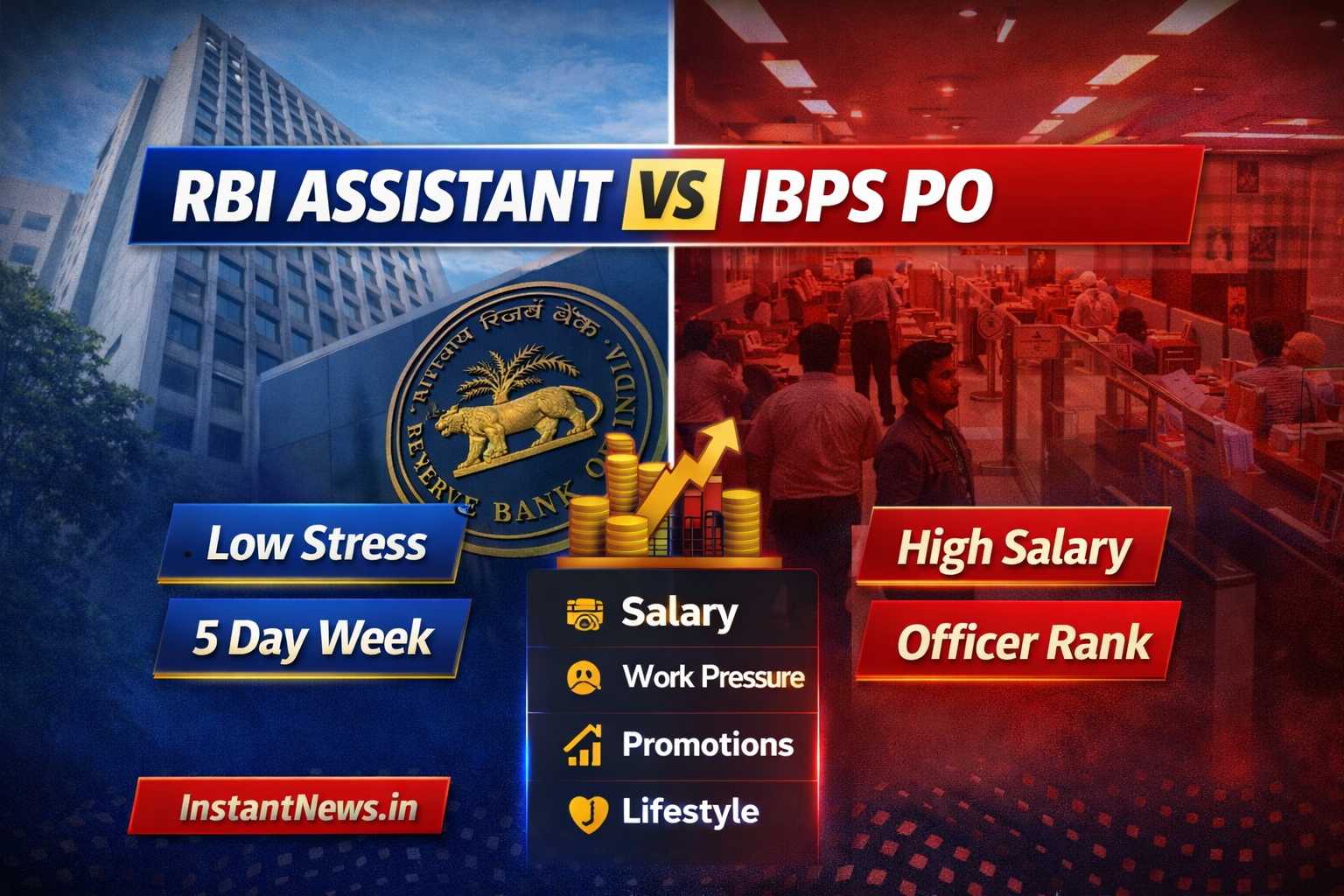
Choosing between RBI Assistant and IBPS PO is one of the most confusing decisions for banking aspirants. Both are prestigious government banking jobs, but they differ significantly in salary structure, job profile, work pressure, promotion speed, authority, transfers, and long-term career growth.
This in-depth comparison covers more than 20 major parameters to help you decide which job suits your goals better.
1. Recruiting Authority
RBI Assistant
Recruited by the Reserve Bank of India, the central banking institution of the country.
IBPS PO
Recruited through the Institute of Banking Personnel Selection for various Public Sector Banks like SBI (separate exam), PNB, Bank of Baroda, Canara Bank, Union Bank and others.
Verdict: RBI Assistant works under India’s central bank. IBPS PO works in commercial public sector banks.
2. Post Level
RBI Assistant – Clerical Level Post
IBPS PO – Officer Scale I (Entry-Level Officer)
Verdict: IBPS PO is higher in designation and authority.
3. Salary Comparison
RBI Assistant
Gross Salary: ₹45,000–₹48,000
In-Hand: ₹38,000–₹42,000
IBPS PO
Gross Salary: ₹52,000–₹57,000
In-Hand: ₹48,000–₹52,000
Verdict: IBPS PO earns more initially.
4. Pay Scale Growth
RBI Assistant
Steady increments but slower promotional financial jumps.
IBPS PO
Higher basic pay and faster financial growth after promotion.
Verdict: IBPS PO wins in long-term pay growth.
5. Work Nature
RBI Assistant
Clerical and administrative support role. Mostly back-office tasks.
IBPS PO
Branch operations, loan processing, customer handling, business targets.
Verdict: RBI Assistant is less field-oriented. IBPS PO is more operational.
6. Work Pressure
RBI Assistant
Moderate pressure. No sales targets.
IBPS PO
High pressure. Loan targets, CASA targets, customer handling.
Verdict: RBI Assistant has significantly lower stress.
7. Work-Life Balance
RBI Assistant
Five-day work week. Fixed office hours.
IBPS PO
Six-day work in many banks (alternate Saturdays). Longer working hours.
Verdict: RBI Assistant offers better work-life balance.
8. Transfers
RBI Assistant
Limited transfers within regional offices. Mostly stable posting.
IBPS PO
Frequent transfers across states, especially during promotions.
Verdict: RBI Assistant is more stable geographically.
9. Promotion Speed
RBI Assistant
Slower promotions. Requires departmental exams.
IBPS PO
Faster promotions based on performance and internal exams.
Verdict: IBPS PO grows faster in hierarchy.
10. Career Path
RBI Assistant
Assistant → Senior Assistant → Officer (via internal exam)
IBPS PO
PO → Manager → Senior Manager → Chief Manager → AGM → DGM → GM → Executive Director
Verdict: IBPS PO has broader career ladder.
11. Authority & Decision Power
RBI Assistant
Limited decision-making authority.
IBPS PO
Loan approvals, customer relationship decisions, branch operations.
Verdict: IBPS PO has more authority.
12. Social Status
RBI Assistant
Prestigious due to RBI tag.
IBPS PO
Recognized as a bank officer with managerial role.
Verdict: Both have strong prestige but IBPS PO has officer tag advantage.
13. Exam Difficulty
RBI Assistant
Highly competitive due to fewer vacancies and high cut offs.
IBPS PO
Competitive but comparatively more vacancies.
Verdict: RBI Assistant cut off can be tougher.
14. Number of Vacancies
RBI Assistant
Usually limited vacancies.
IBPS PO
Higher number of vacancies every year.
Verdict: IBPS PO offers more opportunities.
15. Job Security
Both are permanent government jobs with high job security.
Verdict: Equal.
16. Pension & Benefits
Both follow NPS system.
RBI provides slightly better medical and internal benefits.
Verdict: RBI Assistant slightly better benefits.
17. Risk Level
RBI Assistant
Minimal operational risk.
IBPS PO
High operational and financial responsibility.
Verdict: RBI Assistant is safer.
18. Posting Location Quality
RBI Assistant
Posted mostly in urban RBI offices.
IBPS PO
Can be posted in rural, semi-urban, or remote branches.
Verdict: RBI Assistant usually gets better location.
19. Target Pressure
RBI Assistant
No business targets.
IBPS PO
Strong business targets.
Verdict: RBI Assistant has less mental pressure.
20. Long-Term Growth Potential
RBI Assistant
Growth possible but slower.
IBPS PO
Can rise to top executive roles in public sector banks.
Verdict: IBPS PO has higher ceiling.
21. Learning Exposure
RBI Assistant
Limited exposure to public dealing.
IBPS PO
Strong exposure in banking operations, credit, risk, leadership.
Verdict: IBPS PO provides broader learning.
22. Stress vs Stability
RBI Assistant
Stable and predictable career.
IBPS PO
Dynamic but stressful.
Verdict: Depends on personality.
23. Suitable For Whom?
Choose RBI Assistant if:
- You want low stress
- You prefer stable location
- You value work-life balance
- You are okay with slower promotions
- you dont want customer handling
Choose IBPS PO if:
- You want authority
- You want faster career growth
- You can handle pressure
- You aim for managerial roles
- you want to make connections in society
Final Conclusion
If your priority is peace, fixed schedule and stable life, RBI Assistant is the better choice.
If your priority is power, faster growth, higher salary and managerial authority, IBPS PO is superior.
Neither job is universally better. The right choice depends entirely on your personality, ambition and tolerance for pressure.
FAQs
Is RBI Assistant better than IBPS PO?
It depends on whether you prefer work-life balance or faster career growth.
Who earns more in long term?
IBPS PO earns more due to higher promotions.
Which job has more stress?
IBPS PO has significantly higher work pressure.
Can RBI Assistant become Officer?
Yes, through internal exams and promotions.
